2026-10-24 · 19 min · agents · security · agentic-coding · developer-tools · mcp
A 1:48 narrated explainer, drawn in code. Every number and picture in it is this article's own; the sources are below.
› transcript
Hi, I'm Rafter! Today: how the sandbox behind Claude Code's shell keeps a command from your files and the internet, with no container. Mounts decide which files a command can see or change. Its only network is a socket to a proxy that checks every host. Without a sandbox, the agent asks before each command, and people stop reading. With one, the boundary is drawn once, and only a new host asks. On Linux, the policy becomes one bubblewrap command line. First, the whole disk is mounted read-only. Then the project folder is bound back, writable. Shell startup files and git hooks are frozen again on top. A denied folder gets an empty mount over it, so its files are gone. And the network is removed. Only loopback is left. The command's proxy variables point at a small relay inside the sandbox. The relay forwards into a Unix socket, the only thing that crosses the wall. On the host, a proxy checks the hostname against the allowlist. An allowed host gets through. Anything else gets a four oh three, logged against the command. In Claude Code, writes outside the project and denied hosts fail inside the sandbox. Its proxies allow known hosts, deny listed ones, and ask you about the rest. On my Linux machine, a wrapped command cost about a tenth of a second with the proxy up. The full command line tool, most of a second. An allowed domain is a whole domain. The proxy reads hostnames, not what you send. Mounts for files, one socket for the network, and a proxy that checks every host. Every source is in the full article. I'm Rafter. Bye!
Why read this
Notabletop 60%srt run for real on Linux: the bwrap argv it builds, each denial's exact error, the violation block, and per-command overhead, against the code.
- Original analysis
- Runs on a laptop CPU
- Widely used
Security & safetyApache-2.0Practitioner tool
How this was scored
- Is it new?
- 1 of 3: An incremental tweak
- Can I trust it?
- 2 of 3: Measures key facts from files, code or configs
- Can I run it?
- 2 of 3: Open code or weights with real limits
- Will I understand it?
- 2 of 3: Mechanism from first principles with figures
- Can I act on it?
- 2 of 3: A concrete recipe, numbers or comparison
- Will it last?
- 2 of 3: A reference for a year or more
- Does it affect many?
- 2 of 3: A widely used model, tool or lab release
- Only here?
- 2 of 3: A teardown or measurement few others did
Score 66 of 100, ranked 216 of 607 rated articles. Each question is answered 0–3 by hand, and a 3 is rare. How articles are scored
An agent that writes code needs a shell. A shell can read ~/.ssh, append to .bashrc and POST either to anywhere. Claude Code's old answer was to ask before almost every command, and Anthropic's engineering post on sandboxing is candid about where that leads: "approval fatigue", where people stop reading what they approve. Its answer is a boundary drawn once, inside which commands run without prompts. The post reports that in internal use sandboxing "safely reduces permission prompts by 84%" (reported; I have no way to check it).
That boundary is a separate package, @anthropic-ai/sandbox-runtime, with a CLI called srt. It wraps any command (an agent, a local MCP server, npm install) in filesystem and network restrictions without starting a container. The X post that pointed me at it put the real problem well: an allowlist tight enough to be safe stops the agent installing dependencies, and one loose enough to be useful weakens the sandbox. I wanted to see exactly where the line sits, so I read the source and ran it.
- license
- Apache-2.0
- branch
- main
- tests
- 264 files
- source
- 4.0 MB
- commit date
- 2026-10-23
by size of tracked source at this commit, file counts in brackets; docs, data and vendored trees excluded
local clone, 2026-10-24 at c66fb77 — branch, commit, commitDate, fileCount, hasTests, languages, license, licenseFile, testFileCount
The clone is commit c66fb77 (2026-10-23), package version 0.0.81, Apache-2.0. It is not small. src/ holds 31,376 lines of TypeScript, and test/ holds 131 *.test.ts files with 76,703 lines (measured with wc -l). The Linux backend alone, linux-sandbox-utils.ts, is 3,937 lines; macOS is 1,725; the alpha Windows backend is 4,606. Most of that bulk is edge cases: symlinks, globs, and paths that do not exist yet.
Two boundaries, one config
The design premise, stated in both the README and the blog post, is that filesystem and network isolation only work together. Without the network fence, a process that can read your SSH key can send it out. Without the filesystem fence, a process can rewrite the tools that run outside the sandbox and get the network that way.
The policy is a JSON file (~/.srt-settings.json by default, or --settings). This is the one I ran:
{
  "network": { "allowedDomains": ["example.com"], "deniedDomains": [] },
  "filesystem": {
    "denyRead": ["$S/run/secret"],
    "allowWrite": ["$S/run/project"],
    "denyWrite": []
  },
  "bwrapPath": "$S/bin/bwrap",
  "socatPath": "$S/bin/socat"
}
$S is my scratch directory; I shorten it everywhere below. The rules have deliberately asymmetric defaults:
- Reads are open by default.
denyReadcarves regions out, andallowReadre-opens paths inside them. HereallowReadwins overdenyRead, unless the deny is more specific than the allow it sits under. - Writes are closed by default.
allowWriteopens paths, anddenyWritecloses paths inside them. Here the deny wins. An emptyallowWritemeans no writes at all, apart from a few defaults (/tmp/claude,~/.npm/_logs,~/.claude/debug, the child's stdio). - The network is closed by default. An empty
allowedDomainsmeans no network. Entries are exact hosts or*.domainwildcards, with an optional:port. - Some writes are always denied. Shell rc files (
.bashrc,.zshrc,.profileand friends),.gitconfig,.gitmodules,.ripgreprc,.mcp.json,.vscode/,.idea/,.claude/commands/,.claude/agents/,.git/hooks/and.git/configare write-denied even inside an allowed directory. These are the files that run code later, outside the sandbox.
The open-read default is worth saying twice. Claude Code's own docs list the default read scope as "Most of the machine, including credential files such as ~/.ssh and ~/.aws/credentials" (reported). The network fence is what makes that tolerable. If you widen the network, you should narrow the reads.
The network decision
Every outbound connection is decided by one function in sandbox-manager.ts. It first rejects hosts with control characters and canonicalises IP shorthand, so 2852039166 cannot slip past a deny entry for 169.254.169.254. Then it runs five checks in order:
- a
deniedDomainsmatch denies; - an
allowedDomainsmatch allows; strictAllowlistdenies whatever is left;- a per-command allow list, keyed by an id the client presents in the proxy username, allows;
- an embedder's ask callback decides, and with no callback the answer is no.
Claude Code is an embedder with a callback. That is how "this command wants registry.npmjs.org, allow it?" reaches you. The bare srt CLI has no callback, so anything off the list is simply denied. One detail of the matcher is easy to trip on: *.example.com matches api.example.com but not example.com, so a recipe needs both.
After an allow, a second check runs before the proxy dials. The proxy resolves the name once, drops any address that is loopback, link-local, a cloud metadata endpoint, one of this host's own interfaces or anything in deniedResolvedAddresses, and connects to an address that survived. Without that, anyone who controls the DNS of an allowed name could point it at 127.0.0.1. Private ranges such as 10.0.0.0/8 are not denied by default; you list them yourself.
Linux: bubblewrap builds the box
On Linux, srt turns the policy into a single bwrap command line. I had it print the wrapped string through the library's wrapWithSandbox. Trimmed, with the environment flags and proxy credentials removed, it reads:
bwrap --new-session --die-with-parent --unshare-net
  --bind /tmp/claude-http-<id>.sock /tmp/claude-http-<id>.sock
  --ro-bind / /
  --ro-bind $S/run/project/.git $S/run/project/.git
  --bind /root/.npm/_logs /root/.npm/_logs
  --bind $S/run/project $S/run/project
  --tmpfs $S/run/secret
  --ro-bind /dev/null $S/run/project/.bashrc        (and 10 more like it)
  --ro-bind /tmp/claude-empty-<id> $S/run/project/.claude
  --ro-bind $S/run/project/.git/hooks $S/run/project/.git/hooks
  --ro-bind $S/run/project/.git/config $S/run/project/.git/config
  --dev /dev --unshare-pid --unshare-user --cap-drop ALL --cap-add CAP_SETFCAP
  --proc /proc -- /usr/bin/bash -c '<socat listeners; wait loop; apply-seccomp bash -c CMD>'
Read it top to bottom and the whole Linux design is there.
The filesystem is a mount table. --ro-bind / / makes the entire host tree visible and read-only. --bind re-mounts each allowWrite path read-write on top. Each denyWrite path and each mandatory deny is then re-bound read-only over that. A denyRead directory gets --tmpfs, an empty directory mounted over it. Mandatory-deny files that do not exist yet get a read-only /dev/null mounted at their name, so they cannot be created either. A ripgrep scan finds the dangerous files in subdirectories, three levels deep by default. My project held one git repository and got 12 of these placeholder mounts (measured from the debug log). There are no path checks in user space at all; the kernel's mount table is the policy.
The network is absent. --unshare-net gives the command a network namespace with nothing in it but lo. Inside the sandbox /proc/net/dev listed one interface, lo, with zero bytes received (measured). The only way out is a filesystem object: the host-side proxy listens on a Unix socket (/tmp/claude-http-<id>.sock), and that socket is bind-mounted into the sandbox. Inside, two socat processes listen on localhost:3128 (HTTP) and localhost:1080 (SOCKS) and forward to it. HTTP_PROXY, HTTPS_PROXY, ALL_PROXY and friends point there, GIT_SSH_COMMAND tunnels ssh through it, and a small Java agent in JAVA_TOOL_OPTIONS does the same for JVMs. In this version one socket serves both protocols: a multiplexer peeks at the first byte and sends 0x04/0x05 to SOCKS and everything else to HTTP.
The command runs one level deeper. The wrapper starts both socat listeners, polls /proc/net/sockstat until two TCP sockets are listening (for up to 30 s), then hands off to apply-seccomp. That static binary, shipped prebuilt for x64 and arm64, creates a nested user, PID and mount namespace, installs seccomp filters and runs the command. One filter returns EPERM for socket(AF_UNIX, …) and AF_VSOCK, and blocks io_uring_setup, io_uring_enter and io_uring_register, because an io_uring socket opcode would sidestep the socket() rule. A second filter refuses unshare and clone with the user- or mount-namespace flags, setns, mount, umount2 and pivot_root. That second filter matters more than it looks. Every write deny on Linux is a bind mount, and a process that can make a fresh user namespace gets a private copy of the mount tree it can rearrange. So the command is kept in the namespaces built for it.
What I ran, and what it said
The task allowed one exception to my usual "read, don't run" rule, and this is it. bubblewrap is not installed on this machine, so I downloaded the Ubuntu 24.04 .deb packages for bubblewrap (0.9.0) and socat (1.8.0, plus its libwrap0 dependency), extracted the binaries into scratch, and installed @anthropic-ai/[email protected] from npm with --ignore-scripts. The machine is a shared 4-core cloud VM running Ubuntu 24.04 on kernel 6.18, as root, with CAP_SETFCAP in the bounding set. Unprivileged user namespaces were available: unshare -U -r true succeeded on the host. Every result below is measured.
Reads. One allowed, one under denyRead:
$ srt --settings $S/run/srt-settings.json -c "cat notes.txt; echo exit=\$?; cat $S/run/secret/key.txt; echo exit=\$?; ls -la $S/run/secret"
public notes
exit=0
cat: $S/run/secret/key.txt: No such file or directory
exit=1
total 4
drwxr-xr-x 2 root root   40 Oct 24 03:29 .
drwxr-xr-x 5 root root 4096 Oct 24 03:29 ..
The denied file is not "permission denied". It is gone. The directory is a fresh tmpfs: 40 bytes, empty. The README says this is intended, and it has a consequence I confirmed: the tmpfs is writable. echo h > $S/run/secret/new.txt exited 0 inside the sandbox, and afterwards the host directory still held only key.txt. The write went into the tmpfs and vanished with it.
Writes. Outside the project, into the home directory, into the mandatory denies, and into /tmp:
$ srt --settings $S/run/srt-settings.json -c 'echo a > ok.txt; echo b > $S/run/outside/x.txt; echo c > $HOME/srt-probe.txt; echo d >> .bashrc; echo e > .git/hooks/pre-commit; echo g > /tmp/t.txt'
ok-exit=0
/usr/bin/bash: line 1: $S/run/outside/x.txt: Read-only file system
/usr/bin/bash: line 1: /root/srt-probe.txt: Read-only file system
/usr/bin/bash: line 1: .bashrc: Permission denied
/usr/bin/bash: line 1: .git/hooks/pre-commit: Read-only file system
/usr/bin/bash: line 1: /tmp/t.txt: Read-only file system
(I trimmed the echo …-exit=$? markers; each refused write exited 1.) Most failures are EROFS, because the path is under the read-only --ro-bind / /. The .bashrc refusal is EACCES, because it hit the read-only /dev/null placeholder. After the run, ok.txt existed in the project, and none of the other files existed on the host. The placeholders were cleaned up too: no .bashrc was left behind in the project.
Network. One allowlisted host, one that is not, and a direct dial:
$ srt --settings $S/run/srt-settings.json -c 'curl -sS -o /dev/null -w "example.com https %{http_code}\n" https://example.com; curl -sS -o /dev/null -w "example.org https %{http_code}\n" https://example.org; curl -sS --noproxy "*" -o /dev/null https://example.com'
example.com https 200
curl: (56) CONNECT tunnel failed, response 403
example.org https 000
curl: (6) Could not resolve host: example.com
Over plain HTTP the proxy can say more, because it sees the request:
$ srt ... -c 'curl -sS -i http://example.org'
HTTP/1.1 403 Forbidden
Content-Type: text/plain
X-Proxy-Error: blocked-by-allowlist
...
Connection blocked by network allowlist
The last line of the first block is the important one. With the proxy variables ignored, even the allowed host is unreachable. There is no resolver and no route in the namespace. A program that does not honour HTTP_PROXY does not get around the fence; it just fails. The README's "Linux proxy bypass" limitation is about exactly this: such programs cannot connect, not that they escape.
Sockets and namespaces. Inside the sandbox, python3 -c "import socket; socket.socket(socket.AF_UNIX)" died with PermissionError: [Errno 1] Operation not permitted, and unshare -U true printed unshare: unshare failed: Operation not permitted. Both are the apply-seccomp filters.
The widget below replays each of these and, beside it, what the macOS profile does according to the source. Its second half is a port of the five-step network decision; type a host and watch which rule decides.
How violations are reported
A block is only half the job; the agent needs to know what was blocked, or it will just try another way.
On macOS the kernel does the reporting. The generated profile opens with (deny default (with message "<tag>")), where the tag is CMD64_<base64 of the command>_END_ plus a random per-session suffix. srt runs log stream filtered on that suffix, decodes the command from each Sandbox: … deny … line, drops known noise (mDNSResponder, diagnosticd, analyticsd), and files the rest under the command. I could not run this; it is read from macos-sandbox-utils.ts.
On Linux bubblewrap reports nothing, and the README still tells you to use strace. The code has moved on. apply-seccomp can install a seccomp USER_NOTIF filter on write-intent syscalls (28 of them on x86-64, from openat, unlinkat and renameat2 to the legacy creat and chmod) and stream each one, with its path, to a Unix socket the library bind-mounts in. The kernel reports attempts, not denials, so the monitor intersects each path with the allow and deny lists. The source comment is blunt about the trust level: the path is read from the sandboxed process's memory, so it is "ATTACKER-CONTROLLED and racy", and the events "must never gate a policy decision". They are hints for the user; the mount table stays the boundary.
The network side is simpler, because the proxy itself decides. Each connection carries an attribution key (by default the base64 of the command) in the proxy username, so a deny is filed under the command that made it.
The CLI prints none of this. The library does. With the monitor on (the third argument of SandboxManager.initialize), I wrapped one command that writes outside the project and calls a non-allowlisted host, then called annotateStderrWithSandboxFailures on its stderr:
exit 56
/usr/bin/bash: line 1: $S/run/outside/x.txt: Read-only file system
curl: (56) CONNECT tunnel failed, response 403

<sandbox_violations>
deny openat $S/run/outside/x.txt
deny network-outbound example.org:443 (host is not on the allow list)
</sandbox_violations>
That block is what a model reads. It names the syscall or the host, and for network denials a reason. deniedDomainReasons lets you write that reason yourself, such as "SSH pushes to GitHub are blocked; use an https:// remote", so the model learns the sanctioned alternative, not just the refusal.
macOS: a Seatbelt profile per command
On macOS there is no namespace to build. srt writes a Seatbelt profile and runs env … /usr/bin/sandbox-exec -p <profile> <shell> -c <command>. The profile starts from (deny default) and adds what a shell needs: exec and fork, signals only within the same sandbox, and a named list of Mach services with no wildcard. Reads are (allow file-read*) followed by the denyRead rules and the allowRead re-allows. Writes allow the allowWrite roots, deny the mandatory denies as globs, and block renames that would move a protected path aside.
The network section is the macOS equivalent of the missing namespace. With restrictions on, it allows network-outbound only to localhost:<httpProxyPort> and localhost:<socksProxyPort>, the two ports the host proxies listen on. Unix sockets need an explicit allowUnixSockets path.
Two options open real holes, and the README says so plainly. enableWeakerNetworkIsolation re-allows com.apple.trustd.agent for Go TLS verification, "a potential data exfiltration vector". allowAppleEvents lets a command run open and osascript, and since launched apps run outside the sandbox, it "removes code-execution isolation, not just weakens it".
How Claude Code wires it in
All of the following comes from the Claude Code docs (reported), not from Claude Code's source, which I did not read. The docs state that "Claude Code builds the sandbox on the open source @anthropic-ai/sandbox-runtime package". Some replies under the X post claim the shipped sandbox differs from the open-source one. I cannot check that from the outside.
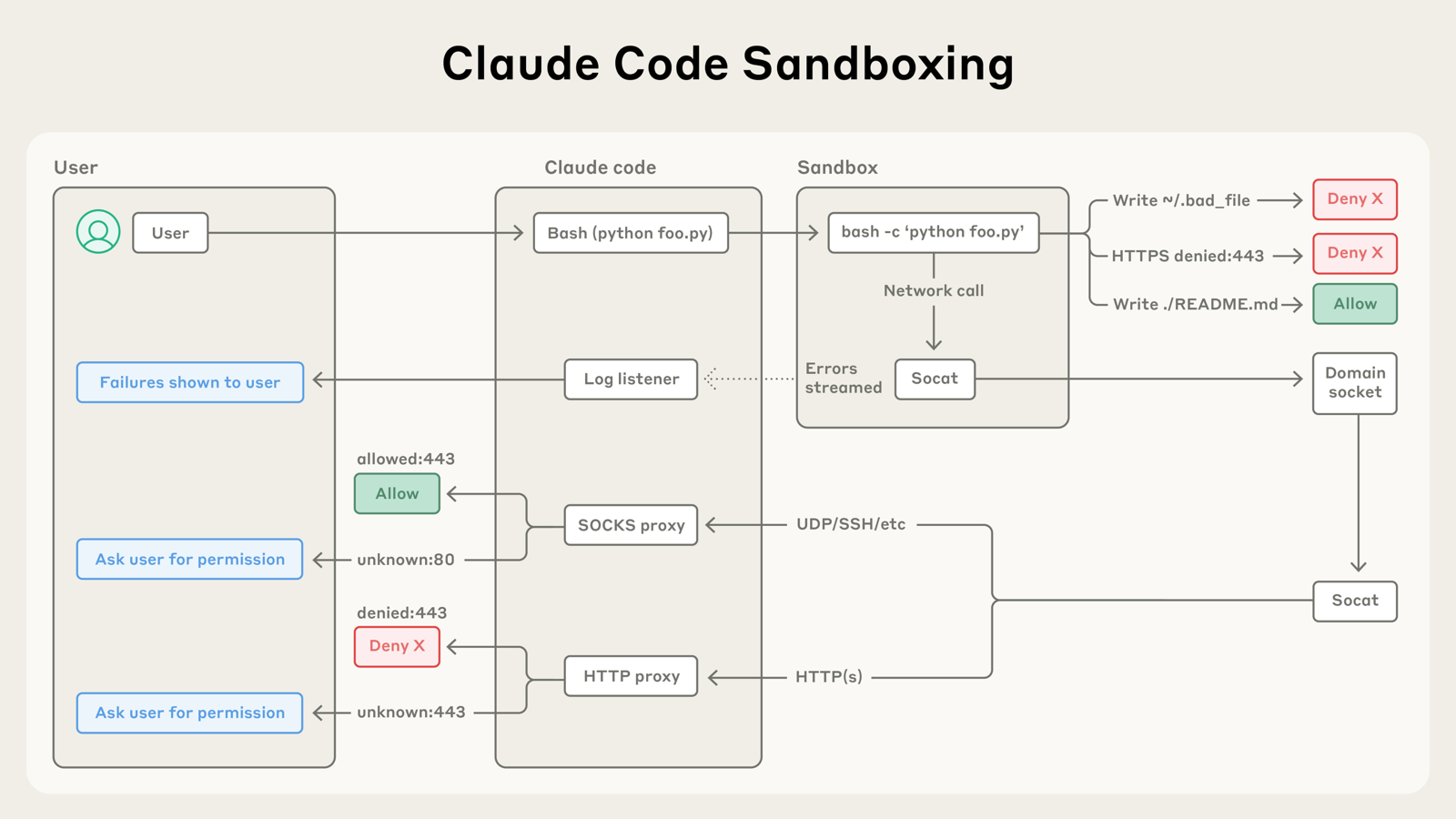
The sandbox wraps the Bash tool and nothing else. Claude Code's own Read, Edit, Write and WebFetch tools follow permission rules instead. Hooks, local MCP servers, LSP servers and the status line command run "with your full access". The sandbox is off by default; /sandbox or sandbox.enabled: true turns it on. With autoAllowBashIfSandboxed (default true), a command that runs sandboxed is approved without a prompt. That is the 84% claim in mechanical form.
Then there is the escape hatch. When a command fails in the sandbox, Claude can retry it with dangerouslyDisableSandbox, which runs it unsandboxed. Your permission mode decides who approves that: a prompt in manual mode, no prompt in bypassPermissions. allowUnsandboxedCommands: false turns the hatch off, and failIfUnavailable: true stops Claude Code from quietly running unsandboxed when bubblewrap is missing. That last default matters on Linux. Without bubblewrap installed, the docs say Claude Code "runs commands without sandboxing".
Claude Code on the web takes the other route. The whole session runs in a gVisor sandbox with no git credentials inside, and a git proxy holds the token:
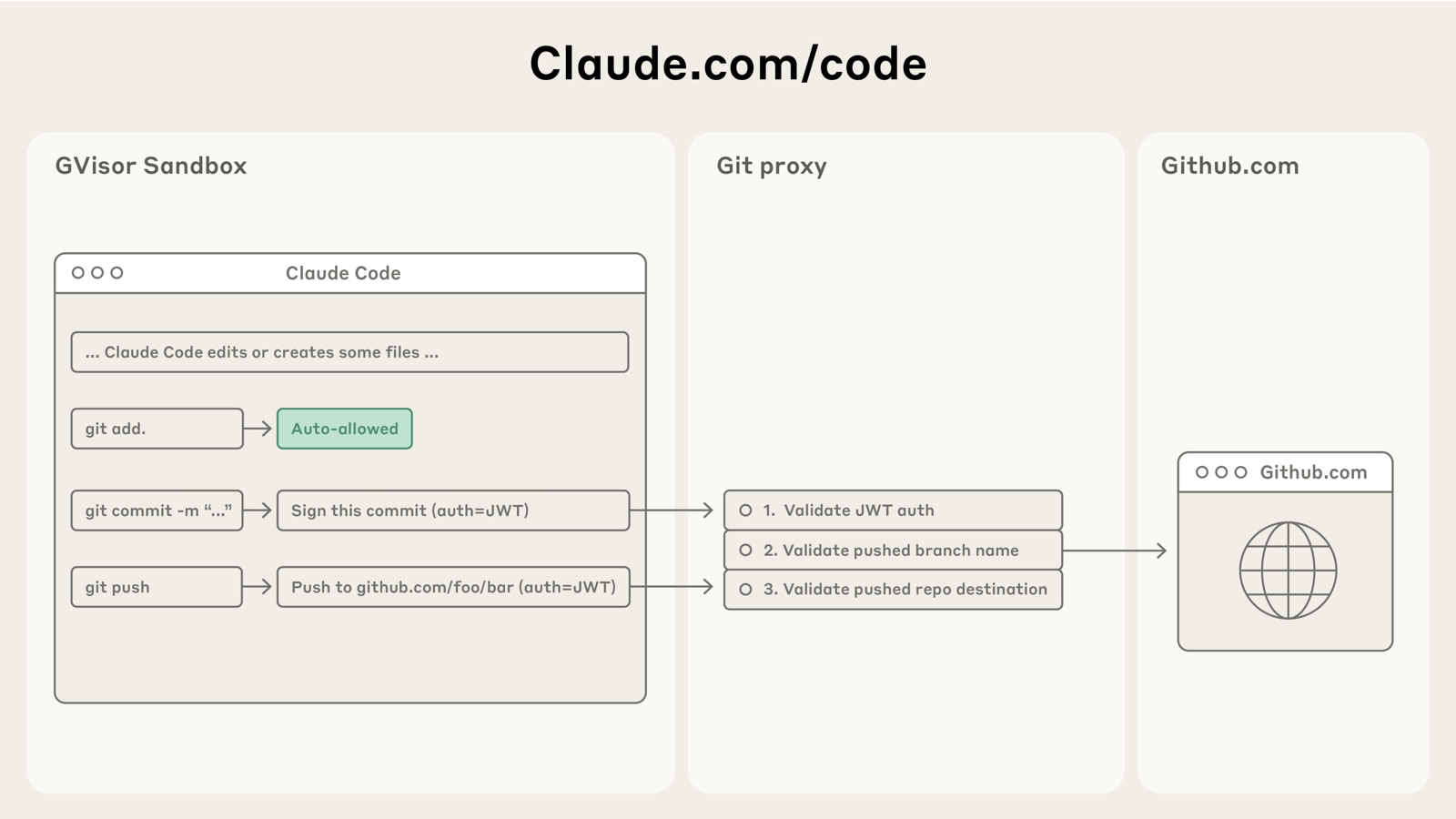
srt has a local version of the idea: credentials entries can withhold a secret or swap in a sentinel that the proxy replaces on the way out. It needs the experimental network.tlsTerminate, and I did not test it.
What it costs per command
The runs below come from the shared VM described above. The 1-minute load average was about 10 on 4 cores while they ran, so treat these as upper bounds. Every figure is a median of 20 runs (measured).
| What | Median |
|---|---|
bash -c true, unsandboxed, from a shell loop | 6 ms |
srt -c true, the whole CLI: Node start, proxy start, wrap, run | 734.5 ms |
SandboxManager.initialize (proxies, bridge), once per session | 123.9-238.5 ms |
wrapWithSandbox("true"): build the argv, ripgrep scan | 33.1-47.2 ms |
run the wrapped true, proxies already up | 80.9-108.1 ms |
run bash -c true unwrapped, same harness | 4.3-9.7 ms |
The ranges are three separate runs of the library harness. For an embedder like Claude Code, which initialises once, the per-command price is the wrap plus the wrapped run: roughly 115-155 ms against under 10 ms bare (reasoned, from the rows above). Part of it is fixed by design. The wrapper waits until both socat listeners are up before it starts your command, so a command never races its own network bridge. For commands that take seconds, that is noise; for a loop of a thousand greps, batch them.
Where the boundary is thin
The README and the Claude Code docs list the limits themselves, and they are the right ones to know before relying on this.
- An allowed domain is a whole domain. The proxy decides from the hostname, the CONNECT target or the SOCKS name, and by default never looks inside TLS. Allowing
github.comallows pushing to any repository. Both documents warn that domain fronting "may" bypass the filter, for the same reason. The fix they suggest is a custom or TLS-terminating proxy that inspects requests (network.filterRequest,mitmProxy), at the cost of a CA certificate inside the sandbox. - DNS happens on the host. Inside the Linux sandbox there is no resolver; names go to the proxy (
socks5h://, CONNECT). That stops DNS tunnelling from the sandbox, but it means the host's resolver decides what an allowed name points at. The resolved-address check covers loopback, link-local, metadata and the host's own interfaces; your LAN is covered only if you list it. - Unix sockets are a side door you open yourself.
allowUnixSockets: ["/var/run/docker.sock"]is, in the README's words, effectively access to the host. On Linux the seccomp filter cannot match by path, so it is all or nothing (allowAllUnixSockets), and it does not touch sockets inherited or passed in withSCM_RIGHTS. - Linux globs are narrower than they look.
allowWriteanddenyWritetake literal paths. AdenyReadglob is expanded once, when the command is wrapped, so a file created later is not covered. A pattern with a wildcard in its first component is skipped, and "a skipped pattern hides nothing". - Three switches turn the walls down.
enableWeakerNestedSandbox(for Docker without privileged namespaces) "considerably weakens security".allowNestedUserNamespaceslets a command undo its own write denies. AndallowAllUnixSocketstogether withenableWeakerNestedSandboxleaves user namespaces unlimited, because bubblewrap's own--disable-usernscannot be used there. - The sandbox can rewrite its own runtime. If
srtis installed in<project>/node_modulesand the project is writable, a sandboxed command can modify it, and the nextsrtruns the result unsandboxed. Install it globally. - Not everything is wrapped. In Claude Code, hooks, MCP servers and built-in tools run outside it. For a boundary around all of that, the docs suggest running Claude Code itself under
srtor in a container.
These are the honest edges of a design that chose OS primitives over a VM. Compare NVX, which builds a micro-VM up from nothing, and OpenShell, which puts Landlock and a seccomp supervisor between the agent and every connection. Strands Box uses the same macOS Seatbelt primitive with a policy language on top. Octop's optional bubblewrap backend is a mount-namespace jail with no network fence. srt is the lightest of these. Nothing is started, the command still runs on your kernel, and you pay a small cost per command.
What I would check before trusting it
I ran the Linux path end to end. I only read the macOS profile, the TLS-terminating proxy, credential masking, Windows and Claude Code's wiring.
The question the X post asked, how tight to make the allowlist, has no universal answer. srt gives you the tools to make it a conscious one. Start from the deny-everything default. Turn on strictAllowlist if you do not want an ask callback widening the list. Add denyRead for ~/.ssh and ~/.aws before adding any domain. Add deniedResolvedAddresses for your private ranges. And treat every domain you allow as a place your files can go.