2026-08-26 · 26 min · qwen · distillation · quantization · gguf · benchmarks · on-device
Why read this
Essentialtop 10%Shows 69% of a distill's GSM8K gain is lm-eval's last-number filter, with real regexes running on the page, and sizes its GGUFs and KV cache from the files.
- Original, source-checked analysis
- Runs on a phone
- A guide you can follow today
Evals & benchmarksApache-2.0Practitioner model
How this was scored
- Is it new?
- 1 of 3: An incremental tweak
- Can I trust it?
- 3 of 3: Reproduces the headline result, or shows from primary files it is wrong
- Can I run it?
- 3 of 3: Open, permissive, runs on reader hardware with instructions
- Will I understand it?
- 2 of 3: Mechanism from first principles with figures
- Can I act on it?
- 3 of 3: A decision guide a practitioner can follow today
- Will it last?
- 2 of 3: A reference for a year or more
- Does it affect many?
- 1 of 3: A specialist community
- Only here?
- 3 of 3: The only place this analysis exists
Score 80 of 100, ranked 26 of 577 rated articles. Each question is answered 0–3 by hand, and a 3 is rare. How articles are scored
empero-ai/Qwen3.8-2B-Distill-GGUF is a full-parameter distillation of Qwen3.8 2.4T A95B into the smallest member of the Qwen3.5 family, quantized for llama.cpp. It has 155,055 downloads and 93 likes eleven days after upload (764,995 and 143 a month later). The pitch is compact and appealing: the reasoning curriculum of a 2.4-trillion-parameter teacher, MMLU 0.283 → 0.548, GSM8K 0.330 → 0.640, 262k context, function calling, 1.3 GB on a phone.
I went and read the files. Not the card — the five GGUF headers, the safetensors index, the config.json, the chat template, llama.cpp's memory allocator, the lm-evaluation-harness task YAMLs that produced those numbers, and the training_args.bin that Empero shipped alongside the weights and probably did not mean to publish as evidence.
Two things came out of it. The distillation is real and cheap, and it did something worth having. And the benchmark table is a much weaker claim than it looks, in a way the parent model card itself discloses and the GGUF card does not reprint.
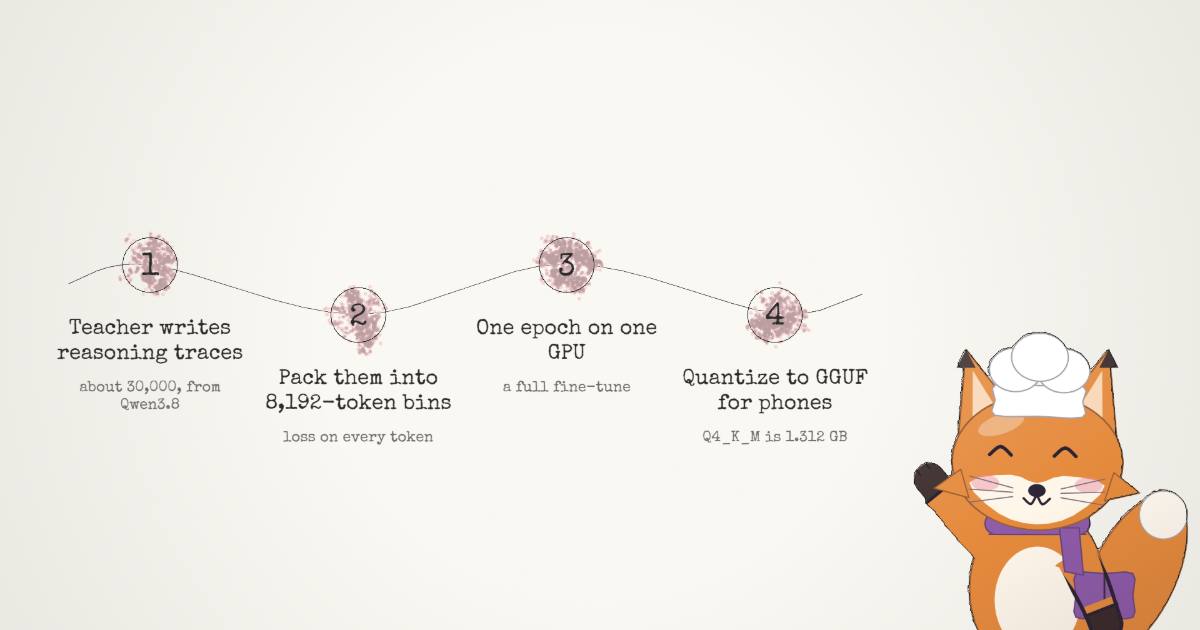
| What it is | Qwen3.5-2B, full-parameter SFT on ~30,000 Qwen3.8 teacher traces, converted to GGUF |
| Repo | five quants, nothing under 1 GB — Q4_K_M is 1,312,164,224 bytes |
| Real parameter count | 2,274,069,824 in the safetensors; 1,942,653,248 in the GGUF; 1,373,265,728 in the transformer that does the work |
| Vision | the base is a VLM. The 331M-parameter ViT is in the download and absent from every GGUF |
| Advertised context | 262,144 — and the GGUF header agrees, qwen35.context_length = 262144 |
| Context it was trained at | 8,192 — max_length in the shipped training_args.bin |
| KV cache at 262,144 | 3.221 GB, or 2.45× the weights it serves |
| Training run | 1 epoch · lr 3e-5 cosine · 5 warmup steps · paged_adamw_8bit · one GPU · seed 42 |
| The headline metric | lm-eval flexible-extract, which takes the last number in the output |
| The column not reprinted | GSM8K strict-match: 0.545 → 0.640, a gain of +0.095, not +0.310 |
| Same recipe at 4B / 9B | GSM8K −0.065 and −0.015. The distillation makes the larger siblings worse |
| License | Apache-2.0, inherited. Genuinely open |
- task
- text-generation
- library
- gguf
- license
- apache-2.0
- gguf files
- 5
- largest file
- 3.90 GB
- files
- 8
- downloads
- 771.5K
- likes
- 151
- languages
- en
repo last modified 2026-08-16
What is actually in the repo
Start with the byte sizes, because they are the one thing nobody can spin. The Hugging Face blob listing gives exact lengths, and each file's own GGUF tensor table gives the breakdown.
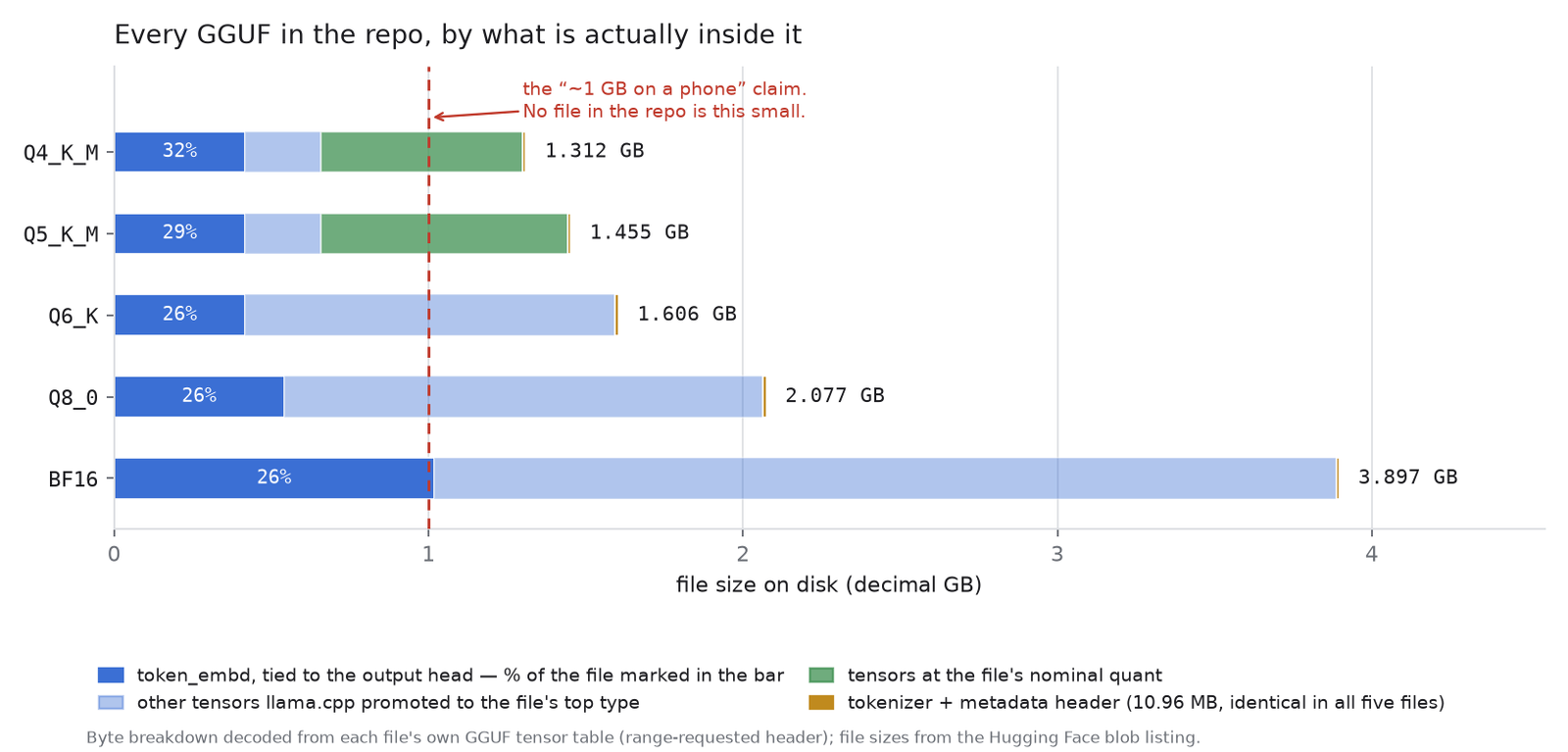
There is no Q3, no Q2, no IQ quant. The smallest file on offer is Q4_K_M at 1.312 GB — 1.222 GiB if you prefer binary — and it is the one the card recommends. So the "~1 GB" figure is not a rounding of anything in this repository. It has no file behind it.
The reason is structural, and it is the most interesting thing about the ladder. I decoded the tensor table of each file and summed the ggml block sizes; for Q4_K_M the total lands on 1,312,164,210 bytes against a 1,312,164,224-byte file, a 14-byte alignment remainder. Inside that total, the Q6_K bytes (657,162,240) outweigh the Q4_K bytes (641,802,240). Half the byte volume of a file called Q4_K_M is at six bits, and its true rate is 5.404 bits per weight, not 4.5.
token_embd.weight alone is 417,177,600 bytes — 31.8% of the download — and llama.cpp holds it at Q6_K. That is not a quirk of this publisher's recipe. Qwen3.5's vocabulary is 248,320 tokens because it covers 201 languages plus vision and tool sentinels, and config.json sets tie_word_embeddings: true, so that matrix is also the output projection. llama.cpp will not take the output projection to four bits. The floor is 417 MB before a single transformer weight is quantized, and it is why the entire K-quant ladder is compressed into 1.31–1.61 GB.
The other surprise in that ledger is what is missing. The parent is Qwen3_5ForConditionalGeneration — the base is a vision-language model, and the safetensors carries a 24-layer ViT at model.visual.*, 331,416,576 parameters. The GGUF parameter count is 1,942,653,248, which is exactly the safetensors minus that tower, to the parameter. No GGUF in the repo contains a single v.* or mm.* tensor and there is no mmproj file. 663 MB of the bf16 download does nothing in llama.cpp. The parent card is upfront that the fine-tune is text-only; the GGUF card does not mention vision at all.
The metric is doing the work
Here is the table as the GGUF card prints it:
| Task | Qwen3.5-2B (base) | Qwen3.8-2B | Δ |
|---|---|---|---|
| mmlu (CoT, 57 subjects) | 0.283 | 0.548 | +0.265 |
| gsm8k_cot | 0.330 | 0.640 | +0.310 |
And here is the parent card's version of the same table, which has twice as many rows:
| Task | Metric | base | student | Δ |
|---|---|---|---|---|
| gsm8k_cot | exact_match (flexible) | 0.330 | 0.640 | +0.310 |
| gsm8k_cot | exact_match (strict) | 0.545 | 0.640 | +0.095 |
| mmlu (CoT) | acc (flexible-extract) | 0.283 | 0.548 | +0.265 |
| mmlu (CoT) | acc (strict-match) | 0.004 | 0.225 | +0.221 |
Look at the second row. Under lm-eval's strict-match filter the base model already solves 54.5% of GSM8K, and the distilled student reaches 64.0%. The gain is +0.095. The headline +0.310 exists because the base scores 0.330 under the other filter — 21.5 points lower than under the strict one.
If your intuition says a "flexible" filter should never score lower than a "strict" one, that intuition is wrong, and the reason is one line of YAML.
From lm_eval/tasks/gsm8k/gsm8k-cot.yaml, verbatim:
filter_list:
- filter:
  - function: regex
    regex_pattern: The answer is (\-?[0-9\.\,]+).
  - function: take_first
  name: strict-match
- filter:
  - function: regex
    group_select: -1
    regex_pattern: (-?[$0-9.,]{2,})|(-?[0-9]+)
  - function: take_first
  name: flexible-extract
group_select: -1. lm-eval's RegexFilter does match = self.regex.findall(resp) then match = match[self.group_select], so -1 means the last match anywhere in the generation. flexible-extract is not a relaxed strict-match; it is an unrelated rule that says "the answer is the last number-shaped substring in the output." (take_first is a separate filter that picks the first of N sampled responses. With repeats: 1 it does nothing, and it has no bearing on which match wins.)
So a model that solves the problem, states the answer in the required sentence, and then adds one more sentence of sanity-checking will be scored on whatever number it happened to mention last. That is exactly the shape of an instruction-tuned base model that has not been taught to shut up. And a model that solves the problem but never writes "The answer is" scores zero under strict-match no matter how right it was. Neither filter dominates; which one flatters a model depends on how it ends its answer.
The decomposition is an identity, not an interpretation. Define each model's extraction gap as flexible minus strict on the same generations. Then
with nothing left over. For GSM8K at 2B: . 69% of the advertised GSM8K gain is the base model's extraction gap closing — the student stops talking once it has answered, so both filters land on the same token and its two columns agree to three decimals.
The siblings settle it
Empero released the same recipe at three scales on the same day, and published all three tables. That is a natural experiment they handed us for free.
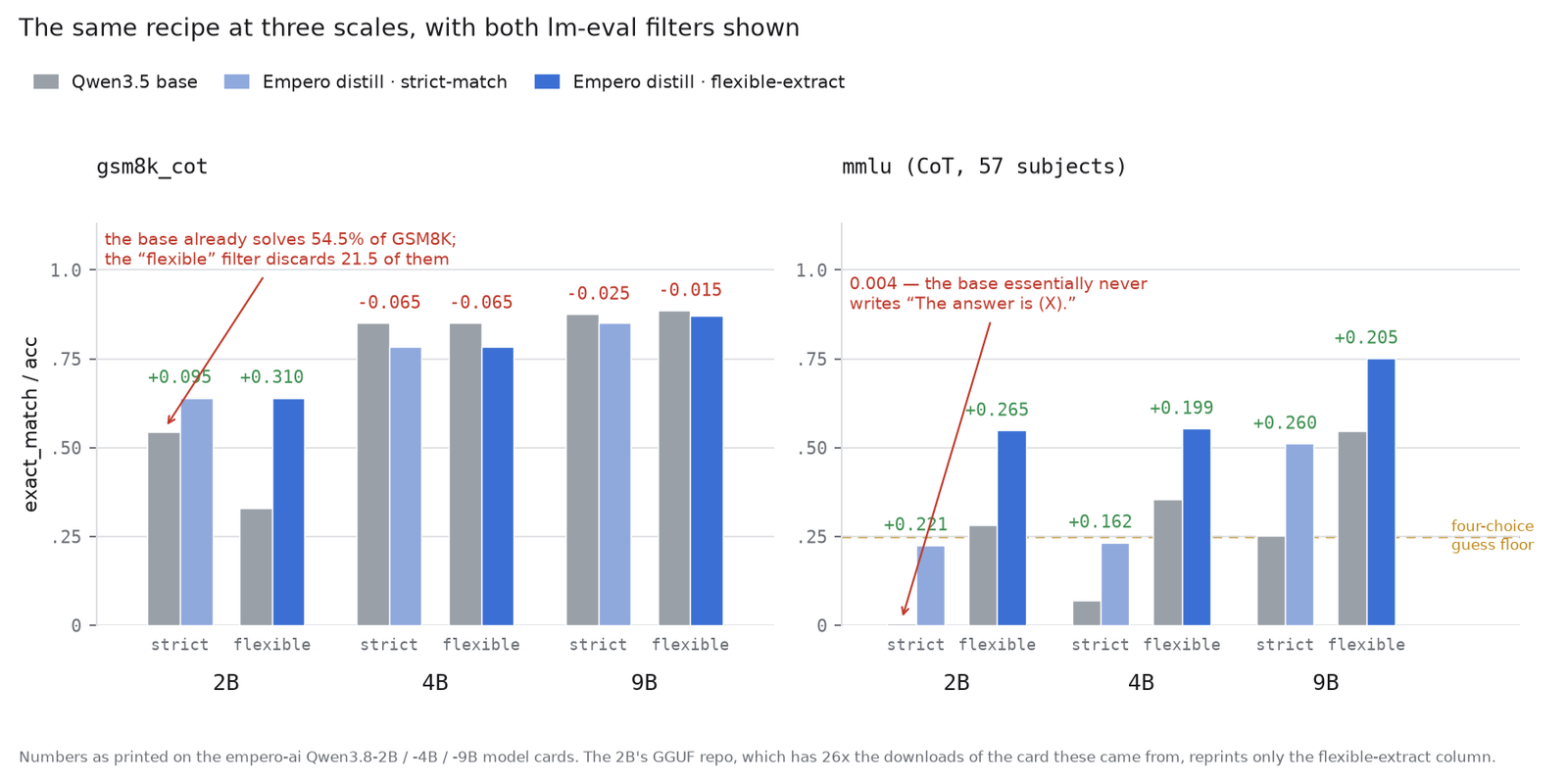
The base models' GSM8K extraction gaps, flexible minus strict:
| Base | gap | reported Δ after distillation |
|---|---|---|
| Qwen3.5-2B | −0.215 | +0.310 |
| Qwen3.5-4B | 0.000 | −0.065 |
| Qwen3.5-9B | +0.010 | −0.015 |
The only scale with a headline GSM8K gain is the only scale whose base had a large extraction penalty to recover. At 4B and 9B, where the base already stopped at its answer, the identical recipe with the identical teacher makes the student worse — 6.5 and 2.5 points worse under a fixed extraction rule. If what was transferred were reasoning, it would not evaporate at 4B, where the student has twice the capacity to hold it.
MMLU is a different and more favourable case, and I want to be careful here because the sceptical reading does not extend cleanly. MMLU CoT improves at all three scales under both filters. But the base's strict-match is 0.004. That is not a knowledge measurement — the mmlu_flan_cot_zeroshot strict filter is four lookbehinds demanding a literal "The answer is (X)" (or one of three near-identical variants) as the last thing on its line, zero-shot, with no exemplar ever shown. The base essentially never writes it. So on MMLU, strict-match cannot see the base at all, and neither column isolates reasoning. The +0.265 is real as a harness result. How much of it is knowledge and how much is the student learning where to put the answer is a question these four numbers cannot answer, and the control that would answer it — rescoring the base few-shot, or with a format-forcing instruction — is not on the card.
The one hint we have points the same way as everything else: gsm8k_cot is an 8-shot task whose YAML bakes in eight exemplars that all end "The answer is N." MMLU CoT is zero-shot. The task where the base is shown the format eight times yields +0.095. The task where it is never shown the format yields +0.265.
What the eval report leaves out
The card says "Measured with lm-evaluation-harness, HF backend, identical settings for base and student." That is more than most publishers write down. It is still not enough to reproduce a number, and the gaps are specific:
- No shot count. The task defaults are 8-shot for
gsm8k_cotand 0-shot formmlu_flan_cot_zeroshot; the card names neither. - No harness version or commit. Both YAMLs are at
metadata.version: 3.0, and gsm8k's filter list has changed across releases. A bare "lm-evaluation-harness" does not pin a filter. - Decoding contradicts the task. The card states
temperature=0.6, top_p=0.95, top_k=20. Both task YAMLs setdo_sample: false. To get sampling you must override with--gen_kwargs, which makes the run stochastic — and no seed and no confidence interval are reported. If they did not override, the numbers are greedy and the stated sampling is decoration. - No
max_gen_toks. The HF backend's default is 256 (lm_eval/models/huggingface.py,max_gen_toksreturns256). This is a model whose card says "every answer opens with a<think>block" and recommendsmax_new_tokens=16384. Those two facts cannot both be true of the same run. Either the budget was raised — and a reasoning model's score is a function of its thinking budget, so the value matters — or every generation was cut at 256 tokens. - Which MMLU?
mmlu_flan_cot_zeroshothasvalidation_split: validationand notest_split, so it runs on MMLU's 1,531-question validation split, not the 14,042-question test set. The card's "~1,700 questions" is in that neighbourhood. These are not the MMLU numbers anyone else reports.
That last point is worth pulling out, because it reframes the base model entirely. Qwen's own card for Qwen/Qwen3.5-2B reports MMLU-Redux 69.2 in non-thinking mode and 79.6 in thinking mode, and MMLU-Pro 55.3 / 66.5. Whatever "0.283" measures about Qwen3.5-2B, it is not that model's knowledge; it is that model's score under one zero-shot generative harness whose extractor takes the last parenthesised capital letter it can find. The distilled student's 0.548 sits fourteen points below the base's own published MMLU-Redux.
The training run, from the file they shipped
training_args.bin is in the parent repo — 5,777 bytes, a torch.save of TRL's SFTConfig. Unpickle it and the entire run is there:
learning_rate      = 3e-05        lr_scheduler_type = cosine
num_train_epochs   = 1            warmup_steps      = 5
per_device_train_batch_size = 8   gradient_accumulation_steps = 8
max_length         = 8192         truncation_mode   = keep_start
packing            = True         packing_strategy  = bfd
assistant_only_loss = False       loss_type         = nll
optim              = paged_adamw_8bit
bf16 = True   gradient_checkpointing = True   seed = 42
_n_gpu = 1    distributed_type = NO    fsdp = None    deepspeed = None
Four things fall out of that block.
It is a genuine full fine-tune. paged_adamw_8bit with gradient checkpointing on a single GPU is precisely what you reach for when you are fitting every parameter of a 2.27B bf16 model plus optimizer state onto one card. Nobody pages an 8-bit optimizer to train an adapter. The repo has one 4.55 GB model.safetensors and no adapter_config.json. The "full-parameter SFT, not LoRA" claim survives contact with the artifacts.
It is about a hundred optimizer steps. Effective batch is 8 × 8 = 64 sequences of 8,192 packed tokens, one epoch over ~30,000 traces. If a CoT trace averages 1,000–3,000 tokens, that is 30–90M tokens, 3,700–11,000 packed bins, and roughly 60–170 optimizer steps. warmup_steps: 5 and save_steps: 25 with save_total_limit: 3 are consistent with a run in exactly that range. Whatever "the full reasoning curriculum of a 2.4T model" means, this is a short, cheap style transfer on one GPU — which is a perfectly good thing to build, and is not what the phrase suggests.
The loss is on everything. assistant_only_loss: False with packing: True: sequences are bin-packed into 8,192-token bins and trained with plain next-token NLL across the whole bin, prompts included. A meaningful share of the gradient is spent learning to predict user turns.
max_length: 8192. Every token this model ever saw during its reasoning fine-tune lived in an 8,192-token window, with anything longer truncated from the end. The card advertises 262,144. That is 3.1% coverage, and the card is careful to say the context is inherited — but "262k context with real reasoning" is a claim about two things that were never trained together.
The context is real, and it is not free
To its credit, the 262k claim survives the check I expected it to fail. The GGUF header does not quietly say 32768:
qwen35.context_length         = 262144
qwen35.block_count            = 25
qwen35.attention.head_count   = 8
qwen35.attention.head_count_kv = 2
qwen35.attention.key_length   = 256
qwen35.rope.freq_base         = 10000000.0
qwen35.rope.dimension_count   = 64
qwen35.full_attention_interval = 4
config.json agrees: max_position_embeddings: 262144, rope_theta: 1e7. Function calling is likewise real — the embedded chat template renders a <tools> block and a <tool_call><function=…> grammar, and the tokenizer carries <tool_call> and </tool_call> as dedicated tokens at ids 248058–248059. Both are inherited wholesale from the base, and neither was evaluated by Empero. The base's own card reports BFCL-V4 43.6 and TAU2-Bench 48.8; those are Qwen's numbers for the base, and they are the only tool-use numbers that exist for this model.
What the card does not put next to 262,144 is the memory bill.
The arithmetic is fixed by the config and it is short. num_key_value_heads: 2, head_dim: 256, and layer_types is eighteen linear_attention layers to six full_attention — so per token the cache holds 2 (K and V) × 2 heads × 256 dims × 6 layers = 6,144 values, or 12,288 bytes at f16. I checked that llama.cpp really does skip the recurrent layers rather than allocating for all twenty-four; in src/llama-model.cpp the hybrid memory filter for LLM_ARCH_QWEN35 is
filter_attn = [&](uint32_t il) {
    return il < hparams.n_layer() && !hparams.is_recr(il);
};
which also excludes blk.24, the MTP block, since its index is not less than n_layer. The cache is sized to cparams.n_ctx_seq — the full --ctx-size — and allocated when the model loads, not as the conversation grows.
So at the advertised context: 262,144 × 12,288 = 3,221,225,472 bytes. The KV cache is 2.45× the Q4_K_M weights, and the two are equal at 106,784 tokens.
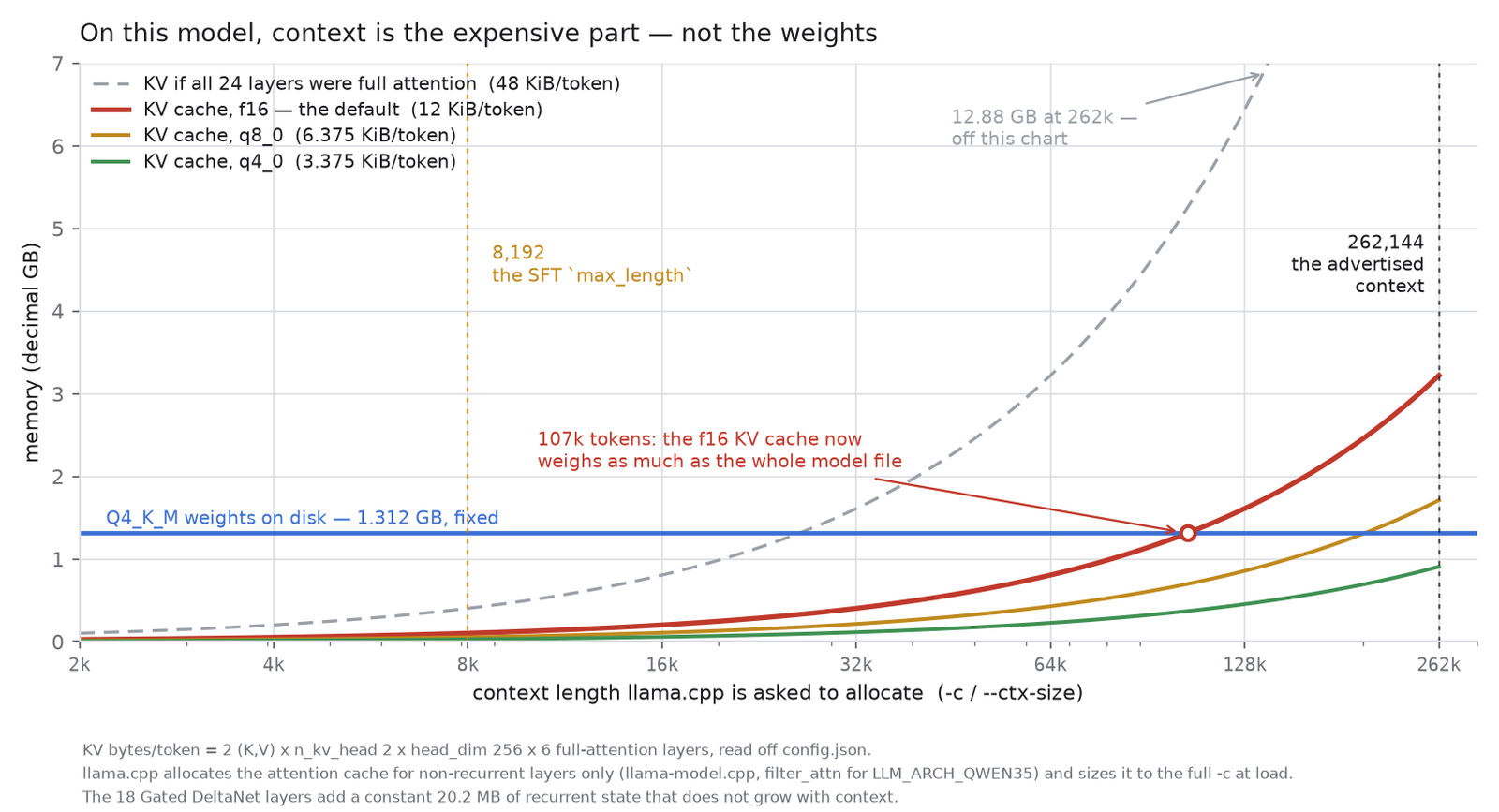
The eighteen Gated DeltaNet layers are the reason this is survivable at all. They keep a fixed recurrent state — 16 heads × 128 × 128 in f32 plus a 6,144-channel convolution window, 20.2 MB total — that does not grow with context. Had all twenty-four layers been full attention, 262k would want 12.9 GB of cache and no handset would be in the conversation. That saving is Qwen's architecture, not the distillation's, and the card that advertises 262k credits it to nobody.
The practical lever is not the quant, it is --cache-type-k. Going to q8_0 cuts the cache to 1.71 GB at full context; q4_0 takes it to 0.91 GB — below the weights again. Rotate-then-quantize is the current state of the art for doing that without wrecking the attention scores, and on a model with this weights-to-cache ratio it matters more than the difference between Q4_K_M and Q6_K.
The reasoning is off by default
One last thing, and it is the kind that only shows up if you open the file. The GGUF card says:
The model is a reasoning model: every answer opens with a
<think>block, so allow a generous-nand strip the<think>...</think>span for end users. Use the built-in chat template (-cnv).
The built-in chat template ends like this:
{%- if add_generation_prompt %}
    {{- '<|im_start|>assistant\n' }}
    {%- if enable_thinking is defined and enable_thinking is true %}
        {{- '<think>\n' }}
    {%- else %}
        {{- '<think>\n\n</think>\n\n' }}
    {%- endif %}
{%- endif %}
Thinking is off unless the caller passes enable_thinking=true. The default branch pre-fills a closed, empty think block, which is Qwen3.5's way of switching reasoning off. And chat_template.jinja in the distill repo is byte-identical to the base's — 7,755 bytes, same MD5. Diff the two config.json files and the only substantive change in the entire repository is eos_token_id moving from 248044 (<|endoftext|>) to 248046 (<|im_end|>), which is a correct and sensible fix for a chat SFT.
Which means the artifact does not agree with its own instructions. A model sold on distilled chain-of-thought ships a template whose default suppresses it, and a one-line change to that template would have fixed it. It also raises a question about the evals that the card cannot answer: lm-eval only applies a chat template when you pass --apply_chat_template, and passing enable_thinking=true through it needs --chat_template_args. The card says neither. If the template was applied without that flag, both models were scored with thinking disabled.
Update — 18 September 2026: the 35B-A3B, and a new way to not be measured
Three weeks after this article, Empero shipped a fourth scale: empero-ai/Qwen3.8-35B-A3B-Distill and its GGUF repo, both created 16 September. It is not quite "the same recipe at a fourth scale" — the base is Qwen3.6-35B-A3B, a generation on from the Qwen3.5 bases the 2B/4B/9B were built from, and it is a sparse MoE rather than a dense model. But the teachers are the same (Qwen3.8 2.4T A95B and Qwen3.8 Flash Next), the method is the same off-policy SFT on curated traces, and the release is from the same publisher eleven days after this piece went up.
Most of what this article complained about is fixed. One thing is not, and it is worse.
What got fixed, and it is not a small list
The file sizes are exact. The failure this article opened with was "~1 GB on a phone" against a smallest file of 1.312 GB. The 35B GGUF card publishes all eleven of its files with three decimal places and states its unit convention in a sentence: "Sizes are exact decimal GB from the uploaded files (1 GB = 1,000,000,000 bytes)." I measured every one against Content-Length after the CDN redirect:
Every one of the eleven file sizes on the Qwen3.8-35B-A3B GGUF card is exact. All eleven round-trip to the byte at three decimal places, the card states its unit convention out loud (1 GB = 1,000,000,000 bytes), and a vision projector now ships alongside the text quants. That is a direct fix of the failure this article opened with: the 2B release was sold on '~1 GB on a phone' against a smallest file of 1.312 GB.
| file | card says | measured bytes | bytes ÷ 1e9 |
|---|---|---|---|
| Qwen3.8-35B-A3B-IQ2_M.gguf | 12.558 GB | 12,558,245,760 | 12.55824576 |
| Qwen3.8-35B-A3B-Q2_K.gguf | 13.839 GB | 13,838,604,160 | 13.83860416 |
| Qwen3.8-35B-A3B-IQ3_M.gguf | 16.340 GB | 16,339,529,600 | 16.33952960 |
| Qwen3.8-35B-A3B-Q3_K_M.gguf | 17.664 GB | 17,663,774,592 | 17.66377459 |
| Qwen3.8-35B-A3B-IQ4_XS.gguf | 19.628 GB | 19,627,788,160 | 19.62778816 |
| Qwen3.8-35B-A3B-Q4_K_M.gguf | 21.713 GB | 21,713,462,944 | 21.71346294 |
| Qwen3.8-35B-A3B-Q5_K_M.gguf | 25.348 GB | 25,347,532,448 | 25.34753245 |
| Qwen3.8-35B-A3B-Q6_K.gguf | 29.209 GB | 29,208,731,296 | 29.20873130 |
| Qwen3.8-35B-A3B-Q8_0.gguf | 37.802 GB | 37,802,149,536 | 37.80214954 |
| Qwen3.8-35B-A3B-BF16.gguf | 71.067 GB | 71,066,994,688 | 71.06699469 |
| mmproj-Qwen3.8-35B-A3B-F16.gguf | 0.899 GB | 899,283,520 | 0.89928352 |
Parameter accounting, measured the same way: 35,951,822,704 total across all 22 safetensors files, every tensor BF16. That splits into model.language_model 34,152,051,328 + lm_head 508,559,360 (= the card's '34.7B text path'), model.visual 446,571,248, and an mtp block of 844,640,768 in its own file. Active per token — dense body 1,813,885,568, shared experts 125,911,040, and 8/256 of 32,212,254,720 routed-expert parameters — is 2,946,429,568, so 'A3B' is honest. model.safetensors.index.json is not: its total_size (71,903,645,408) counts the MTP file's bytes while its total_parameters (35,107,181,936) excludes the MTP file's parameters, which is why the Hugging Face API prints a BF16 parameter count larger than the total.
Eleven for eleven, to the byte. Whatever else is true of this release, nobody is going to be surprised by a download again.
There is an mmproj. The 2B repo shipped a 331M-parameter vision tower in the safetensors and then no v.* tensors, no mm.* tensors and no projector in any GGUF — 663 MB of the download that did nothing in llama.cpp. The 35B repo ships mmproj-Qwen3.8-35B-A3B-F16.gguf, 899,283,520 bytes, with a documented llama-mtmd-cli invocation. The measured vision tower is 446,571,248 parameters; at F16 that is 893,142,496 bytes, so the projector is the tower plus about 6 MB of GGUF framing. It is a real, usable artifact, and the card is careful to say the fine-tune was text-only and vision was not evaluated.
The quant ladder goes down. The 2B repo had no Q3, no Q2, no IQ quant, and a floor of 1.312 GB. The 35B repo ships ten: IQ2_M, Q2_K, IQ3_M, Q3_K_M, IQ4_XS, Q4_K_M, Q5_K_M, Q6_K, Q8_0, BF16 — with importance-matrix calibration named for the low-bit ones and a "what fits" table in VRAM terms.
The 8,192-token training window is now disclosed in writing. This article had to unpickle a training_args.bin to find max_length: 8192 and set it against an advertised 262,144. The 35B card volunteers it, in its Limitations section, unprompted:
Shorter responses. The student was trained on 8,192-token examples and produces noticeably shorter outputs than the base. Long chains of thought are more likely to be cut short, so behaviour on long-form generation and long-context workloads may be degraded relative to the base.
A v2 is in training with longer-context support, aimed squarely at the point above.
That is the exact criticism, stated by the publisher, with a fix in progress. Credit where it is due.
What I measured, since the card does not
The HF API prints something impossible on this repo: a BF16 parameter count of 35,951,822,704 against a total of 35,107,181,936 — parameters exceeding the total. Reading all 22 safetensors headers over range requests explains it, and the explanation is a bug in the shipped index. model.safetensors.index.json declares total_size: 71,903,645,408 and total_parameters: 35,107,181,936. The first number counts the bytes of model-mtp.safetensors; the second does not count its parameters. The difference, 35,951,822,704 − 35,107,181,936, is 844,640,768 — the MTP block, exactly. Two denominators in one file.
The claims that matter do check out. The card says "AutoModelForCausalLM loads the text path (34.7B parameters)": model.language_model (34,152,051,328) plus lm_head (508,559,360) is 34,660,610,688. And "A3B" is honest — the dense body (1,813,885,568), the shared experts (125,911,040) and 8 of 256 routed experts (32,212,254,720 × 8/256 = 1,006,632,960) come to 2,946,429,568 active per token.
And then it is scored on four benchmarks where it never generates
Here is the whole evaluation section of the 35B card:
| Task | Metric | base | student | Δ |
|---|---|---|---|---|
| MMLU (57 subjects) | acc | 0.838 | 0.834 | −0.004 |
| ARC-Challenge | acc | 0.548 | 0.582 | +0.034 |
| ARC-Challenge | acc_norm | 0.548 | 0.591 | +0.044 |
| ARC-Easy | acc | 0.819 | 0.830 | +0.011 |
| ARC-Easy | acc_norm | 0.717 | 0.766 | +0.048 |
No GSM8K. No MMLU-CoT. No flexible-extract, no strict-match, no filter to choose between — because, in the card's own words, this is "Zero-shot, loglikelihood scoring."
The colours are the story. Every number Empero published for the 2B, 4B and 9B releases came from a task where the model writes an answer and an extractor goes looking for it — which is where the flexible-extract problem lives, and where the 2B’s headline +0.310 came from. Every number published for the 35B-A3B comes from a task where nothing is generated at all: lm-eval sums the log-probability of each fixed candidate continuation and takes the argmax. No sampling, no <think> block, no extraction step, and therefore no filter to pick between. The bad metric is gone because the task that exposed it is gone. What replaced it cannot see the thing being sold: a model whose entire pitch is distilled chain-of-thought is now evaluated exclusively on benchmarks in which it never gets to think.
Loglikelihood scoring does not sample. lm-eval computes the summed log-probability of each fixed candidate continuation under the model and takes the argmax. The model writes nothing. It never opens a <think> block, never produces a chain of thought, never has an answer extracted from it. Every capability this release is sold on is invisible to every benchmark it reports. The card's own Highlights lead with "Distilled chain-of-thought — every answer opens with a <think> block learned directly from Qwen3.8 teacher traces", and then not one of the five reported rows lets it write one.
The bad metric is gone. What replaced it is a metric that cannot see the product. The 2B card, for all the trouble flexible-extract caused, at least ran a task where the model had to reason out loud and say an answer.
Two smaller things about that table, since the card names no denominators. ARC-Challenge's test split is 1,172 questions and ARC-Easy's is 2,376, which makes the ARC-Easy acc_norm gain 114 questions and the ARC-Challenge acc gain 40 — the first is comfortably outside sampling noise, the second is about 2.3 single-measurement standard errors, so "the ARC gains are outside it" is fair for some rows and marginal for others. And the card's stated MMLU standard error of 0.003 is itself informative: sqrt(p(1−p)/n) at p = 0.838 gives 0.003 only for n near 14,000, which is MMLU's full 14,042-question test split — not the 1,531-question mmlu_flan_cot_zeroshot validation split the 2B numbers came from. That is an inference from the stated error bar rather than something the card says, but if it is right, the 35B's MMLU is the number everyone else reports and the 2B's never was.
It is also worth naming that a 35B model scoring 0.548 on ARC-Challenge is strange on its face — that is roughly what a good 7B does. The likely reason is the regime itself: a checkpoint fine-tuned to open every response with <think> is being asked to rank fixed continuations it would never have written, and loglikelihood ranking is exactly the setting where that training does the least good and possibly some harm. Which is another way of saying the same thing — these four tasks are measuring a model that is not the one being shipped.
One regression, and one typo
The 35B repo does not ship a training_args.bin. The 2B parent's — 5,777 bytes of pickled SFTConfig — is the single most informative artifact in this entire article: one epoch, lr 3e-5, paged_adamw_8bit, one GPU, seed 42, assistant_only_loss: False, max_length: 8192. None of that exists for the 35B. What replaced it is the prose Limitations section quoted above, which is a better disclosure of the one fact it covers and a total loss of the other six. The card says the MoE pipeline "updates the attention path and the routed and shared expert stacks" — there is now no shipped artifact against which to check that, or to find out how long the run was.
And a trivial one, noted only because this article is about reading the card rather than the headline: the 35B quickstart sets model_id = "empero-ai/Qwen3.8-35B-A3B-Distilled", with a -ed, while the repo is -Distill. It resolves — Hugging Face keeps a redirect from the pre-rename id — so the snippet runs. It is a leftover, not a break.
The ledger
What is genuinely here. A real full-parameter SFT, Apache-2.0, of a strong small base on ~30,000 teacher traces, for what looks like a hundred optimizer steps on one GPU — and it visibly taught the model to state an answer and stop. That is worth having. Output discipline is most of what separates a base checkpoint from something you can put behind an API, and this run bought it for the price of a weekend. The GGUFs are correctly built, the header metadata is complete and truthful, the tensor tables reconcile to fourteen bytes of padding, and the SHA256SUMS file is there.
What the numbers do not support. "1 GB on a phone" — the smallest file is 1.312 GB, a third of it is one embedding table that llama.cpp will not quantize below Q6_K, and the weights are the cheap part once you ask for context. "GSM8K 33 → 64" — the same card prints 54.5 → 64.0 under a fixed extraction rule, and 69% of the advertised gain is the base's extraction penalty closing. "The full reasoning curriculum of a 2.4T flagship" — one epoch, 30k traces, 8,192-token window, loss on the prompts too. "262k with real reasoning" — the context is inherited and genuine, the reasoning was trained at 8k, and the two have never met.
What I could not settle. How much of MMLU's +0.265 is knowledge and how much is format. The base's strict-match of 0.004 means the strict column cannot see it, so the split that works cleanly on GSM8K does not transfer, and the ablation that would decide it — the base rescored few-shot or with a format-forcing prompt — was not run. I also could not verify the teacher traces, which come from "internal Qwen3.8 distillation datasets" that are not published, or check whether the eval used the chat template at all.
What I would watch. Publishers who report both lm-eval filters, and readers who look at the second one. Empero printed the strict-match column on all three parent cards and it undercuts their own headline at every scale — that is more disclosure than most releases manage. The failure is that the number 96% of their users see is the derivative card, which reprints only the flattering column. The fix is not more honesty from the publisher. It is that flexible-extract is a badly named filter that people read as "strict-match, but fairer", and it is neither.