2026-07-02 · 7 min · diffusion · inference
Why read this
Solidtop 85%Why TwoTower splits a diffusion LM into a frozen AR context tower and a trained denoiser, with its 98.7% / 2.42x headline and the code-and-math caveats.
- A new technique
- Open code or weights
- Explained from first principles
LLM architectureNeeds datacenter GPUsCC-BY-4.0Research paper
How this was scored
- Is it new?
- 2 of 3: A real new idea, method or capability
- Can I trust it?
- 1 of 3: Spot-checks a few numbers
- Can I run it?
- 2 of 3: Open code or weights with real limits
- Will I understand it?
- 2 of 3: Mechanism from first principles with figures
- Can I act on it?
- 1 of 3: General advice
- Will it last?
- 1 of 3: Relevant for months
- Does it affect many?
- 1 of 3: A specialist community
- Only here?
- 1 of 3: Some original analysis
Score 48 of 100, ranked 489 of 577 rated articles. Each question is answered 0–3 by hand, and a 3 is rare. How articles are scored
An autoregressive (AR) language model emits one token per forward pass — the sequential axis is the entire sequence, which is exactly why decode is the slow, memory-bound half of inference. Diffusion language models (like iLLaDA) offer the escape: denoise many tokens per step and refine iteratively, so generation can be parallel. The catch is that every diffusion LM so far has made one network do two jobs at once — and those jobs pull in opposite directions.
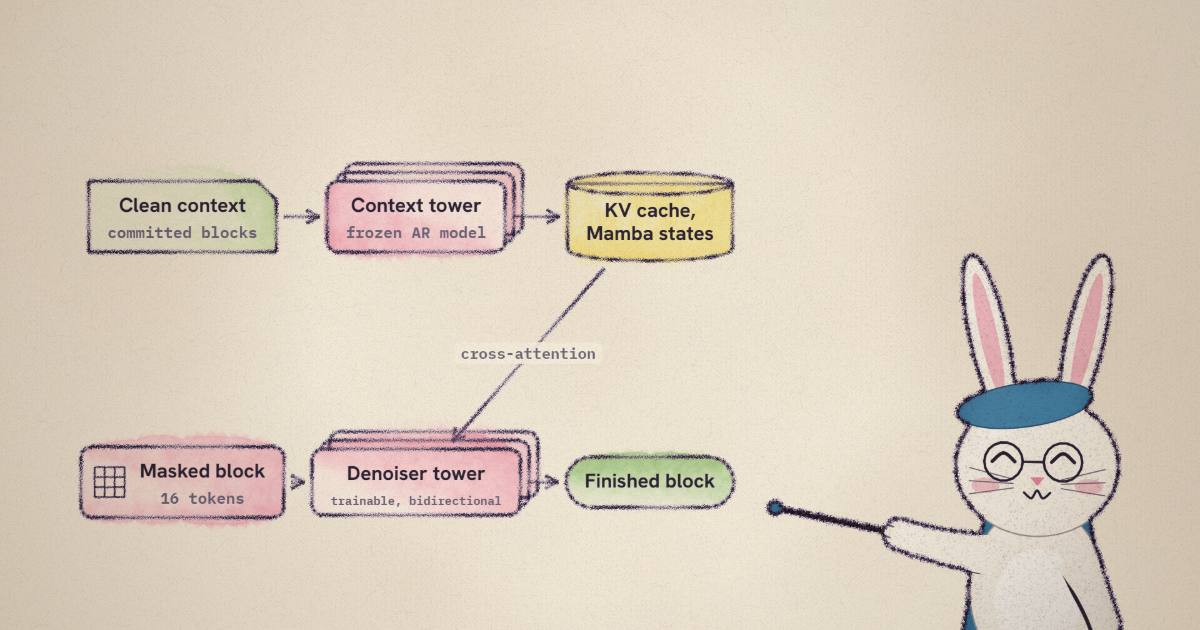
NVIDIA's Nemotron-Labs-TwoTower fixes that by refusing to share. It splits the model into two towers: a frozen autoregressive context tower and a trainable diffusion denoiser tower that reads from it. Built on a 30B Mamba-Transformer MoE, it retains 98.7% of the autoregressive baseline's quality while generating 2.42× faster.
![Side-by-side diagram of the two towers. Left: the AR/Context Tower — token embedding feeding stacked Mamba-2, Self-Attn and MoE blocks over the clean prompt tokens, with a greyed-out LM Head. Right: the Diffusion/Denoiser Tower — masked [M] tokens fed through matching Mamba-2 and MoE blocks whose attention layer is Self-Attn + Cross-Attn, receiving Mamba states and the KV cache from the context tower and looping ×T to unmask the block.](https://media.thesatyajit.com/ai/articles/nemotron-twotower/fig1.png?v=fd346bc5e887cc79)
One network, two jobs that fight
Here's the tension existing diffusion LMs live with. At every denoising step, the same decoder has to (1) represent the clean tokens already committed — which wants strong causal processing, the thing AR pretraining is great at — and (2) denoise the corrupted block — which wants bidirectional attention over the noisy tokens. As the paper puts it, this "entanglement pulls the same set of weights in different directions, limiting their capacity to excel at either." A single set of weights forced to be both a causal reader and a bidirectional denoiser ends up mediocre at both.
TwoTower's move is to stop asking one network to be both:
- The context tower is the frozen pretrained AR model. It causally processes clean tokens and never gets a gradient — so it keeps every bit of the 25T-token backbone's context ability intact. It carries the persistent left-context (KV cache and Mamba states) across blocks.
- The denoiser tower is trained from the diffusion objective and does nothing but refine the current noisy block with bidirectional attention. It reads the context through layer-aligned cross-attention: denoiser layer i attends to context layer i, over both the frozen tower's committed blocks and its own in-block tokens.
The base is Nemotron-3-Nano-30B-A3B, an open hybrid Mamba-Transformer MoE — 30B total,
~3B active, 52 layers (23 Mamba-2, 6 attention, 23 MoE). Cross-attending into a Mamba-hybrid
sounds awkward (Mamba is a recurrence, not a KV cache), and the trick is neat: the Mamba chunk
size is matched to the diffusion block size, so the existing kernel exposes clean recurrent
states exactly at block boundaries — right where the denoiser needs them.
Block-wise autoregressive diffusion
TwoTower isn't fully parallel and isn't fully sequential — it's autoregressive across blocks, diffusion within a block. Text is chunked into blocks (size 16 by default); blocks are generated left-to-right, each conditioned on the finished ones, but within a block all tokens are denoised together over a few steps:
The diffusion is masked/absorbing-state — the same LLaDA-style "replace tokens with [MASK]
and predict them back" as iLLaDA, with a linear
noise schedule. The number of denoising steps is adaptive: a confidence sampler commits any
token whose prediction clears a threshold (γ = 0.8) immediately and lets the uncertain ones wait
another step. In practice most tokens of a block resolve in the first step, so a block costs
far fewer forward passes than its token count — which is the whole source of the speedup. The
sequential axis is now the number of blocks, not the number of tokens.
One sharp constraint falls out of this: you have to sample with the same block size you trained on. Sample with blocks larger than training and generation collapses — GSM8K drops from 89.8 to 2.2 at a sampling block of 64. The block size isn't a free inference knob; it's baked in at training time.
Why decoupling is the whole point
The paper's central experiment is an ablation that isolates the decoupling. Build the model three ways from the same backbone and measure how much quality survives versus the AR baseline:
The entangled single tower — one network trained jointly for both roles — loses 21–26% across general, code, and math. Continued AR training does better. But freezing the context tower and training a separate denoiser keeps the most, losing only 6–11%. That gap is the argument: neither role compromises the other when they don't share weights. It's the same instinct as HydraHead — match the mechanism to the job — applied to whole towers instead of individual heads.
The numbers
The released checkpoint is a genuinely strong model in absolute terms — this isn't a toy that trades away quality for speed:
Aggregated, that's 98.7% of the autoregressive baseline's quality — the headline claim. And the speed lever is the block size: bigger blocks mean more tokens denoised in parallel per step, so higher throughput (the released checkpoint reaches 2.42×):
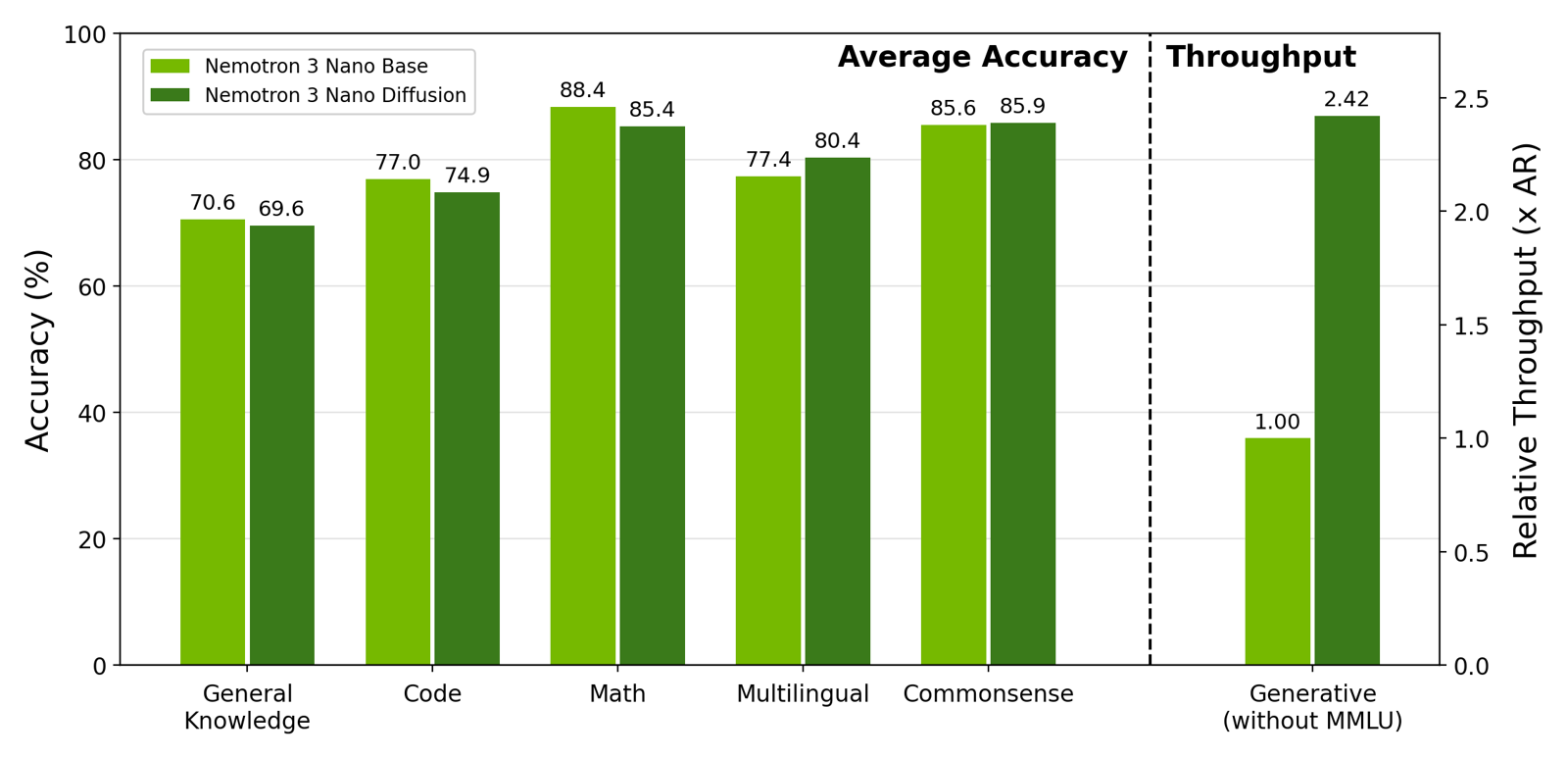
A few honest caveats, because this is a fresh preprint and the framing invites them. The quality "retention" is an aggregate; the per-category drops aren't uniform — code (−10.5%) and math (−11.3%) take the biggest hits, exactly the tasks where a single wrong token derails the answer. The paper reports no comparison to other diffusion LMs (LLaDA, Dream, external block-diffusion) — only its own AR baseline and internal ablations — so "best diffusion LM" is not a claim it makes or supports. Throughput is reported only as a relative speedup (no tokens/sec), the 2.42× is the released checkpoint while the ablation tables show 2.02× at the same block size under a different recipe, and running two towers means the frozen context tower's weights sit resident in memory on top of the denoiser.
The take
The appeal here is architectural honesty. Diffusion LMs have quietly been asking one network to be a causal historian and a bidirectional editor simultaneously, and TwoTower's contribution is mostly the observation that you shouldn't — plus the engineering to make cross-attention into a frozen Mamba-hybrid actually work (the chunk-size-equals-block-size trick is the load-bearing detail). Keeping the pretrained AR tower frozen is the elegant part: you inherit a 25T-token backbone's context ability for free and spend all your training budget teaching the one thing that's genuinely new, bidirectional block refinement.
Whether this is the design that finally makes diffusion decoding a default is still open — the code/math gap is real, and 2.42× on two H100s with extra resident weights is a solid but not seismic win. But "give the diffusion model a frozen autoregressive memory instead of making it grow its own" is the kind of clean decomposition that tends to stick, and the weights are out (CC BY 4.0) if you want to poke at it.
Built on Nemotron-Labs-TwoTower: Diffusion Language Modeling with Pretrained Autoregressive Context (Reda, Kamalu, Waleffe, Patwary, Shoeybi, Catanzaro; NVIDIA, 2026). Benchmark and throughput figures are quoted from the paper's tables; category-level AR-vs-TwoTower comparisons are from its Figure 2.