2026-08-03 · 18 min · llm · inference · quantization · kimi · systems · c · explainer
$ ./bin/k3 ~/k3model --trunk ~/k3trunk --preset laptop \
           --tok ~/k3model --prompt "The capital of France is" --gen 8 --incremental

--- generated text ---
 Paris.",
+            "The Eiffel
----------------------
8 tokens in 261.5 s, 32.69 s/token average
PEAK RSS for the whole run: 8.24 GB
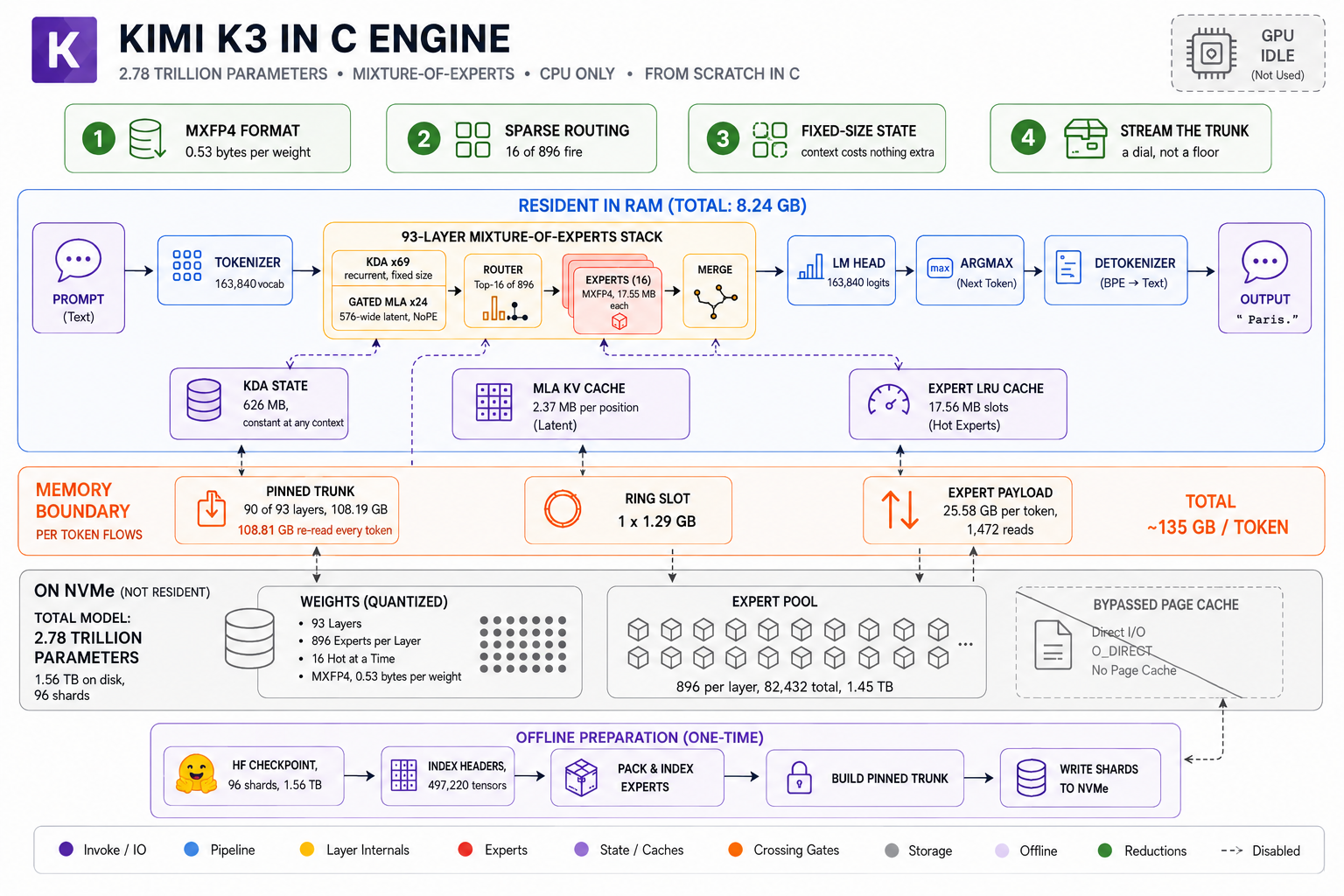
That is Kimi K3 — 2.78 trillion parameters, 1.56 terabytes on disk —
answering a question correctly from a laptop-sized memory budget, on one CPU, with zero GPUs. The
engine that did it is kimi-k3-in-c: 4,779 lines of
portable C99, a single author, Apache-2.0. It is slow — 32.69 seconds for that one token — and it is a
base model, so " Paris." is a continuation of a sentence, not a chat reply. Neither of those facts
changes what the run demonstrates: a frontier-scale mixture-of-experts model, read and multiplied
straight off an NVMe drive, fits in memory most people already own.
I went through the source rather than just the README — src/core/k3_ops.c, src/cache/k3_cache.c,
src/io/k3_st.c — because the interesting claims in a project like this live in code comments, not
marketing copy, and this codebase's comments are unusually good. This piece is about what they say.
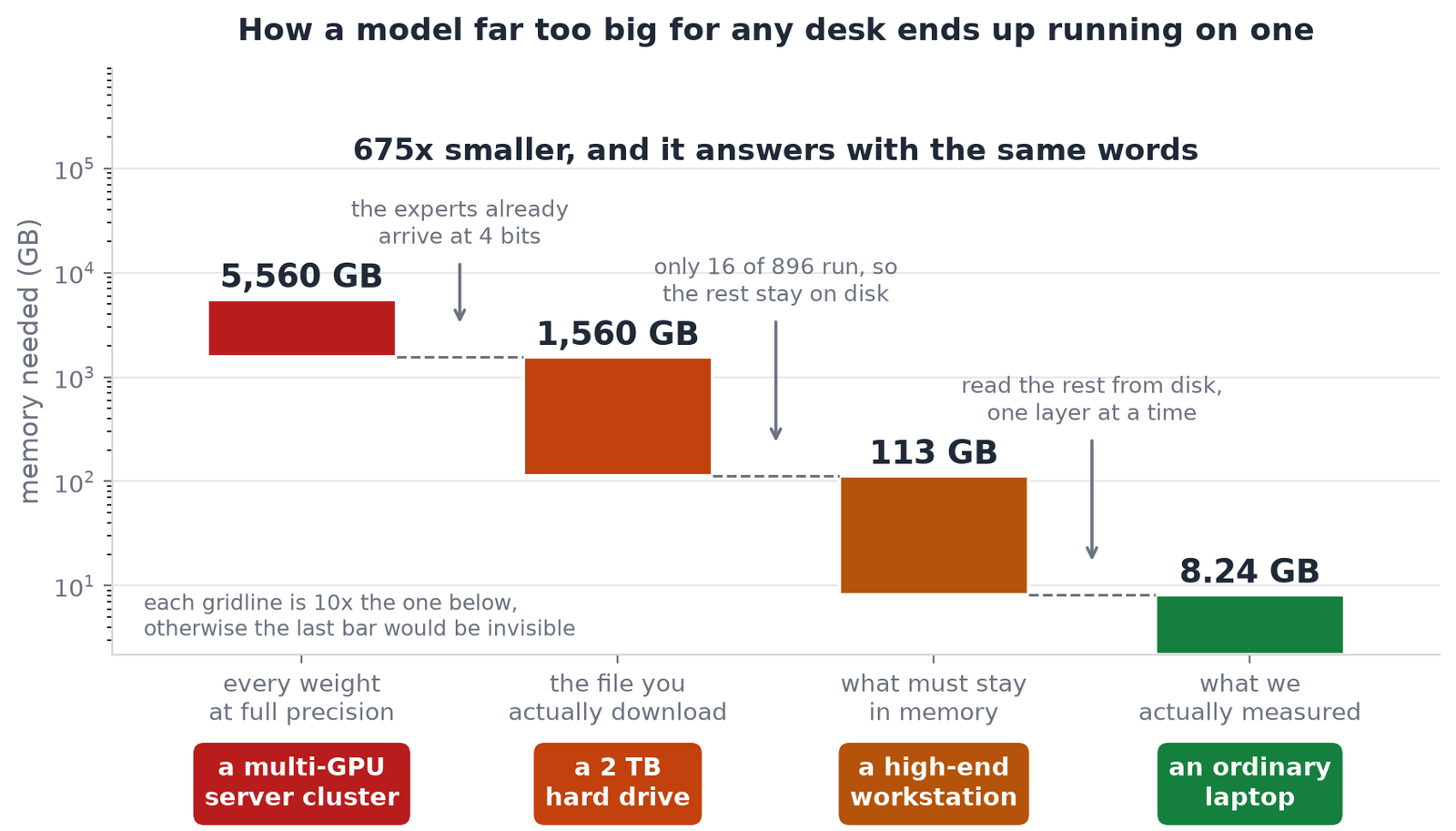
The four reductions
Every parameter at bfloat16 is 5,560 GB. That number is where the project starts and it is not close to fitting anywhere. Four decisions, each one shipped in the checkpoint or written into this engine, bring it down to a measured 8.24 GB — a 675× reduction, with no weight dropped and no approximation:
- The routed experts already ship at half a byte — MXFP4 — multiplied straight out of their packed form, never expanded to floats first.
- KDA gives 69 of the 93 layers a recurrent state that does not grow with context.
- MLA caches one 576-wide latent per position instead of ninety-six heads of key and value.
- The dense trunk streams a layer at a time instead of sitting resident, which turns the last floor into a dial.
The first three are architectural decisions Moonshot made when training Kimi K3; I covered why they exist — the routing, the gating math, the attention-residual stack — in the K3 architecture piece. What is new here is the fourth one, which belongs entirely to this engine, and the fact that all four survive being reimplemented from scratch in C and checked against the released weights.
Reduction one: the experts already ship at half a byte
The routed experts are not quantised by this engine — they arrive from Moonshot already in MXFP4, a microscaling 4-bit float. Every weight is a 4-bit code indexing a 16-entry table, and every 32 consecutive weights share one 8-bit exponent. One routed expert is exactly 33,030,144 parameters. At half a byte plus a shared scale, that is 17,547,264 bytes — 17.55 MB. Dequantised to fp32 first, the same expert is 132 MB.
A token touches 16 experts in each of 92 MoE layers — 1,472 experts. Multiply that out and the difference stops being an abstraction:
- Dequantise everything first: 194 GB of pure format conversion, per token, before one multiply happens.
- Read the nibbles directly: 25.83 GB.
The comment above the kernel that does this is the best sentence in the codebase: "This is not an optimisation; it is what makes streaming experts possible at all." And the mechanism is worth sitting with, because it inverts an intuition every ML engineer carries: quantisation is supposed to trade compute time for memory. Here it does the opposite. A matrix-vector product is memory bound — the arithmetic is cheap, the wait is for bytes to arrive — so reading 7.5× fewer bytes makes the packed kernel faster than dequantise-then-multiply, not slower.
/* y[rows] = W[rows][in] . x[in], with W read straight out of packed MXFP4 and never
 * materialised as floats. This is not an optimisation; it is what makes streaming
 * experts possible at all. */
void k3_matmul_mxfp4(float *y, const float *x, const unsigned char *packed,
                     const unsigned char *scales, int in, int rows, int group)
{
    ...
    for (int r = 0; r < rows; r++) {
        for (int g = 0; g < ngrp; g++) {
            const unsigned char sb = sr[g];
            if (sb == 255) continue;              /* NaN scale: contribute nothing */
            /* expand the group of 32 to floats, dot product, then apply ONE scale */
            ...
            acc += sub * (double)K3_E8M0[sb];
        }
        y[r] = (float)acc;
    }
}
The reason the inner loop is fast is a small lookup table: K3_E2M1_PAIR[256][2] maps a whole byte to
both of its decoded values, so the loop does one 8-byte load instead of masking and shifting each
nibble out separately. Groups of 32 elements are exactly 16 packed bytes, which is why the group size
was chosen there — and the scale factors out of the inner sum entirely, applied once per group instead
of once per weight.
The matmul never masks or shifts a nibble out of a byte. It loads the byte once and uses it as an index into K3_E2M1_PAIR[256][2], a 2 KB table built once at startup that already holds both decoded values for every possible byte. The scale shown here is fixed for one byte; in the kernel one E8M0 exponent covers a whole 32-element group — 16 packed bytes — and is multiplied in once per group, after the group's dot product, not once per weight.
The first cut is reduction one and it never moves: reading packed nibbles instead of dequantising first drops 194 GB to 25.83 GB before the cache does anything. The second cut is the cache, and it is honest about its limits — drag below ~36 GB of arena and the bar does not move at all, because Kimi K3's router is trained to flatten expert usage, which leaves the cache nothing hot to hold.
A floating-point contract, not a convention
Kimi K3's headline claim is stronger than "it runs small": "the same model runs in 8 GB and in 224 GB
and produces byte-identical output at every budget between." Not close. Identical. That does not
happen by accident in floating point, because addition is not associative — (a + b) + c and
a + (b + c) round differently once you are past a handful of terms, and this engine sums thousands of
them per output, across a scalar path, an OpenMP path, and an AVX2 path, at any thread count.
k3_matmul fixes the order rather than trusting the compiler with it:
void k3_matmul(float *y, const float *x, const float *W, int in, int out)
{
    for (int o = 0; o < out; o++) {
        const float *row = W + (size_t)o * in;
        double a0 = 0.0, a1 = 0.0, a2 = 0.0, a3 = 0.0;
        int i = 0;
        for (; i + 3 < in; i += 4) {
            a0 += (double)row[i    ] * (double)x[i    ];
            a1 += (double)row[i + 1] * (double)x[i + 1];
            a2 += (double)row[i + 2] * (double)x[i + 2];
            a3 += (double)row[i + 3] * (double)x[i + 3];
        }
        double acc = (a0 + a1) + (a2 + a3);
        for (; i < in; i++) acc += (double)row[i] * (double)x[i];
        y[o] = (float)acc;
    }
}
Four accumulators, partitioned by i % 4, reduced as (a0 + a1) + (a2 + a3) — written out by hand
rather than left for the compiler to vectorise however it likes, because that specific split is the
summation order the AVX2 path must reproduce exactly. A __m256d register holds four doubles; loading
four elements per iteration places element i in lane i % 4, the same partition as the scalar
accumulators, and reducing with the same parenthesisation gets the same bits back. Two more details
carry the guarantee: the accumulators are double, because a float accumulator loses precision the
comparisons can see at hidden size 7168; and the AVX2 code uses a separate multiply and add, never a
fused multiply-add, because -ffp-contract=off means the scalar path rounds twice and an FMA rounds
once — a hardware capability that would otherwise quietly change the output. k3_matmul_bf16 mirrors
the same layout for the bf16 trunk, so all three paths — scalar, OpenMP, AVX2 — agree to the bit. And
because output rows never depend on each other, threading the outer loop changes nothing about the
arithmetic either: every row is still summed by exactly one thread in exactly this order, so the result
is identical at any thread count.
That determinism is also honest about its one exception. k3_matmul_mxfp4 is not bit-identical to
dequantise-then-multiply, and the comment says so without hedging: it sums each group of 32 under its
own accumulator and applies that group's scale before combining groups, while a plain matmul sums the
whole row under one accumulator — a different order. But the bound on that difference is derived, not
asserted. Every individual product inside a group is exact in double: an E2M1 value carries 3
mantissa bits, x carries 24, the product needs 27 of the 53 bits double has to spend, so only the
additions round at all. Reassociating exact terms moves the result by about one unit in the last place
of a double — roughly 1e-16 relative. The test gate requires agreement to 1e-6. The margin between
what the reordering actually costs and what the test demands is nine orders of magnitude. A codebase
that states plainly where it is not exact, and then bounds how far off, is doing something most
numerical code does not bother to do.
KDA in the code
I wrote about KDA's decay as a half-life from the technical report alone,
and had to infer that the forget gate is parameterised in log-alpha space — the report gives the
mechanism but not the exact functional form, so I flagged the parameterisation as unverified. This C
source confirms it outright. k3_kda_decay computes the gate per head, then folds it per channel:
void k3_kda_decay(float *g, float *alpha, const float *z, const float *A_log,
                  const float *dt_bias, int H, int D, float lb)
{
    for (int h = 0; h < H; h++) {
        /* PER HEAD. The checkpoint stores head_dim floats but only the first H are
         * nonzero. Indexing this per channel is a silent, fatal error. */
        const float a = expf(A_log[h]);
        for (int d = 0; d < D; d++) {
            const int i = h * D + d;
            const float u  = a * (z[i] + dt_bias[i]);
            const float gi = lb * sigmoidf_(u);   /* in (lb, 0] */
            g[i] = gi;
            alpha[i] = expf(gi);                  /* in (e^lb, 1] */
        }
    }
}
gi = lb * sigmoid(u) is log-alpha directly, and alpha[i] = expf(gi) is exactly the exponential I
had to guess at from the outside. With the checkpoint's gate_lower_bound of −5, alpha lands in
(e^-5, 1], about (0.0067, 1] — a per-channel retention factor, with a per-head base rate (A_log
is indexed by h, not by the channel index i) modulating it. An independent reimplementation
confirming an inference from the outside is a satisfying result on its own, and it is the reason these
two pieces belong read together.
The comment on A_log is worth pausing on for a second reason: it is one of five invariants the
codebase states up front as places a plausible-looking implementation silently produces the wrong
model — no crash, no NaN, just a different function that still writes fluent English. A_log being
per-head rather than per-channel is invariant one.
The recurrence itself is the delta rule, in four stages that the comments number:
void k3_kda_step(float *S, float *o, const float *q, const float *k,
                 const float *v, const float *alpha, float beta, int dk, int dv)
{
    /* 1. channel-wise decay: scale ROW i of S by alpha[i] */
    for (int i = 0; i < dk; i++) { ... }

    /* 2. read the state along k: u = S^T k */
    ...

    /* 3. rank-one delta write. (v - u) is the prediction error: this is what makes
     *    it a DELTA rule rather than plain accumulation. */
    for (int i = 0; i < dk; i++) {
        const float ki = k[i];
        float *row = S + (size_t)i * dv;
        for (int j = 0; j < dv; j++) row[j] += ki * beta * (v[j] - u[j]);
    }

    /* 4. output from the ALREADY UPDATED state: o = S^T q */
    ...
}
Decay the state, read from it along the key, write back the error between the value and what the
state already predicted — not the value itself — then read the output from the state that write just
produced. That third stage is what turns a running sum into a rule that corrects itself: writing v
directly would just accumulate; writing v - u writes only what the state did not already know. Step 4
reading from the post-write state, not the pre-write one, is the second place a plausible-looking bug
hides with no visible symptom.
The cache the project exists for
The dense trunk is 108.81 GB and every layer of it runs on every token — nothing to skip there, so it streams from a packed file with a pinned prefix and one rotating ring slot. The routed experts are the opposite kind of problem: 1.45 TB of the 1.56 TB checkpoint, and only 1,472 of the 82,432 experts fire per token. The header comment on the cache that handles them does not undersell its importance: "This is the part the project exists for."
Left uncached, one decode step reads 25.83 GB of experts. At the roughly 1.2 GB/s a commodity NVMe device sustains on cold random reads of that size, that alone is about 21 seconds per token from storage. The cache holds those experts in the same MXFP4 bytes the matmul consumes directly — caching dequantised floats would cut the number of experts that fit by 7.5× for nothing, since nothing downstream ever wants the expanded form.
The replacement policy is LRU with pinning, and the victim search is a plain linear scan, on purpose:
/* Least recently used unpinned slot. Linear, deliberately: a few hundred comparisons
 * against a 17.55 MB read is not where the time goes. */
static int pick_victim(K3Cache *c) { ... }
A few hundred integer comparisons next to a 17.55 MB disk read is not a place worth a heap. And the cache keeps a request histogram — 82,432 counters, 330 KB — purely so a hot set can be identified and pinned, because, as the comment puts it, "which experts are hot is not knowable in advance": without measuring it, pinning is guesswork.
The bug the code confesses to
The slot table has three states, not two, and the comment explains why with a candour I have rarely seen in a repository:
/*     >= 0             holds that key
 *     K3_SLOT_EMPTY    holds nothing, free to take
 *     K3_SLOT_INFLIGHT reserved by a batch prefetch whose read has not finished
 *
 * The third state exists because of a real bug. The batch prefetch marks a slot empty
 * before reading into it ... But the empty test below is a FAST PATH that returns
 * immediately, ahead of the pinned check and the LRU scan -- so the next expert in the
 * same batch was handed the SAME slot, several parallel reads wrote into one buffer, and
 * the MoE multiplied garbage. It cost one wrong token (65 instead of 2494) on the real
 * model and nothing at all in the fixtures, because no fixture exercises the streaming
 * cache. */
Read that last clause again. The bug was invisible to the entire test suite, because the fixtures test
kernels and the fault lived in the cache. It surfaced as exactly one token — 65 where the model
should have emitted 2494 — in a run that otherwise produced fluent, plausible text. That is the
failure mode that should worry anyone building inference infrastructure: not a crash, not a NaN, but one
silently wrong token inside an output that reads perfectly well.
The first cut is reduction one and it never moves: reading packed nibbles instead of dequantising first drops 194 GB to 25.83 GB before the cache does anything. The second cut is the cache, and it is honest about its limits — drag below ~36 GB of arena and the bar does not move at all, because Kimi K3's router is trained to flatten expert usage, which leaves the cache nothing hot to hold.
That component reuses the measured, steady-state numbers, and they are less flattering to the cache than a quick simulation suggested. K3's training process uses a technique called Quantile Balancing specifically to keep expert usage flat across the pool — good for training, and exactly what defeats an LRU cache, which needs a hot subset to be worth anything. Below about 36 GB of cache arena, the bytes read per token do not move at all, a fact the engine's own measurements caught and reported rather than smoothing over: a full-recompute trace predicted a 36% hit rate at 8 GB; steady-state incremental decode measured 0%.
Why the trunk stays at 16 bits
There is an obvious asymmetry in all of the above. The experts are 4-bit. The trunk — 108.81 GB of it — is bfloat16, and the engine has no bit-width knob for it at all. If quantisation is what made the experts streamable, why not quantise the part that has to stay resident?
Because they measured it. A sensitivity study over 31 real attention tensors, quantised symmetrically per row, gives about 1% mean relative weight error at int8 and about 17% at int4 — a ratio of roughly 18 that holds across every tensor type. The worst individual rows at int4 reach 45%, 56% and 65%. So the trunk's precision is not an oversight or a to-do; it is a decision with a number behind it, and the absent knob is the decision being enforced rather than left to a flag.
A second measurement worth stealing: on their hardware, O_DIRECT cold reads run at 3.2 GB/s and are
faster than buffered ones. The repo flags this as "the opposite of the usual expectation, and it is
why the engine opens the trunk O_DIRECT". When you are streaming a terabyte past a model, the page
cache is not helping you — it is another copy.
The memory dial
Put the streaming trunk and the streaming cache together and memory stops being a wall and becomes a
knob. The engine ran the identical prompt through twelve cgroup-enforced budgets, from 8 GB to 224 GB,
with MemorySwapMax=0 so an over-budget rung fails outright instead of quietly swapping:
Twelve cgroup-capped runs of the same binary on the same prompt, from a laptop's 8 GB to a small server's 224 GB. More memory pins more of the 108.81 GB dense trunk and grows the routed-expert cache, which is why the bars move — 28× the memory buys 1.70× the speed, not more. The token ids at the bottom do not move at all, at any position of the slider.
Every one of those twelve runs produced the same token ids. Not similar — identical, at a budget span of 28×. Going from 8 GB to 224 GB buys 1.70× the speed, and the paper trail behind that number is worth respecting: three back-to-back runs of one identical configuration on a quiet machine spanned 33% just from device timing noise, so the engine's own docs treat anything under that as unproven. The 28×-memory-for-1.70×-speed result clears the noise floor with room to spare; a great many of the smaller steps in between do not, and the source says so rather than reporting every row as significant.
One more result from the same measurement campaign is worth stating because it runs against instinct: at a fixed 128 GB total, giving memory to the trunk before the expert cache is 1.69× faster, even though the winning split reads 79% more expert bytes from disk than the losing one. Optimising the number that looks obviously important — cache hit rate — actively picks the slower configuration, because the trunk is re-read in full on every single token while the experts are only ever sampled.
What this is not
This is a hobby project, version 0.1.0, one author, Linux x86-64 only. 32.69 seconds per token is not
usable for anything interactive, and the project does not claim otherwise — the README's own words are
"slow, and answering correctly." Every measurement in this piece is the author's own, taken on one
workstation; nothing here is independently replicated the way a benchmark suite would be. What sets it
apart from most projects making similar claims is that it ships the receipts: raw TSVs and JSON traces
under docs/data/, a replicated-noise-floor study that argues against several of its own smaller
results, and a fixture ladder that gates every kernel against a PyTorch reference before the released
checkpoint is ever touched.
None of that makes this a serving solution — nobody should run a chatbot on it. What it demonstrates is narrower and, I think, more interesting: that a 2.78 trillion parameter model can be read, multiplied, and audited on hardware someone already owns, by one person, in under 5,000 lines of a language older than most of the engineers who trained the model. That is a pedagogical and archival result, not a production one, and it is worth having regardless.
This engine is a C implementation of Kimi K3 — see that piece for why K3 uses KDA, MLA, and Stable LatentMoE in the first place. Its MXFP4 kernel is the concrete, memory-bound case behind the general argument in how LLM inference actually works: decode is bound by bytes moved, not by arithmetic, which is exactly why reading fewer bytes wins even when it means reading them in an awkward packed format. And its confirmation of KDA's log-alpha gate closes a loop from the half-life piece I published the same day. If you're comparing this to training-time low-precision work like Neutrino-1, the distinction is the direction: that piece is about training a model to tolerate ternary weights from the first gradient step. This one is about multiplying weights a much larger model already shipped in 4-bit form, without ever training anything.