2026-09-22 · 15 min · llm · attention · mixture-of-experts · kv-cache · inference-optimization · explainer
Attention has been picked apart from every direction except one. Queries got grouped (GQA), keys and values got compressed into a shared latent (MLA), keys got reconstructed from values so the key stream could be dropped, whole layers got replaced with sliding windows or linear recurrences. The feed-forward network, meanwhile, got sparsified twenty different ways and every open frontier model now ships a mixture of experts.
What nobody had shipped is MoE sparsity inside attention. K2-Horizon-MoVA-36B-A4B,
from IFM, does exactly that: it deletes v_proj and puts a router and sixty-four
value experts in its place.
- architecture
- K2HorizonForCausalLM
- task
- text-generation
- library
- transformers
- license
- apache-2.0
- safetensors
- 48 shards
- largest file
- 4.16 GB
- files
- 63
- downloads
- 16.3K
- likes
- 363
- languages
- en
repo last modified 2026-09-21
The card above reports 37.44B parameters — my own count from the headers agrees to the parameter — and 5.17 TB of repository storage, which is not a typo. The repository carries every intermediate checkpoint of every training stage as a git branch. More on that at the end; it is the best thing about this release.
The architectural claim is a short list, and the third item is the one that should make you stop:
- compatible with FlashAttention, GQA and sparse attention;
- no additional KV cache cost compared to standard GQA.
That reads wrong on its face. If every token selects a different mixture of
value experts, then every token has a different value vector, and the cache has
to store something per token. So either the cache grows, or the routing is not
really per-token, or it is doing something clever. The repository ships
modeling_k2_horizon.py, so the question is answerable in an afternoon rather
than arguable.
It is doing something clever, and the clever thing is an ordering.
Where the routing happens
Here is K2HorizonMoVAAttention.forward, reduced to the four lines that matter:
# modeling_k2_horizon.py
router_logits = F.linear(flat_hidden_states, self.v_router.weight)   # 2560 -> 64
routing_weights, selected = calc_router_weights(
    router_logits, self.v_router.bias, "sigmoid", top_k=4, scaling_factor=2.5)

mixed_value_states = combine_routed_experts(                          # Σ wₖ·SiLU(Vₖx)
    flat_hidden_states, routing_weights, selected, self.v_experts, activation=F.silu)

value_states = mixed_value_states.view(*input_shape, -1, 128).transpose(1, 2)
# ... rope on q and k ...
key_states, value_states = past_key_values.update(key_states, value_states, self.layer_idx)
self.v_experts is a ModuleList of 64 nn.Linear(2560, 8 * 128) — sixty-four
complete GQA value projections. The router picks four, runs them, applies SiLU to
each, and weights them by the renormalised sigmoid scores scaled by 2.5. The
result, mixed_value_states, is (tokens, 1024). Reshaped, it is
(batch, 8 heads, tokens, 128).
Which is exactly the shape a plain GQA v_proj would have produced.
past_key_values.update is called, so the cache stores exactly the GQA shapes and the attention kernel never learns that routing happened. Transcribed from modeling_k2_horizon.py.That is the whole answer. The mixture is collapsed before the cache is
touched. past_key_values.update receives one 8 × 128 value tensor per token,
indistinguishable in shape, dtype and layout from what an ordinary
grouped-query model writes. The router's decision is a property of how the
value was computed, not of what is stored — it is baked into the numbers and
then thrown away.
Everything downstream follows from that. The attention kernel is called through
ALL_ATTENTION_FUNCTIONS[self.config._attn_implementation] with no special
casing at all, so FlashAttention, SDPA, a paged kernel, or a sparse-attention
backend all work unmodified — they are being handed a GQA tensor. The
num_key_value_groups = 32 / 8 = 4 repeat is the standard one. The
sliding_window argument is passed straight through. All three compatibility
claims are true, and they are true for the same single reason.
So what does it cost?
Not cache. Weights.
| where the parameters are | stored | active / token |
|---|---|---|
MoE feed-forward experts top-8 of 100 · 45 layers | 26.54B | 2.12B |
MoVA value experts top-4 of 64 · 45 layers | 7.55B | 472M |
attention q / k / o dense, all 48 layers | 1.13B | 1.13B |
attention output gate softplus, per head | 503M | 503M |
shared expert | 265M | 265M |
embedding + output head | 1.28B | 1.28B |
dense FFN, layers 0-2 | 142M | 142M |
routers, norms, dense v_proj | 27M | 27M |
| total | 37.44B | 5.95B |
v_proj, 4× the decode multiply-accumulates · 0× the cacheForty-five of the forty-eight layers are MoVA layers (mlp_only_layers: [0, 1, 2]
keeps the first three dense, with an ordinary v_proj of 2.62M parameters each).
Each MoVA layer stores 64 × 2560 × 1024 = 167.8M parameters of value experts
where a GQA layer would store 2.6M. Across 45 layers that is
7,549,747,200 parameters — 20.2% of the entire model — sitting in the value
projection alone.
Per token it runs four of them: 10.49M multiply-accumulates against a plain
GQA v_proj's 2.62M, plus a 164K-parameter router. So the trade is:
| weights | decode FLOPs | KV cache | |
|---|---|---|---|
MoVA vs plain GQA v_proj | 64× | 4× | 1× |
That is the honest statement of the design, and it is a good one. Parameters are cheap to store and expensive only when you read them; cache is expensive at every context length and cannot be amortised across a batch. Moving cost from the second column to the first is the same bet the whole MoE field made, applied where nobody had applied it.
What it is not is free. A 4× multiplier on the value projection at decode time
is real work in the regime where decode is memory-bound, and four experts is four
scattered weight reads instead of one contiguous one. combine_routed_experts in
the released code is the naive loop — one index_add_ per touched expert — which
is fine for correctness and is not what you would serve; the SGLang recipe passes
xllm_source_router_gemm_partitions to get a fused path.
"No additional cache cost" and "a small cache" are different sentences
The claim is exact. It is also worth seeing next to the absolute number, because K2-Horizon spent its architecture budget on the opposite axis from everyone else this month.
use_sliding_window is false, sliding_window is null. All 48 layers are
full attention. 8 KV heads × 128 dims × 2 tensors × 48 layers × 2 bytes =
196,608 bytes = 192 KiB per token.
config.json. The MiMo row caches a 160-wide entry per KV head because its query/key head dim is 192 and its value head dim is 128; the exact number does not change the shape of the comparison, which is 60 layers that stop growing at 128 tokens.At the model's native 512K context that is 96 GiB of KV cache for a single sequence in BF16, 48 GiB in FP8 — several times the 72 GB of weights. MoVA does not make that worse than GQA, which is the claim and it holds. But three weeks later MiMo-V2.6 shipped 60 of its 70 layers as sliding-window attention with a 128-token window, so 6/7 of its layers stop growing past 128 tokens.
Two releases, three weeks apart, making opposite bets about where attention should be cheap: IFM buys representational capacity in the value path and pays full freight on the cache; Xiaomi buys cache and pays with locality. Neither is wrong. But a reader seeing "no additional KV cache cost" should not come away thinking this is a long-context-cheap model. It is a long-context-capable model with a 2020-shaped cache.
The paired comparison that would settle it
The one experiment I want and cannot find is the obvious one: K2-Horizon-36B
with MoVA against K2-Horizon-36B with a plain v_proj, matched on tokens and
everything else. Without it, MoVA's contribution is confounded with 22.9T
pretraining tokens, four midtraining stages and two SFT phases.
The family gives a partial substitute, because IFM shipped
K2-Horizon-32B, K2-Horizon-7B, K2-Horizon-3.7B and K2-Horizon-0.9B
alongside it. On Artificial Analysis' Intelligence Index:
The 25.30 is confirmed on AA's own board, and the interesting row is the top one: the 375B sibling, more than ten times the stored parameters and nearly five times the active ones, scores 30.50. The 36B recovers 83% of its family's flagship index at a tenth of the size. That is the most controlled comparison available and it is a strong result — stronger, I think, than beating another lab's 550B model, because at least the data and the recipe are held roughly fixed.
The size comparison, checked
The card's own wording is "outscores open weight dense (approximately 30B model size) and MoE models up to 15× its size." The largest model in its comparison table and figure is Nemotron 3 Ultra 550B-A55B, and 550 / 36 = 15.3. So the 15× is exactly right and names a real model.
I was asked about a claim of "over 20× the total parameters." Nothing in the model card, the benchmark figure or the GGUF card says 20×, and no comparator in either the table or the figure is above 15.3× — the list is Nemotron 3 Ultra 550B-A55B, Nemotron 3 Super 120B-A12B, G9v3-39A5B, Qwen3.6-35B-A3B, Muse Glimmer 30B, Gemma 4 31B-it, and GPT 5.6 luna (medium) as the closed baseline. If 20× is circulating, it did not come from the artifact.
The other thing to say about that table is that K2-Horizon leads two of its nine rows.
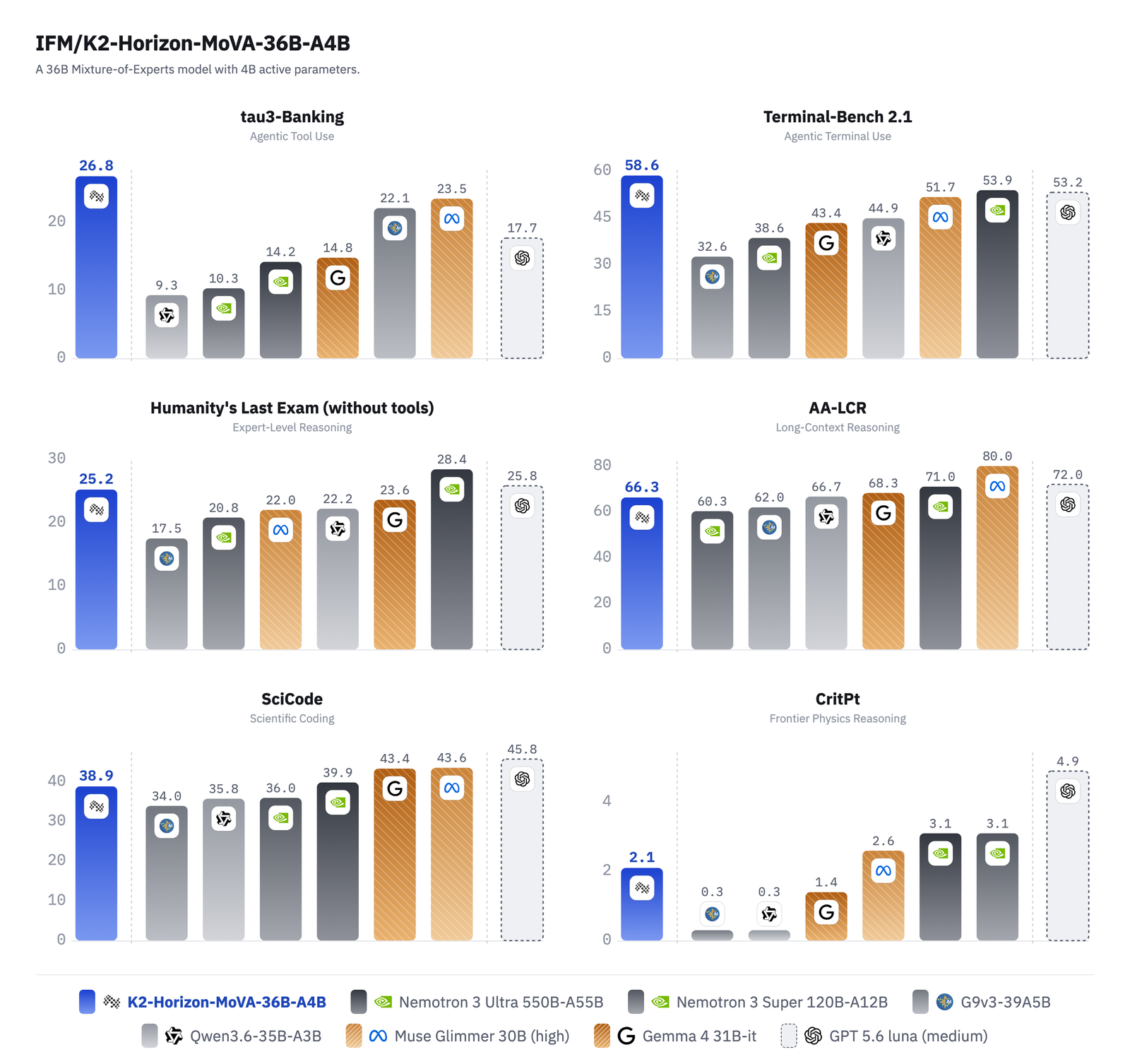
That is not damning — an aggregate index can be won by a model that loses most individual rows, because the index averages across ten evaluations and these are six of them. But "outscores models up to 15× its size" is doing a lot of work for a table where the 15× model wins seven of nine printed comparisons. The precise version is: the 36B wins the index, and it wins it on the agentic evaluations while losing the knowledge and science ones, which is exactly the profile you would predict for a model with 4B active parameters and a 512K context.
The zero nobody has mentioned
Artificial Analysis' record for this model carries
"terminalBench40": 0 — a literal zero on Terminal-Bench 4.0, one of the ten
evaluations that make up the 25.30 index. The card reports 58.6 on
Terminal-Bench 2.1, which is a strong score, and does not report 4.0 at all.
A zero on an agentic benchmark is almost never a capability result; it is a
harness result — a tool-call format the scaffold cannot parse, a container that
never starts, a reasoning-effort setting that runs out of budget. The card is
unusually specific about exactly the things that would cause it: always pass
reasoning_effort: "high", enable the k2_horizon reasoning parser, enable the
k2_horizon tool-call parser, and note that the model supports json, xml and
xml_typed tool-call formats with xml as the default. Miss any of those and a
terminal agent produces text that no harness will execute.
Two things make this worth stating rather than dismissing. First, the headline index of 25.30 is achieved with a zero in it — whatever is broken, fixing it can only move the number up. Second, Nemotron 3 Ultra, the 550B comparator, scores 1/198 on the same benchmark, so this is not a K2-Horizon peculiarity; it is a harness compatibility problem that eats open-weight models on Terminal-Bench 4.0 specifically, which is the sort of thing a harness comparison exists to warn about.
The release around the model
I have been hard on the benchmark framing, so let me be equally direct that the release is the most open one I have read this year, and by a distance.
- 22.9T pretraining tokens, then four midtraining stages that walk the context from 8K to 32K to 128K to 512K (1.1T + 498B + 110B + 199B tokens), then two SFT phases (219B + 50B). Every stage has its step count and token budget printed.
- Intermediate checkpoints as git branches on the model repo —
pretrain_*,mid_1_*…sft_2_2500— loadable directly with vLLM's--revision. Not a final checkpoint with a story about training; the training, as artifacts. - The W&B run is public. The loss curves below are reconstructed from it by IFM themselves, with the checkpoint-resume lineage drawn rather than smoothed away.
- Apache 2.0, with the pretraining and midtraining datasets named in the card
metadata, and an artifact index that marks the technical report and the
xllmcode repository as In Progress with dates rather than pretending they exist.
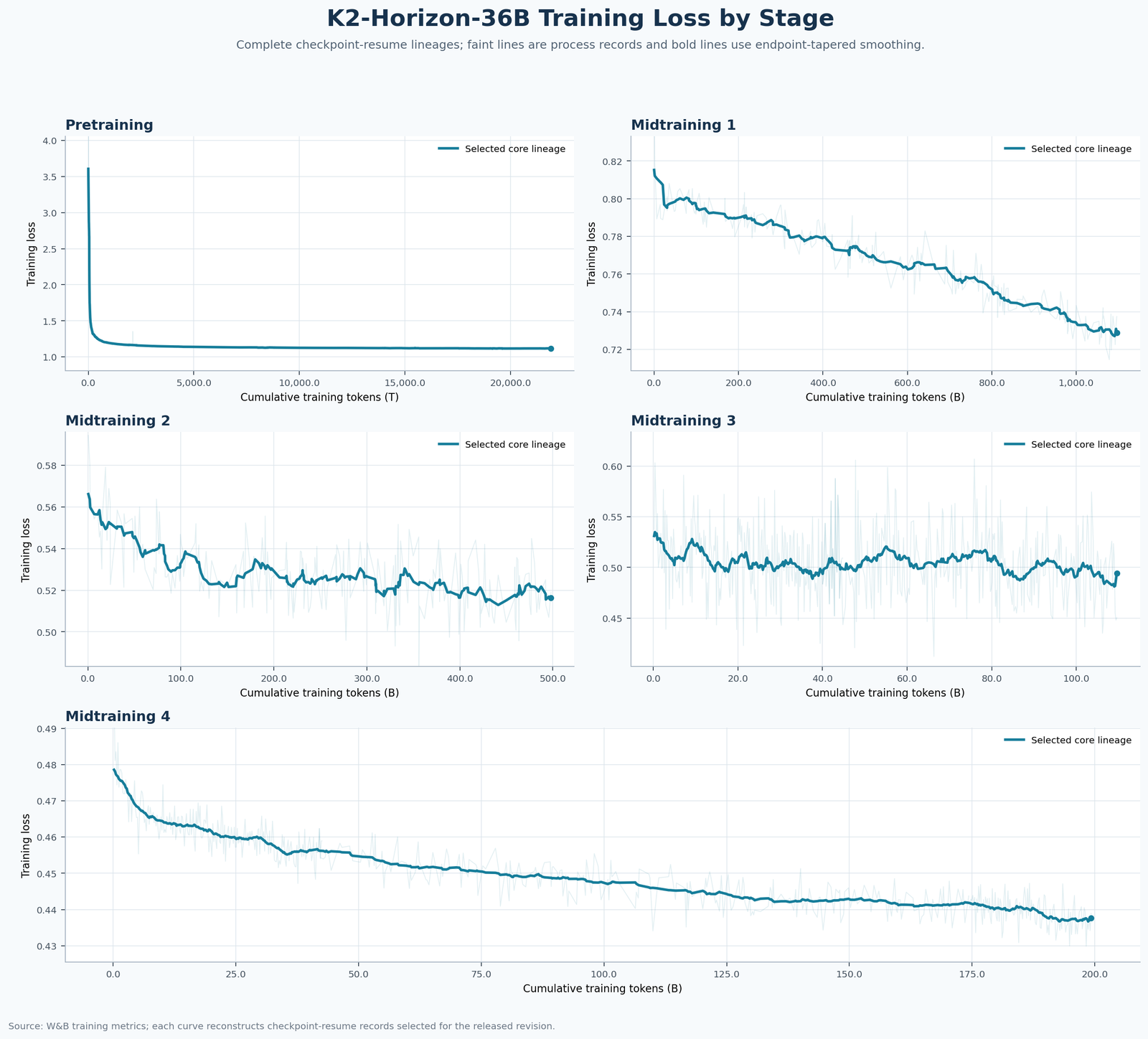
Publishing that figure at all is a choice. The stage-3 panel is visibly flat and noisy — 110B tokens at 512K sequence length that barely move the loss — and most labs would have cropped it.
The take
MoVA is a real idea, cleanly implemented, and the compatibility claims survive reading the code because they all reduce to one design decision: collapse the mixture before the cache, and everything downstream stays ordinary. That is worth stealing. It is also the answer to the objection in the title — the cache stores the mixture's output, one vector per token, exactly as GQA does, and the routing information is not retained because nothing downstream needs it.
The cost is 20% of the model's parameters in a projection that used to be 0.3% of it, and a 4× multiplier on that projection's decode work. Whether that buys more than spending the same parameters on eight more FFN experts is the experiment IFM has not run, or at least has not published, and it is the only experiment that would settle whether MoVA is a contribution or a decoration.
What I would want next, in order: the ablation; a fused decode kernel measured against a matched GQA baseline on the same hardware; and someone to find out why this model scores zero on Terminal-Bench 4.0, because a 4B-active model that does 58.6 on 2.1 should not be doing that, and the index it is already winning has that zero inside it.
What would change my mind
5 claims above, and what would falsify each
MoVA's routed value mixture is collapsed before the KV cache is written, so the cache is shape-identical to GQA.
Read
K2HorizonMoVAAttention.forwardinmodeling_k2_horizon.py:mixed_value_statesis reshaped and passed topast_key_values.updateas a single (batch, 8, tokens, 128) tensor. If a production serving path caches the router indices and the per-expert outputs instead — to recompute or to re-mix on a later pass — then the cache does grow in that path and the claim holds only for the reference implementation.K2-Horizon-MoVA-36B-A4B stores 37.44B parameters and activates 5.95B per token, of which the value experts are 7.55B stored and 0.47B active.
Summed from the safetensors headers of all 48 shards. Load the model and print
sum(p.numel() for p in model.parameters()). The card says 36B and 4B; those are round numbers under some convention — the closest I can construct is 4.66B, excluding both the embedding lookup and the output head. If someone shows a convention that lands on 4.0B, my accounting is missing a term.No comparator in the release is more than 15.3× K2-Horizon's total parameters.
The full comparator list is in the card's table and its benchmark figure: 550B, 120B, 39B, 35B, 30B, 31B, plus one closed model. If IFM publishes a comparison against a 750B-plus model, or the forthcoming technical report adds one, the 20× framing has a source and this section is out of date.
Artificial Analysis records K2-Horizon-MoVA-36B-A4B at 0 on Terminal-Bench 4.0.
Read from the embedded
terminalBench40field on AA's model page on 2026-09-22, where it is the number 0 rather thannull— other models on the same page carrynullwhere the evaluation was not run, which is why I read it as measured. If AA confirms it means "not evaluated", the section is wrong and the index of 25.30 is computed over nine evaluations rather than ten with a zero.MoVA's benefit cannot be separated from the rest of the recipe without an ablation.
Falsified the moment IFM publishes a matched
mova_num_experts: 0run at the same scale and token budget — the config supports it, the class falls back toK2HorizonAttentionwith a plainv_proj, and the intermediate checkpoints make a shorter matched run cheap. If such a run exists in the forthcoming technical report, this is the section to delete.
The mechanism is Measured from
modeling_k2_horizon.py
and config.json in
IFM/K2-Horizon-MoVA-36B-A4B,
read on 2026-09-22. Parameter counts are Measured: summed from the safetensors
headers of all 48 shards, fetched by HTTP range request. KV-cache figures are
arithmetic on the two models' configs. Benchmark figures are Reported — from the
model card's own table and figure, and from
Artificial Analysis
for the index and the comparator scores. No model was run; there is no GPU here.
Both figures are IFM's; the diagram, the parameter table and the cache ledger are
mine. Related: Grouped Value Attention for
the other 2026 attempt to change what the value stream is for,
Mixture of Experts from scratch for
the routing machinery MoVA borrows, and MiMo-V2.6 for the
release three weeks later that made the opposite bet.