2026-09-18 · 16 min · llm · attention · inference-optimization · kv-cache · explainer
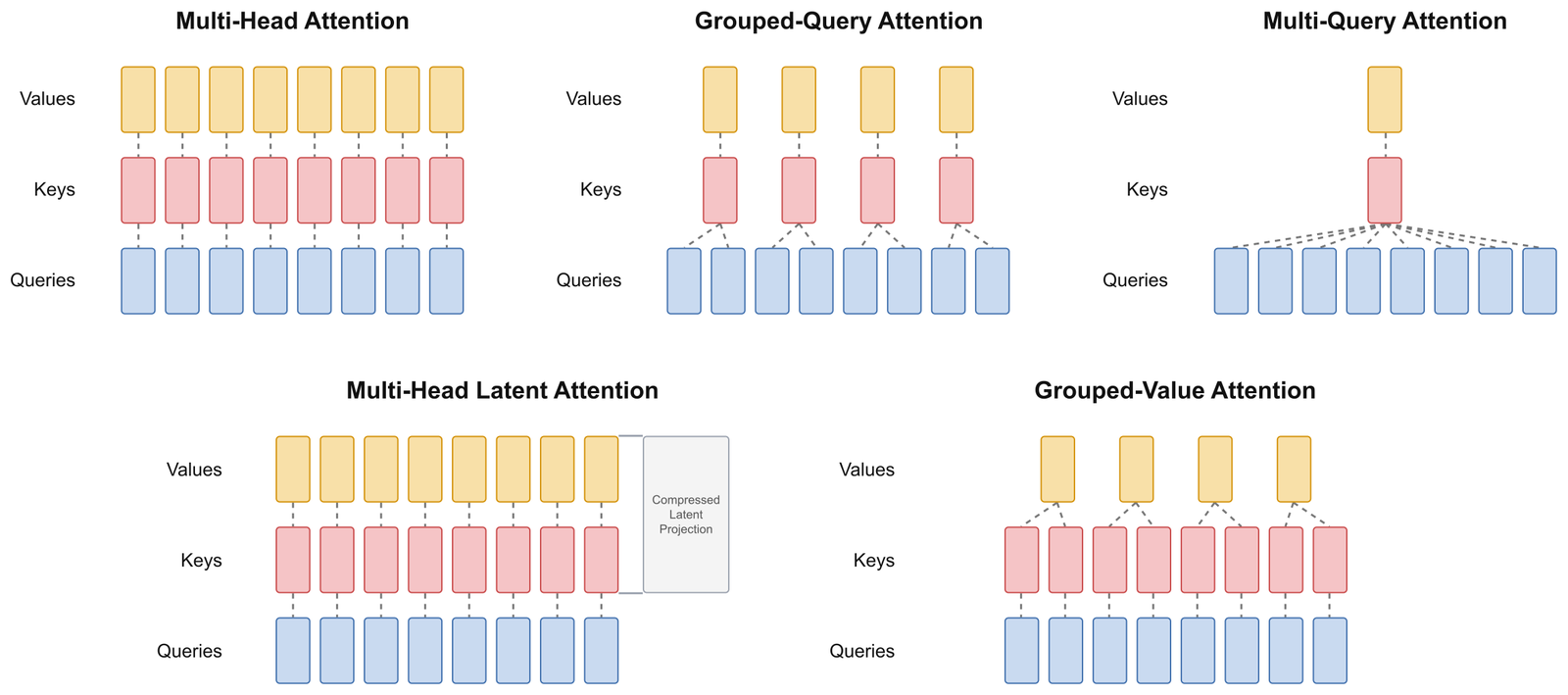
Grouped-query attention shares key and value heads across groups of query heads, which is why almost every open model since Llama 2 ships it: fewer distinct heads, smaller cache, small quality cost. But GQA still writes two streams to the cache every step — a key and a value, per group, per token. Multi-head latent attention (MLA) went further and compressed both into one shared latent. Grouped Value Attention (GVA), from FrontiersMind (arXiv 2609.13285), tries a third cut: keep the value cache GQA already has, and stop writing a key stream at all — reconstruct each query head's content key from the cached value with a learned linear map, computed once per decoded token and folded straight into the query.
The mechanism, precisely
GQA's grouping rule stays: H query heads share G value groups. What changes is the key. GVA
gives every query head h its own learned map M_h, and reconstructs that head's content key
on the fly from its group's cached value:
where g(h) is the value group assigned to head h. Only V_{g(h)} — the value — is ever
written to the cache. M_h is a small, fixed, per-head weight matrix, learned during training
and frozen at inference, not part of the cache. The paper's framing: values already carry the
content the attention output needs, and the map just picks out the features used for scoring
that content, so a separate key projection is redundant.
That reconstruction is only free if it can be absorbed into the query — computed once per decoded token, not once per cached position. It can, because matrix multiplication associates:
q̃_h = q_h M_h^T is a single (d_n × d_h) matmul, done once per query token, then reused
against every cached position. Content attention becomes one matmul against the value cache; no
key tensor is ever materialized. This is the exact same absorption trick MLA uses for its
up-projection — the "content key" idea, and the trick of folding a learned map into the query so
the cache never has to reflect it, both trace straight back to DeepSeek's MLA decomposition. GVA
just applies it to a linear map from value to key instead of a low-rank latent
up-projection.
Why the positional part is the hard part
RoPE breaks the absorption. Rotate the query and the reconstructed key by their positions t
and j, and the score becomes:
The relative rotation R_{j-t} sits between q_t and M^T, and it changes with every cached
position j — even for a fixed query. There is no single transformed query that works against
every cached position anymore, because the thing you'd need to precompute depends on the position
you haven't seen yet. Any reconstruction scheme that rotates the reconstructed key hits this
wall — it's the same reason MLA can't just up-project a rotated latent, and the same reason
naive KV quantization schemes that touch keys have to be careful
about what survives compression.
GVA's fix is DeepSeek MLA's decoupled RoPE, applied to a reconstructed rather than a compressed
key: split every query and key into an unrotated content slice (width d_n) and a rotated
positional slice (width d_r, shared across all heads, not grouped). The score splits into
two additive terms —
— where the first term is the absorbable one (k^nope_j = v_{j,g(h)} M_h, folds into the query
exactly as above) and the second reads a small, already-rotated, shared positional key straight
from the cache. Nothing learned sits between the two rotations in the second term, so relative
position survives untouched, and it costs d_r scalars per token — not G · d_r — because it's
shared across heads rather than grouped. This is the same content/positional split MiniMax's
sparse attention and every MLA-descended design now leans
on: RoPE is what forces you to keep something rotated and cached, and the trick everywhere is
to make that something as small and as shared as possible.
The first thing the authors tried was blunter: just set the key equal to the value, K = V,
and halve the cache immediately. It doesn't work — one vector asked to both score and be
retrieved never catches up to GQA's loss over the run they show:
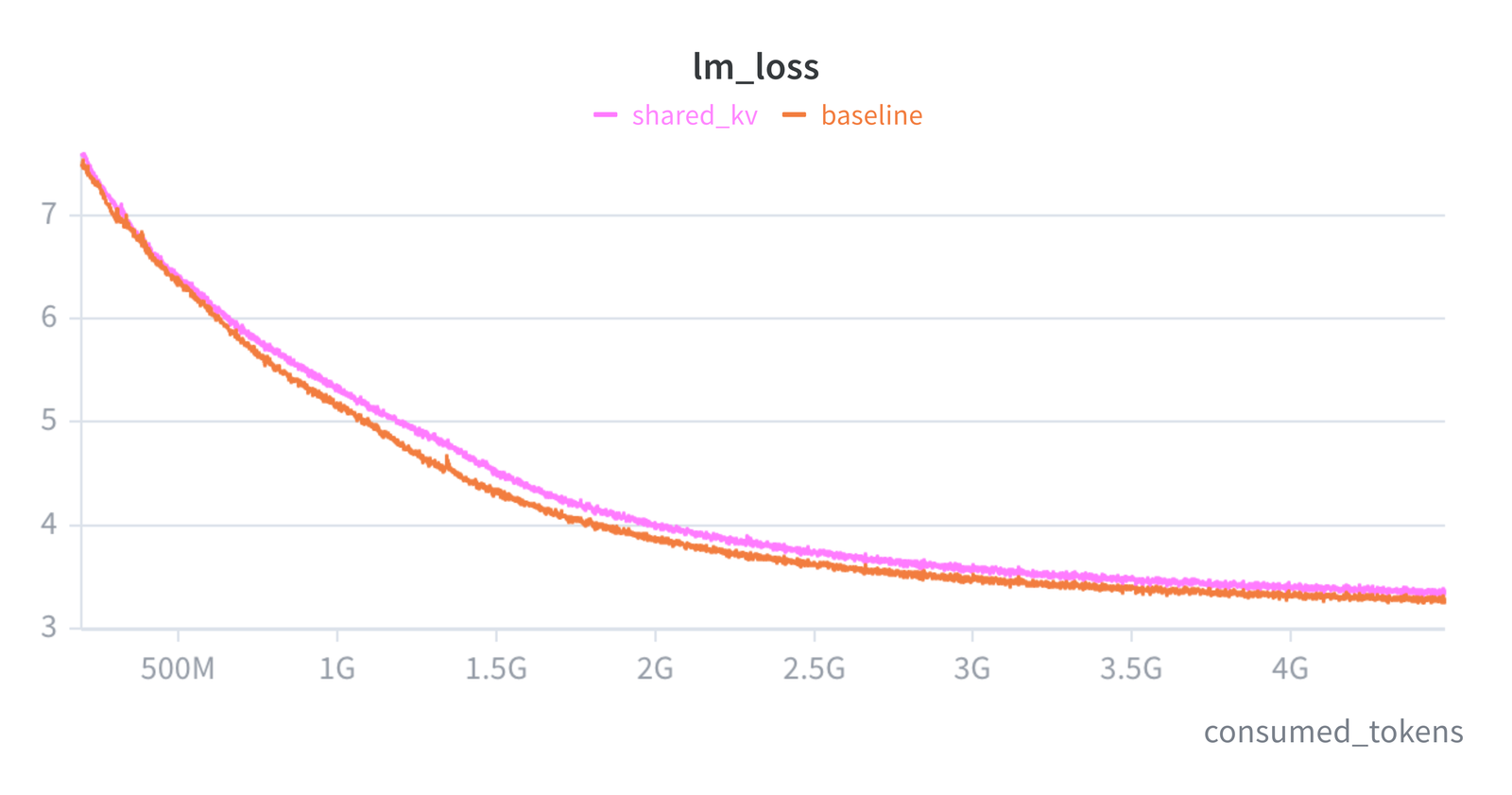
That failure is the whole justification for M_h existing at all: a learned, per-head, linear
reconstruction recovers head-specific content keys — H distinct key representations from only
G cached value streams — where the raw K = V shortcut collapses everything a group's heads
see into one vector.
The cache layout, and the reconstruction step
No kernel or reference implementation is public yet (more on that below), so there's no repo to quote. This is a direct transcription of the paper's cache-size equations (§3.4) and its Algorithm 1 into code, faithful to the math, not benchmarked:
# Persistent KV-cache tensors, per layer. G = kv groups, T_max = max sequence
# length, d_h = head dim, d_r = shared positional width.

# GQA — two grouped streams (paper, Eq. 3): N_GQA = 2 * T * G * d_h
k_cache = torch.empty(B, G, T_max, d_h, dtype=torch.bfloat16)
v_cache = torch.empty(B, G, T_max, d_h, dtype=torch.bfloat16)

# GVA — one grouped value stream + one small SHARED positional-key stream
# (paper, Eq. 13): N_GVA = T * (G * d_h + d_r). Note this is not grouped —
# one k_rope per token, reused by every head, not one per group.
v_cache      = torch.empty(B, G, T_max, d_h, dtype=torch.bfloat16)
krope_cache  = torch.empty(B,    T_max, d_r, dtype=torch.bfloat16)
# M_h (H of them, each d_h × d_n) are ordinary model weights — never cached.
# One decode step for query head h (paper, Algorithm 1 / Eqs. 8-11).
# M_h is a learned weight, resident with the model, not the cache.
def gva_decode_step(x_t, W_q, W_v, W_r, M_h, R_t, v_cache_g, krope_cache):
q = x_t @ W_q # (d_n + d_r,)
q_nope, q_rope = q[:d_n], q[d_n:]
q_rope = q_rope @ R_t.T # rotate the positional slice only
v_t = x_t @ W_v # (d_h,) — appended to v_cache_g
k_rope_t = (x_t @ W_r) @ R_t.T # (d_r,) — shared, appended once per layer
q_tilde = q_nope @ M_h.T # absorb M_h — ONCE per token, not per position
content_scores = q_tilde @ v_cache_g.T # (T,) — reads only the value cache
rope_scores = q_rope @ krope_cache.T # (T,)
scores = (content_scores + rope_scores) / math.sqrt(d_n + d_r)
return scores.softmax(dim=-1) @ v_cache_g # (d_h,)The q_tilde = q_nope @ M_h.T line is the whole trick: one small matmul per head, per decoded
token, independent of context length T. The actual attention computation —
q_tilde @ v_cache_g.T, an inner product against every cached position — is O(T) and memory-
bandwidth-bound the way it always is. The reconstruction overhead sits alongside it as a fixed
O(d_n · d_h) cost per head that doesn't grow with context, so on paper it shouldn't eat into the
bandwidth win. Nothing in the paper measures whether that holds on real hardware — see below.
What it actually saves: the calculator
The paper's own arithmetic (§3.4): GQA caches 2 · T · G·d_h scalars per layer; GVA caches
T · (G·d_h + d_r). Divide, and the ratio is 1/2 + d_r / (2·G·d_h) — half, plus a small tax
for the shared positional slice. At the widths the paper tests, that tax is a few percent, which
is where "45–47% smaller" comes from. It checks out exactly: I get 46.9% and 45.3% (rounding to
47% and 45%) backing out G·d_h ≈ 256 from the two reported figures, which is consistent with a
single small G·d_h across both d_r settings, as the paper's wording implies.
Percent of scalars isn't the number that decides whether a request fits on a GPU, though — bytes are. Drag the knobs below; the formulas are the paper's, in bytes, at layer counts and head widths from real production models rather than the 350M-parameter research config the paper itself trains at:
At the default 8-KV-head / 128-dim width (Llama-3-8B and Llama-2-70B both use it), GVA saves 49% of GQA’s cache — a bit better than the paper’s own 45–47%, because the fixed 16-scalar positional slice is a smaller tax on a wider cache. MLA, at DeepSeek-V2’s own reported width, saves 72% — comfortably more than GVA at any width tested here. None of this counts the reconstruction map M: it is a model weight, absorbed into the query once per decoded token, and never touches the cache.
The reduction actually improves at production scale, not the reverse: GVA's tax is a fixed
d_r (16 or 24) added to a G·d_h that grows with the model, so the tax shrinks as a fraction —
roughly 49% saved at an 8-head-group, 128-dim config, versus the paper's own 45–47% at their much
narrower research setting. What doesn't improve is the comparison with MLA: at DeepSeek-V2's own
reported cache width, MLA saves closer to 72% against the same GQA baseline — GVA lands in
between GQA and MLA on bytes, not past MLA. GVA's own framing is explicit about the tradeoff: it
keeps the value as the literal persistent state rather than projecting into a separate joint
latent, which is simpler to reason about and to absorb, but it doesn't compress as hard as a
learned bottleneck does.
None of this byte accounting includes the reconstruction matmul, because — per the walkthrough above — it's a fixed per-head, per-token cost that doesn't scale with cache size. Whether that theoretical near-zero overhead survives contact with an actual kernel is exactly what's unmeasured (again, see below).
The headline number, checked
The number this method gets quoted with is a comparison against GQA and MLA on five zero-shot
benchmarks at 350M parameters, 30B FineWeb-Edu tokens. Checking it against the arXiv source
directly turns up something worth flagging on its own: the paper's own number is 44.35, not
44.18. A 44.18 figure circulates on at least one third-party paper-mirror site, but it appears
nowhere in the arXiv HTML of either the original submission or the current revision — I fetched
both directly and grepped the full text. The real gap, straight from Table 2, is 44.35 − 44.36 = -0.01 — smaller than the popularly quoted -0.18, and the revised abstract says so explicitly:
"a gap of 0.01 points, within seed variation."
That phrase is the thing actually worth checking. The paper reports three runs per configuration, each with a different random seed, averaged — real methodology, better than a lot of small-scale ablation work bothers with. But it never reports the per-seed values or a standard deviation, despite its own limitations section warning that "small differences should not be interpreted as statistically significant without assessing variability across seeds." So "within seed variation" is asserted, not shown.
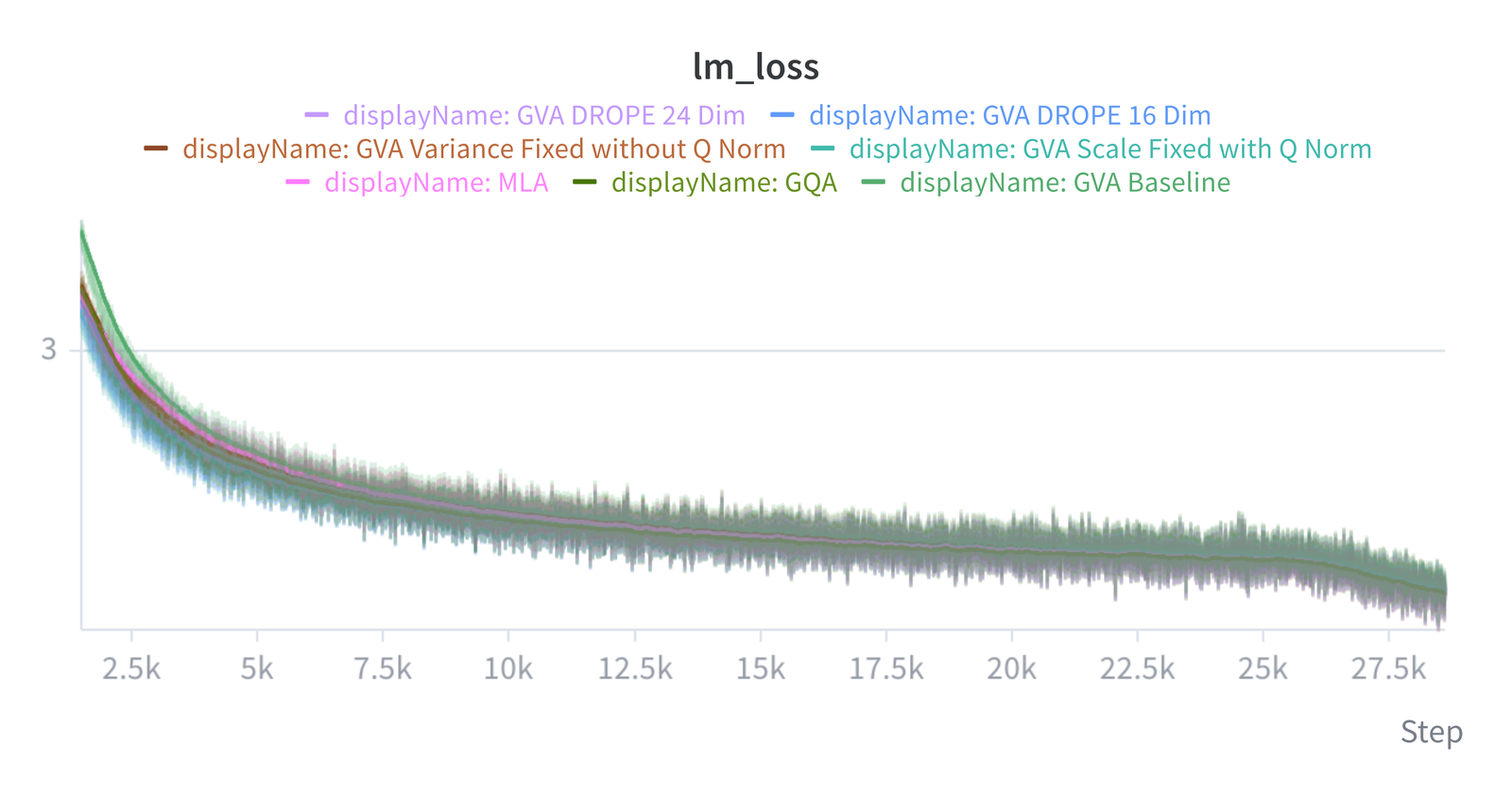
The loss curves alone would tell you these models are indistinguishable. Table 2 is where the separation actually shows up — and it's worth seeing exactly how much of it there is, and how it compares to the -0.01 headline. What the table shows, honestly:
The proposed row (bold) sits 0.01 points below GQA — but the seven GVA variants the paper itself trained, changing only initialization and query normalization, already span 0.64 points. And GQA and MLA — two methods nobody disputes are different architectures — land 0.48 points apart in this same run. The paper reports three random seeds per configuration and averages them, but never publishes the per-seed spread, so there is no error bar to put on any of these dots — only the honest fact that 0.01 is small next to everything else moving in this table.
Every dot above is the paper's own reported number. The 0.01-point GVA-vs-GQA gap is real, but it's dwarfed by two things that are also real and also in this table: the 0.64-point range across GVA's own seven trained variants (same data, same token budget, differing only in initialization and normalization — exactly the kind of small-scale noise the "seed variation" line is gesturing at), and the 0.48-point gap between GQA and MLA, two methods nobody would call equivalent. None of this makes the paper's claim false. It makes "matches GQA" a claim that would benefit from an actual variance number the paper doesn't provide — the central thing to check, and the thing that stays unresolved after checking it.
The full table, for reference (bold = best per column, as in the paper):
| Method | HellaSwag | WinoGrande | OBQA | ARC-E | ARC-C | Avg. |
|---|---|---|---|---|---|---|
| GQA | 43.41 | 52.48 | 33.40 | 63.42 | 29.09 | 44.36 |
| MLA | 43.20 | 51.61 | 34.60 | 62.87 | 27.13 | 43.88 |
| GVA, baseline init | 42.12 | 52.96 | 34.80 | 61.95 | 27.73 | 43.91 |
| GVA, scale-matched + Q-norm | 42.05 | 53.51 | 34.40 | 62.75 | 29.35 | 44.41 |
| GVA, variance-fixed, no Q-norm | 42.71 | 53.35 | 32.20 | 62.33 | 28.24 | 43.77 |
| GVA + DRoPE, d_r = 24 | 42.94 | 53.12 | 33.20 | 63.69 | 28.50 | 44.29 |
| GVA + DRoPE, d_r = 16 (proposed) | 42.69 | 53.35 | 33.60 | 63.81 | 28.32 | 44.35 |
Averaged over three seeds per row; per-seed values not published.
Worth noting since it's easy to miss reading only the headline row: the paper's strongest GVA configuration isn't the proposed one. Scale-matched GVA with query-RMSNorm hits 44.41 — better than GQA — but drops the decoupled-RoPE positional slice, which means it can't use the absorbed decode path and falls back to reconstructing a position-dependent key every step. The proposed 44.35 row is the one that keeps the systems property (absorption, no key materialization); the one that beats GQA on this table doesn't.
What's established, and what isn't
350M parameters and 30B tokens is a genuinely small-scale study, and the paper's own limitations
section says so without hedging: one model scale, one data mix, three seeds, no sweep of RoPE
width, no context-length sweep. That's a normal, honest place for architecture research to stop —
it is not a scandal that a new mechanism gets validated small before it gets validated big. But
it bounds what the result means. MLA's advantages over GQA are documented mainly at production
scale and long context — DeepSeek-V2's own comparisons run at
tens of billions of parameters, not hundreds of millions — and nothing in the GVA paper tests
whether the accuracy parity it reports at 350M holds at 7B, 70B, or past a few thousand tokens of
context. The d_r sweep is two points (16 and 24); the cache-width sweep is effectively one
(whatever G·d_h ≈ 256 corresponds to in their config). Established: a linear reconstruction
from grouped values, with a scale-matched initialization and a decoupled RoPE channel, tracks
GQA's training loss and lands within a fraction of a point of it on five small-model benchmarks,
with a real (if unmeasured for variance) methodology behind the number. Not established: that any
of this holds at a scale or context length anyone would actually deploy.
What exists today
Working backward from "coming soon" to what's actually checkable right now:
- Decoding kernels. None released. The paper says custom decoding kernels have been developed and it is "currently testing their inference performance," with an open-source release "planned soon" — nearly the same sentence recurs in the abstract, the introduction, the limitations section, and the conclusion. No repository is linked anywhere in the paper.
- Hugging Face artifacts.
FrontiersMind/GVAexists, but it's a paper landing page — no weight files, no listed model size, downloads not tracked. It documents the method; it isn't a model you can load. - The one thing that IS real and downloadable is
FrontiersMind/Lumma-0.6B-Base, a genuine 600M-parameter checkpoint with safetensors weights on the Hub. But read its own paper citation carefully: it implements the shared-KV ablation —K = V, no learned reconstruction — which is the variant Figure 3 above shows failing to match the GQA baseline, and which the paper states outright is "not a proposed system." There's also an open (unmerged) pull request adding nativetransformerssupport for the Lumma architecture — again the shared-KV design, not the decoupled-RoPE GVA that gets the 44.35 number.
So: today, the thing you can actually download implements the ablation the paper itself recommends against, and the thing the paper recommends has no released code at all. That's not a criticism of the research — the loss curves and the accuracy table are real, checked results — it's just the honest state of "kernels coming soon": a paper with a well-specified method, not yet a deployment option.
The take
The idea underneath GVA is clean: if a key and a value both encode "content," maybe you don't need to store both, you need a way to recover one from the other, and MLA already showed how to make a learned recovery map free at decode time by absorbing it into the query. GVA applies that same absorption trick to the simplest possible map — one linear transform per head, not a shared low-rank bottleneck — and gets most of MLA's systems property (no materialized key) without MLA's compression. What that buys you: values stay literal, easier to reason about, easier to absorb, a smaller reconstruction than MLA's up-projection. What it costs: a cache reduction that tops out well short of MLA's, at scales this paper doesn't get to.
The number that will actually decide whether this matters is the one the paper doesn't have yet: measured decode throughput against GQA and MLA on a real kernel. Until that exists, the honest summary is a well-verified architecture result — the mechanism is sound, the arithmetic checks out, the loss curves converge — sitting on top of an accuracy claim that needs an error bar it doesn't have, and ahead of a systems claim it hasn't tried to make yet.
Built on Grouped Value Attention: Efficient KV Caching via On-Demand Key Reconstruction (Vishesh Tripathi, Abhay Kumar, Ramsha Khan; FrontiersMind, 2026), arXiv:2609.13285v2, revised 2026-09-15. Figures 1, 2 and 3 and the results table are reproduced from the paper; all cache-size and accuracy numbers are taken directly from its equations and Table 2. The "44.18" figure quoted in some secondary coverage does not appear in either arXiv revision of the paper — checked directly against the primary source.