2026-10-02 · 12 min · explainer · rust · agents · gpu · systems · open-source
Dmitriy Kovalenko (@neogoose_btw, who lists himself at OpenAI) released
fframes last week with a line that is easy to misread:
a 128-second launch video "vibed in 48 minutes and rendered in 36 seconds." The framework is five years
old and had never shipped, he says, because its API was "so complicated and verbose that noone will ever
learn it" — and the thing that changed is that an agent, handed a skill, does not mind verbose. The
motivating complaint is concrete: people wait 12 hours for a render, and he had something faster sitting
unreleased.
I cloned it at 7bbec12 and read the parts that make the claims true: the svgr! macro, the Skia render
cache, the libav linkage, and the benchmark against Remotion. Every number below is labelled measured
(I read it out of the code or counted it), reported (the repo or author says so and I did not re-run
it), or reasoned (my arithmetic on the other two). It is MIT, written in Rust, and had 1,831 stars
when I pulled the repo metadata (measured, GitHub API, 2 October 2026).
- license
- MIT
- branch
- main
- tests
- 20 files
- source
- 2.9 MB
- commit date
- 2026-10-02
by size of tracked source at this commit, file counts in brackets; docs, data and vendored trees excluded
local clone, 2026-10-02 at 7bbec12 — branch, commit, commitDate, fileCount, hasTests, languages, license, licenseFile, shallow, testFileCount
shallow clone: counts describe the pinned tree, not the history
A video is a function of the frame index
Programmatic video starts from one idea: a video is a pure function from a frame index to a frame. Give me
i, I give you the picture at i, and nothing about frame i depends on frame i − 1. Remotion builds
that frame as a React tree in a headless browser. Motion Canvas builds it with
a canvas generator. fframes builds it as an SVG tree returned by a Rust function.
The contract is a trait. You implement Video — frame rate, dimensions, duration, an audio map, and the
one method that matters:
impl Video for HelloWorldVideo<'_> {
    const FPS: usize = 30;
    const WIDTH: usize = 1920;
    const HEIGHT: usize = 1080;

    fn render_frame(&self, frame: Frame, ctx: &FFramesContext) -> fframes::Svgr<'_> {
        fframes::svgr!(
            <svg viewBox="0 0 1920 1080" width={ctx.current_video_size.width} height={ctx.current_video_size.height}>
                <rect x="400" y="400" width="200" height="200" fill="blue"
                    transform={frame.animate(fframes::timeline!(
                        at 0., animate Transform::translate(0, 0) => Transform::translate(200, 480), Easing::Linear,
                    ))} />
                <text x="100" y="440" font-size="74">
                    {format!("This frame index: {}, second: {:.2}", frame.index, frame.seconds())}
                </text>
            </svg>
        )
    }
}
That is the whole model. svgr! is a JSX-like macro that produces an Svgr — an SVG document — and
frame.animate(timeline!(…)) is just a function of frame.index that returns the interpolated transform
for this frame. There is no retained scene graph, no mutable state threaded between frames, no diff against
the previous frame. Ask for frame 850, you get frame 850.
Scrub the index below. The square's x and the dot's cy are functions of i; the fill, the geometry and
the viewBox are constants. That split is the whole performance story, and I will come back to it.
- static, cached
- viewBox, width, height, fill, cx, r
- dynamic, recomputed
- x, cy, the text content
The coloured strings are the only ones that change frame to frame. The macro hashes the rest at compile time and the renderer replays the painted path, so a static subtree is drawn once and reused, not rebuilt.
The reason this shape suits an agent is not that Rust is fashionable. It is that a pure function of i is
deterministic, diffable and snapshot-testable. The same index always paints the same bytes, so a frame
can be compared to an approved PNG and a one-pixel regression fails a check. This is the same property I
leaned on reading Voxel Musou, whose "deterministic fixed 60 Hz" let me reason about
a 9,254-line game without running it, and the same one that makes the pipelines in
one-shot launch videos legible: when a frame is computed from a clock and
nothing else, the behaviour lives in data you can read, not in a render you have to watch.
What makes it fast
Three things, and they are independent. A honest reading keeps them apart, because the benchmark exercises only one of them.
Static markup is hashed at compile time. This is the clever part and it is easy to miss. When svgr!
expands your markup, it walks the tree and assigns a static_hash to every node whose lexical content is
fully known at compile time — a node with no {expression} in it or its children. A node that reads the
frame gets None. From svgr-macro/src/nodes_to_svgtree.rs (measured): the hash mixes the tag, the static
attributes and the static children, and the macro is careful about inheritance — a dynamic fill on a
parent poisons its descendants, because fill is inherited and changes how they render, so they cannot be
static either.
At render time the Skia backend keeps a RenderCache keyed by that hash (measured,
fframes-skia-renderer/src/render/mod.rs). It caches converted skia_safe::Paths, fill and stroke
Paints, and — the big one — a recorded skia_safe::Picture of an entire static subtree. The comment in
the source is blunt about why: "Replaying a picture is dramatically cheaper than re-traversing the subtree
and re-issuing every draw call." A background, a logo, a grid that never moves: painted once, replayed for
every remaining frame.
There is a subtlety the code handles that a lazier cache would get wrong. A node's static_hash is stable,
but its final appearance can still change between frames — it might inherit a colour from a dynamic parent
produced by a different svgr! call, or reference a gradient that is itself animated. So before any cached
entry is reused, the renderer compares a cheap runtime fingerprint of the resolved node against the one
it cached, and rebuilds instead of replaying if they differ (measured, render/fingerprint.rs). The
compile-time hash is the fast key; the fingerprint is the correctness check. This is the kind of detail that
separates a benchmark toy from something you would trust on a real timeline.
The GPU rasters. The Skia backend draws on Metal on macOS and Vulkan elsewhere, and the README reports it is "about 10× faster than the built-in CPU backend" (reported — I did not measure the GPU path, and as you will see, neither did the benchmark). Note what fframes does not do: it does not write GPU kernels, the way the Rust-on-GPU work in CUDA Rust does. It hands an SVG tree to Skia and lets a mature rasterizer use the device. A recent commit, "hand frames to the encoder on the GPU," keeps the rastered frame on the device and feeds it to the encoder without a round trip back to main memory (reported).
libav is linked, not shelled out. fframes links ffmpeg's libav libraries statically through
ffmpeg-sys-fframes (measured, fframes-media/Cargo.toml) rather than spawning an ffmpeg process and
piping frames to its stdin. No per-frame process boundary, no PNG-encode-then-decode just to hand a picture
across. This is the unglamorous half of "fast" and the half most tools get wrong.
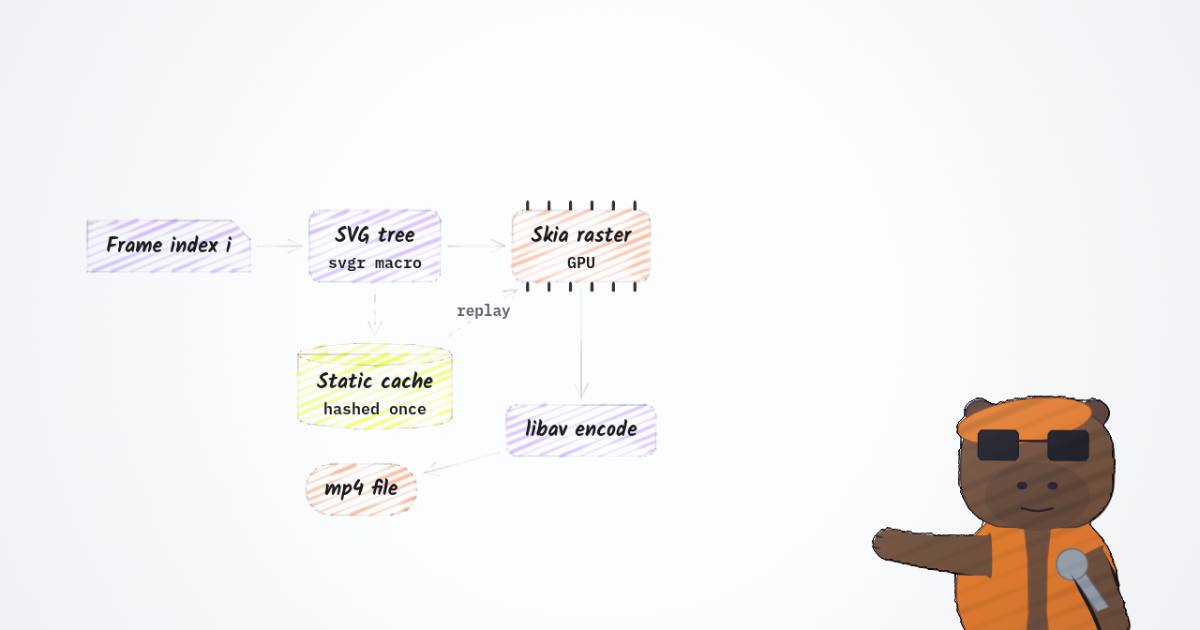
Here is the pipeline end to end, and where the cache sits:
frame.index ─▶ svgr!  ─▶ Skia raster ─▶ libav encode ─▶ .mp4
   (i)          SVG tree   (GPU)           (linked)
                   │
            static_hash ──▶ RenderCache (paths, paints, pictures)
                            replayed, not rebuilt
Built for an author that cannot watch
The framing that makes fframes interesting is not the speed, it is who it is for. An agent cannot watch a video or hear a soundtrack, so fframes ships a command line that turns a video into things an agent can read: PNGs, text and numbers. The commands I found in the README and the project skill (reported):
inspectwalks a frame every 0.25 s and the first and last frame of every scene, and reports missing fonts, text clipped by the canvas, invalid SVG and panics — each with its time and scene, exit code 2 on errors. An agent runs this instead of looking.striplays evenly spaced frames on one contact sheet;onionblends frames to show a motion's path and easing;framewrites full-size PNGs. Three ways to see motion without a video player.audio analyzereports loudness in LUFS, true peak, clipping and silence, per scene.snapshotcompares the current frames to approved PNGs and marks what changed in a.diff.png. This is the determinism cashed out: a visual regression test for video.render --draftencodes one scene at half size in about a second (reported), so the loop between "change a number" and "look at the result" is short.
Read that list as a design, not a feature table. Every item exists because the author is an LLM that reads rather than watches. It is the same instinct behind the skills I pulled apart in one-shot launch videos: the interesting engineering is in the harness that lets a model check its own output, not in the one-shot generation everyone screenshots.
The 31× number, traced
The README leads with "render it on the GPU" and "31.16× faster than Remotion." Those are two different claims, and the benchmark supports only part of one of them.
I read render-bench/vs-remotion rather than running it (I do not execute third-party repos). The scene is
fixed and synthetic (measured): 99,000 one-pixel rectangles and 1,000 changing text digits on a 1000×1000
canvas, 30 frames, both renderers running serially with no video encoder instantiated. Both load the same DM
Sans font. The fframes side computes the content directly and rasters it with Skia; the Remotion side builds
it as a React tree in headless Chrome. The published result (reported, the committed table in the
benchmark's README.md — the runner's results.md summary is generated and gitignored — measured on
Linux ARM64 in Docker against Remotion 4.0.529):
| Renderer | Median for 30 frames |
|---|---|
| fframes + Skia CPU | 3.877 s |
| fframes + Skia GPU | skipped: no hardware GPU |
| Remotion | 120.801 s |
reasoned, not measured: README says the GPU backend is about 10× the CPU one, so roughly 0.39 s — the bar is a dashed placeholder
fframes + Skia on the CPU is 31.16× faster than Remotion here (120.801 / 3.877). That is the README’s headline, and it is real for this scene. It is also CPU versus CPU: the GPU, which is what “render it on the GPU” sells, was skipped because the benchmark box had no hardware device. And the Remotion side pays for 12 chained effect passes per element, a React pattern this workload leans into. Read the number as a floor for one synthetic scene, not as a general 31× over Remotion.
The division checks: Remotion's 120.801 s over fframes' 3.877 s is 31.16× faster (reasoned), exactly the
README's figure. So the number is real and the harness is reproducible — run.sh is in the repo. But three things keep it from meaning "31×
faster than Remotion" in general.
First, the GPU was never exercised. The benchmark box had no hardware device, so the GPU run printed
skipped and the 31.16× is fframes-on-the-CPU versus Remotion. The headline feature — Skia on Metal or
Vulkan — contributed nothing to the headline number. The GPU bar in the chart above is a dashed placeholder
for exactly this reason; the roughly 0.39 s it shows is my arithmetic on the README's "about 10×" claim
(reasoned), not a measurement.
Second, the Remotion side is doing a lot of self-inflicted work. Reading browser.jsx (measured), every
one of the 100,000 elements is wrapped in a component with 12 chained useDerivedFrame hooks — twelve
dependent effect-and-commit passes before the element reaches its final value. That is 1.2 million effect
passes per frame, a pattern that stresses React's reconciliation and commit model about as hard as anything
could. The README is honest that "results apply to this React workload with many effects," but the headline
is not, and most readers will only see the headline.
Third, it is one scene, chosen by the author of the tool it flatters. A wall of one-pixel rects is close to the best case for a cache-and-raster pipeline and close to the worst case for a retained virtual-DOM diff. Change the workload to a few animated SVG paths with gradients and real text layout and the ratio will move; nothing in the repo tells you where. This is the same failure mode I found in lexing on the GPU, where a real 3.03× win shrank to 1.86× once the host-to-device transfer the headline quietly excluded was added back. A benchmark is a claim about a workload, and the workload is always the fine print.
None of this makes fframes slow. 3.877 s for 30 frames of a 100,000-node scene on a CPU is a good number, and the architecture — compile-time static caching, direct libav — is sound engineering that would hold up on workloads the benchmark does not cover. The honest summary is narrower than the tweet: fframes is fast for structural reasons, and the one published comparison is a floor for one synthetic scene, measured CPU versus CPU.
The mirror
I have a specific reason to care, and it is worth stating plainly rather than pretending to neutrality. The
explainer films on this site — including the one for this article — are painted frame by frame in headless
Chromium with a Canvas2D engine. A film is, in that engine, a pure function of time: ask for the frame at
t, it paints it. That is the same contract as render_frame(frame), and the resemblance runs deeper than
the signature.
The site's painter cannot afford to re-run p5.brush on the GPU every frame, so it does what fframes does by
another route: it paints each brush stroke and shape once, keyed by its geometry, and lays the kept painting
down with a multiply blend on later frames. A static logo is painted once and composited; only what moves
is repainted. That is, almost exactly, fframes' compile-time static_hash cache — the same observation
(most of a frame does not change, so do not redraw it) reached independently by a drawing engine and a video
framework.
So fframes is the kind of pipeline that could, in principle, replace a Canvas2D painter: a Rust frontend
over Skia on a real GPU, encoding through linked libav, is strictly more machine than headless Chromium
drawing to a 2D context. I am stating that as an observation, not a plan. The site's look is not an SVG-tree
workload — it is boiling hand-inked linework, motion-blurred washes and per-stroke paper texture, none of
which falls out of svgr! for free. Porting the style would be most of the work, and the raster backend
the easy part. But the shape is right, and the convergence is the interesting thing: when you treat a frame
as a deterministic function of its index, the same cache falls out whether you write it in Rust and hand it
to Skia, or in a "use client" component and hand it to Canvas2D.
That is the quiet thesis under the launch video. Programmatic video that an agent can drive, check and ship
is a better fit for the way these tools actually get made than any timeline UI — not because the renderer is
Rust, but because a frame that is a pure function of i is a frame a machine can reason about. The 31× is
marketing. The function is the point.