2026-08-14 · 5 min · inference · pricing · agents · api
Why read this
Nichelast 15%Arcee's API post read for its one strategy sentence and its price list: output multipliers from 2x to 5x re-rank the catalog for output-heavy agent work.
- Concrete numbers to act on
Inference & servingAPI onlyProprietaryIntro teardown
How this was scored
- Is it new?
- 0 of 3: Repackaging or news of a known thing
- Can I trust it?
- 1 of 3: Spot-checks a few numbers
- Can I run it?
- 1 of 3: API-only, gated or restrictive licence
- Will I understand it?
- 0 of 3: Describes, no mechanism
- Can I act on it?
- 2 of 3: A concrete recipe, numbers or comparison
- Will it last?
- 0 of 3: News that expires in weeks
- Does it affect many?
- 1 of 3: A specialist community
- Only here?
- 1 of 3: Some original analysis
Score 26 of 100, ranked 437 of 445 rated articles. Each question is answered 0–3 by hand, and a 3 is rare. How articles are scored
Arcee's Open Models API beta post is labelled a 1 min read, and that is accurate. It announces that the API now serves models beyond Arcee's own Trinity family, lists six of them, gives a price table, and offers $5 in credits.
Worth reading anyway, for one sentence and one table.
A model lab watching what you pick
The stated motivation is not the usual one:
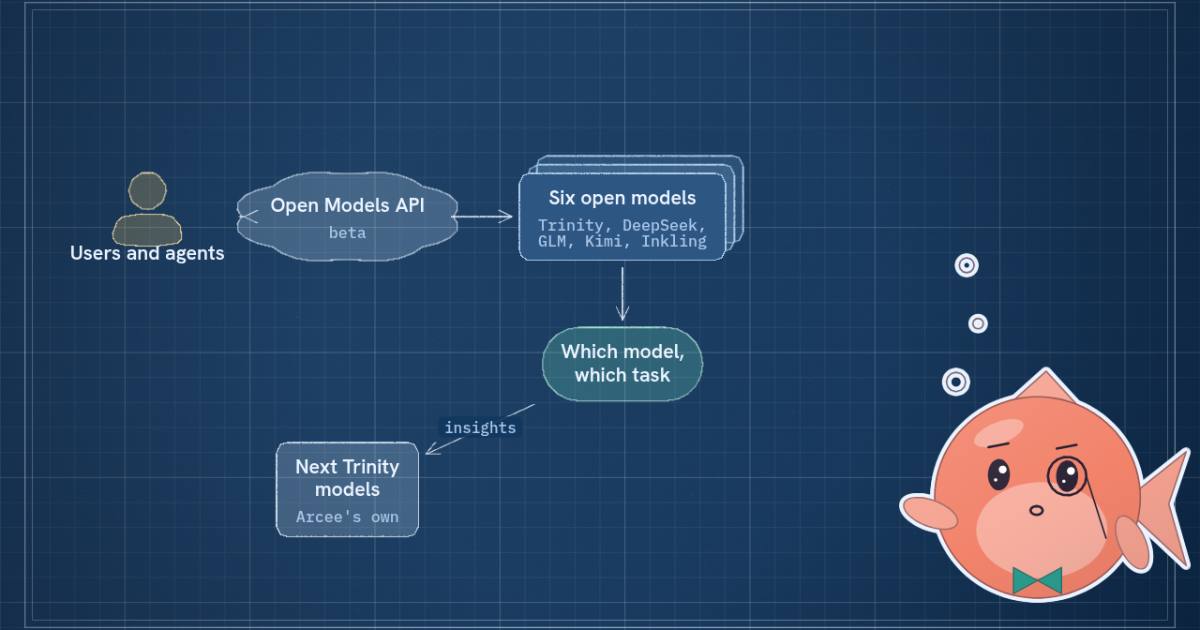
It also helps us better understand why people choose a particular model for a particular task. When the API is used across our products, we can learn which models users prefer for a given task, and more importantly, why they chose them.
Those insights will help us consistently develop and deliver Trinity models that are exceptional, diverse, and widely adopted.
Arcee trains models. It is now serving DeepSeek's, Z.ai's, Moonshot's and Thinking Machines' — and saying plainly that a reason to do so is to learn where its own are not chosen.
That is an honest description of an inference business as a research instrument, and it is unusual to see written down. Most labs that add competitors' models to their API describe it as customer choice and stop there. The reasoning is sound: a lab with no serving surface only learns about its models from benchmarks and complaints, while a lab that routes real workloads sees substitution behaviour — which model people reach for when the task is long, which when it is cheap, which when it has to be right.
The launch catalog:
- Trinity-Large-Thinking (Arcee's own)
- DeepSeek-V4-Pro (Preview) and DeepSeek-V4-Flash-Latest
- GLM-5.2 — the base that GLM-5.3 was post-trained from
- Kimi-K3
- Inkling-Small, from Thinking Machines, which the post goes out of its way to call "another American lab advancing the frontier of open-weight models"
That last aside is doing some positioning work: four of the six are Chinese labs, and Arcee names the American one specifically.
The table is more interesting than the announcement
The output multiplier is the number the price list does not draw attention to, and it ranges from 2× to 5× across six models. DeepSeek-V4-Flash and V4-Pro both charge exactly double for output; Kimi K3 charges five times. That means the ordering you get from skimming input prices is not the ordering you pay. Kimi K3’s input price is 21× DeepSeek-V4-Flash’s, but on a generation-heavy job the bill is 50× — the multiplier more than doubles the gap. And GLM-5.2 overtakes DeepSeek-V4-Pro on that mix despite being the cheaper of the two to read.
Prices are per million tokens, and the number the list does not draw attention to is the ratio between them:
| model | input | output | output ÷ input |
|---|---|---|---|
| deepseek-v4-flash-latest | $0.14 | $0.28 | 2.0× |
| deepseek-v4-pro | $1.74 | $3.48 | 2.0× |
| inkling-small | $0.50 | $1.20 | 2.4× |
| trinity-large-thinking | $0.25 | $0.80 | 3.2× |
| zai-org/glm-5.2 | $1.40 | $4.40 | 3.1× |
| moonshotai/kimi-k3 | $3.00 | $15.00 | 5.0× |
Both DeepSeek models charge exactly double for output. Kimi K3 charges five times. That spread matters because the workload this API is being pitched at — long-horizon agent work, launched the same day as nac — has a token mix that shifts with the task, and the cheap-to-read model is not always the cheap-to-run one.
On a read-heavy job the ordering roughly follows input price. On a generation-heavy one it stops doing so. Kimi K3's input price is 21× DeepSeek-V4-Flash's, but at 5M in and 25M out the actual bill is 50× higher — the output multiplier widens the gap by more than double. And GLM-5.2 overtakes DeepSeek-V4-Pro on that same mix (95.70) despite being the cheaper of the two to read.
Arcee's own Trinity-Large-Thinking is priced to sit second-cheapest on input and to stay cheap on output — 0.80, undercutting Inkling-Small on both. For a lab measuring which model people choose, pricing its own model into the "obvious default" slot is a thumb on the scale worth noting when reading whatever conclusions come out of the experiment later.
Launched alongside nac
The post is explicit that this ships the same day as nac, Arcee's open-source agent harness, and that the two are meant to inform each other:
We built nac to support demanding agentic workloads that may run for extended periods, and over time, what we learn from nac will help us improve how the API routes, serves, and supports models for long-running tasks.
The pairing is the actual strategy. nac is Apache 2.0 and free; it is also a very good instrument for observing long-horizon agent workloads, because its architecture forces every unit of work through a named dispatch with a recorded episode. An orchestrator that plans in one model and dispatches workers to another is a natural place to learn which models are chosen for which kind of step.
One detail from the nac repository suggests the catalog is not settled: the most recent commit at the time of writing is "drop minimax, trinity-mini, and trinity-large-preview from arcee register." Three models removed from the client-side catalog on launch day.
What this is not
It is not a technical post. There is no routing architecture, no latency or throughput figure, no serving stack detail, no context-length or rate-limit table, no availability or region information. "Beta" is doing real work in the title.
There is also no evaluation of any of the six models, which is a slightly odd absence given the stated purpose is to learn which is best for what. The learning is planned to come from usage, not from measurement — which is a legitimate choice, and one that only produces useful answers if the pricing does not distort the selection it is measuring.
Read it for the strategy sentence and the ratio column. The rest is a price list.