2026-10-06 · 24 min · quantization · gguf · llama-cpp · rust · reproducibility · developer-tools · diffusion
Why read this
Essentialtop 10%Checks every QuantUI-rs encoder against llama.cpp, comfy-kitchen and ModelOpt: exact bytes, but the default outputs are not what the README promises.
- Original, source-checked analysis
- Runs on a laptop CPU
- Interactive explanations
Quantization & compressionMITPractitioner tool
How this was scored
- Is it new?
- 1 of 3: An incremental tweak
- Can I trust it?
- 3 of 3: Reproduces the headline result, or shows from primary files it is wrong
- Can I run it?
- 3 of 3: Open, permissive, runs on reader hardware with instructions
- Will I understand it?
- 3 of 3: Mechanism carried by interactives built from real code or data
- Can I act on it?
- 2 of 3: A concrete recipe, numbers or comparison
- Will it last?
- 1 of 3: Relevant for months
- Does it affect many?
- 1 of 3: A specialist community
- Only here?
- 3 of 3: The only place this analysis exists
Score 76 of 100, ranked 39 of 445 rated articles. Each question is answered 0–3 by hand, and a 3 is rare. How articles are scored
The post that sent me here was four lines long: "One static Rust binary that quantizes, converts, and casts models. No Python, no torch, no runtime dependencies," followed by a list of formats, INT8, FP8, MXFP8, NVFP4, f16, bf16, f32, q4_k_m, q8_0, q6_k, iq4_xs, and "ComfyUI ready output."
A quantizer is a strange thing to rewrite. Its output is a few billion integers and a few million scales, and nothing inside the file tells you whether they are right. If two tools disagree in the last bit of one scale you will never see it, and if they disagree in the meaning of a scale you will see it as a blurry image or a model that forgets how to count. So the interesting question about a from-scratch quantizer is never "is it fast". It is "right according to whom?"
QuantUI-rs has an unusually precise answer printed at the top of its README: "output is byte-exact
against the Python/torch and llama.cpp references on every default path." I wanted to know which
references, how you even get byte-exactness out of floating-point code written in two languages,
and whether "ComfyUI ready" means ComfyUI loads it.
| Repository | wildminder/quantui-rs, commit d2cced6 (2026-10-05), release v0.3.1 |
| Licence | MIT, with the ported llama.cpp notice in LICENSE |
| Size | 27,226 lines of Rust in src/, 52,587 with tests; 781 #[test] functions |
| Commands | quantize (ComfyUI safetensors), gguf, cast, validate, info |
| Binaries | static musl builds for Linux x86-64 and ARM64, plus macOS and Windows, about 1.5 MB compressed |
| Sibling | wildminder/quantui, the Python TUI it was ported from |
- license
- MIT
- branch
- main
- tests
- 245 files
- source
- 2.4 MB
- commit date
- 2026-10-05
by size of tracked source at this commit, file counts in brackets; docs, data and vendored trees excluded
local clone, 2026-10-06 at d2cced6 — branch, commit, commitDate, fileCount, hasTests, languages, license, licenseFile, shallow, testFileCount
shallow clone: counts describe the pinned tree, not the history
Byte-exact against whom
The README says "the Python/torch reference". The source is more specific, and the specifics matter, because there are four different references depending on what you ask for:
- INT8 and FP8 are ports of convert_to_quant
(ctq), the Python tool most ComfyUI quantized checkpoints come from, and of the streaming driver
in the Python QuantUI. But only of ctq's
--simplepath. ctq's default is an SVD-based learned rounding ("Skip SVD optimization, use simple quantization" is how its own--helpdescribes--simple). QuantUI-rs accepts--simple"for reference compatibility (always on)" and has no learned rounding at all. - MXFP8 and NVFP4 follow ComfyOrg's comfy-kitchen eager CPU kernels, the same code ComfyUI dequantizes with. The NVFP4 module header notes the goldens have to be generated with CUDA hidden, because the CUDA kernel divides by multiplying with a reciprocal and lands on different E2M1 codes at ties.
- The legacy GGUF types (F16, BF16, Q8_0, Q4_0, Q4_1, Q5_0, Q5_1) are checked against
gguf-py, 49 of 49 golden cases. - K-quants and i-quants are checked against
llama-quantize, but only when an importance matrix is supplied. More on that below, because it is where the "every default path" claim breaks.
What impressed me is how far the port goes to match the Python bytes. Look at the INT8 row-wise scale, and the comment that explains why it is not written the obvious way:
// crates/quant-core/src/quant.rs:100-119 (abridged)
// On row 3 of the conv_net fixture (row_max = 0.11627197265625):
// IEEE `127.0/max` = 0x44888889 but torch emits 0x44888888 —
// 1 ULP off correct rounding — and the golden dequant scale
// 0x3a700001 follows. Plain IEEE division diverged on 29/128
// rows (and cascaded into qdata ties: 3/16384).
let quant_scale = 127.0f32 * (1.0f32 / clamped);
let dequant_scale = 1.0f32 / quant_scale;
torch computes a CPU scalar divided by a tensor as the scalar times the reciprocal, which rounds twice.
QuantUI-rs reproduces the double rounding on purpose. The MXFP8 kernel does the same kind of thing
for torch.ceil(torch.log2(x)): torch takes the log in f32, so a value a few ULPs above a power of
two gets the lower exponent, and the Rust computes the log in f64 and rounds it to f32 to match
(quant_mxfp8.rs:90). The bias-correction path goes further still: it ports torch's MT19937
generator, its Box-Muller sampler and the AVX2 sincos256_ps and log256_ps polynomials from
avx_mathfun.h, plus oneDNN's habit of resetting the GEMM accumulator every 128 elements of K.
All of this buys a real property: for the paths it covers, the Rust
output and the Python output are the same file. It also defines exactly what "exact" can mean. The
bias-correction numerics match torch 2.13 on an AVX2 machine; the header names Vectorized<f32>::size() = 8
as an assumption. A torch build using 16-wide AVX-512 vectors sums in a different order, and then
torch no longer agrees with itself, let alone with the port.
Four formats, one row of weights
Before checking where the bytes go, it is worth being clear about what each ComfyUI format stores, because the formats differ in one design choice: how many weights share a scale, and what the scale is allowed to be.
INT8 is the plain one. Take a block, find its largest magnitude, divide by 127, round every weight to the nearest integer step, half to even, and clamp to ±127. There is no −128; the grid is symmetric. QuantUI-rs's default block is a 128×128 tile with one F32 scale, which costs about 8.002 bits per weight. Row mode keeps one scale per output row instead.
FP8 E4M3 keeps the same per-tile scale but maps the tile's largest value to 448, the biggest
finite float8_e4m3fn, and rounds each weight to the nearest FP8 value. An FP8 grid is a float grid:
eight steps per power of two, so small weights keep relative precision that INT8's even spacing would
throw away.
MXFP8 shrinks the block to 32 weights along a row and makes the scale a pure power of two, one E8M0 byte. That costs 8.25 bits per weight. The interesting choice is the rounding of the exponent:
Rounding up guarantees the block's largest weight lands at or below 448 after scaling, so nothing
clips. The OCP MX specification instead uses , which uses the
whole range and lets the top values saturate. comfy-kitchen chose ceil
(comfy_kitchen/backends/eager/quantization.py:299-303), and QuantUI-rs copies it. On a
1024×1024 Gaussian matrix I counted where the two rules disagree: 16.8% of blocks, which are exactly
the blocks whose largest value would have clipped under the spec's rule. The DEVELOPMENT notes
record that the 4/3 "scale compensation" from arXiv 2509.23202
was tried here and changed no output bytes, and this is why. Compensation exists to undo clipping, and
a round-up exponent never clips.
NVFP4 has two levels. Every 16 weights share an E4M3 scale byte, and the whole tensor shares one F32 scale:
E2M1 has eight magnitudes, 0, 0.5, 1, 1.5, 2, 3, 4 and 6, plus a sign. Four bits per weight plus eight bits of scale per 16 weights is 4.5 bits per weight. The figure from the MR-GPTQ paper puts the two microscaling formats side by side:
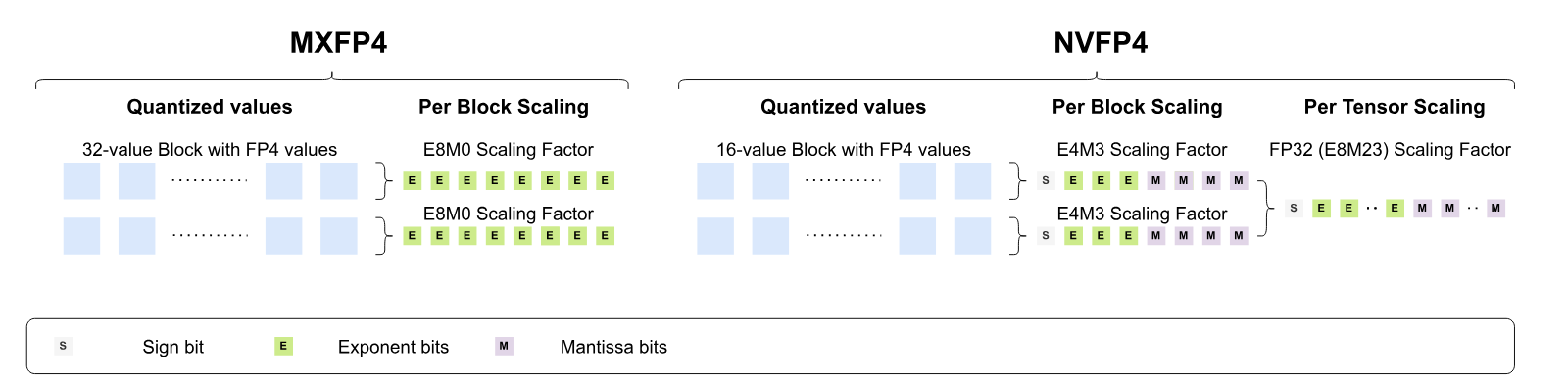
The formula hides one detail. The block scale is rounded to the nearest E4M3 value, and E4M3 has only three mantissa bits. About half the time the scale rounds down, and then the block's largest weight divides out to slightly more than 6 and clips. In my numpy re-implementation of the parity path, 50.9% of blocks on a Gaussian matrix and 51.1% on a Laplace matrix clip their largest weight. ModelOpt does the same thing (I compare the two below), so this is the format as everyone ships it, not a QuantUI-rs bug. But it is exactly the slack the one quality mode in the tool goes after.
The widget runs one row of 32 weights through re-implementations of all four encoders. Boost weight #7 into an outlier and watch what each format gives up. INT8's even step widens for all 32 weights. FP8 and MXFP8 shift their whole grid up but keep relative precision for the small weights. NVFP4 coarsens only the 16-weight block that holds the outlier; the other block keeps its own fine scale.
- tensor scale s_T (F32)
- 4.464e-5
- block 0 scale (E4M3)
- 0x6D = 104 × s_T
- block 1 scale (E4M3)
- 0x74 = 192 × s_T
- relative L2 error
- 7.31%
- clipped weights
- 0
Parity path: the block scale is rounded to the nearest E4M3 value, so about half the time it rounds down and the block max clips at 6.
The search that earned its place
nvfp4_l2 is the only opt-in format that the repo's own measurements kept. Its idea is short: for
each block, try the E4M3 scale bytes around the one the parity path picked, re-encode the 16
weights at each, and keep the byte with the lowest squared error. Then refit the tensor scale by
least squares for the chosen codes, and repeat, three times in all.
The long comment in quant_nvfp4.rs:337-415 is the best thing in the repository, because it
explains why the obvious version of this does not work. The reconstruction depends only on the
product , and halving an E4M3 value is exact until it reaches the subnormal
range, so you can double , halve every block byte, and not change a single decoded value. An unconstrained search has nothing
to stop it drifting: "A prototype observed +32939% before anything objected." The flatness ends only
when the halved block scales start falling into E4M3's subnormal range and rounding to zero. So the
search is fenced in twice: each block may only move four E4M3 codes from its anchor (about half an
octave either way), and may only move by a factor of 4.
The same comment records a bug that is worth knowing about if you ever write one of these. The input is rounded through bf16 before encoding, because the reference pipeline does that. The first version scored its error against those rounded values, and for a one-element tensor holding 0.27318907 it happily "improved" to zero error by reconstructing the bf16 value 0.2734375, which is 2.5e-4 away from what the user passed in. The shipped version picks codes from the rounded values and scores them against the original ones.
The README claims 17.7% lower aggregate L2 error, and 21–26% on uniform and Gaussian data. I re-implemented only the per-block half of the search (fixed , eight neighbouring bytes) in numpy on a 4096×4096 matrix. It cuts the squared error by 23.0% on Gaussian weights and 18.1% on Laplace weights. So the claim is in the right range, and most of the gain comes from un-clipping the half of the blocks that clip.
Two things the number does not say. It is weight-space error with every weight counted equally:
there is no activation statistic and no importance weighting, and the crate never runs a model, so
there is no perplexity or image-quality result behind it. The output is also not byte-exact with
anything, and the run says so on its parity: quality-tuned line, which is the right way to ship
a deviation.
Rotations, and the one that ComfyUI can't see
int8_convrot rotates each row's weights by a group-wise Hadamard matrix before row-wise INT8,
the trick from QuaRot and ConvRot: a rotation spreads an
outlier's energy across its group, so the absmax that sets the scale drops. The matrix is built from
a 4×4 base whose rows each sum to 2, Kronecker-multiplied up to 256 (convrot.rs:61-100), rather
than the Sylvester construction whose first column is all ones. The ConvRot paper's figure shows why
that column matters: the standard transform piles the row-wise outliers onto one channel.
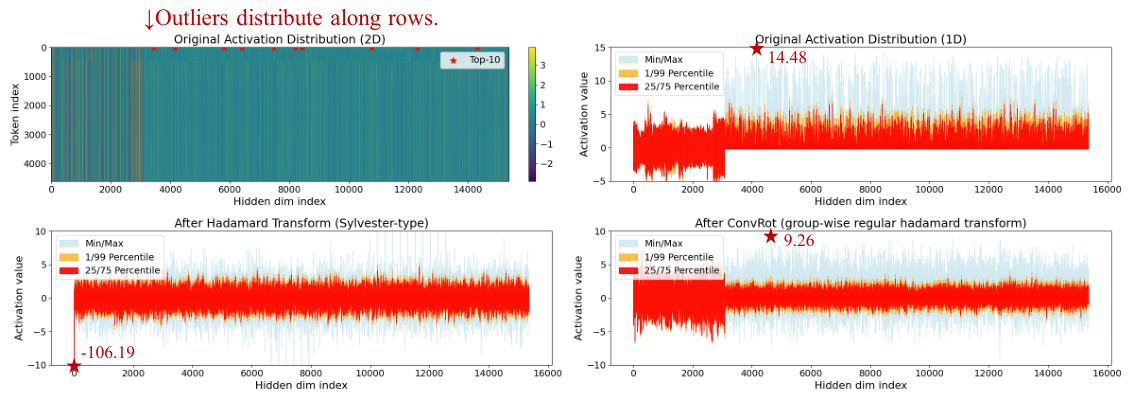
A rotation only works if the inference side rotates the activations by the same matrix. For
int8_convrot it does: the blob carries "convrot": true, "convrot_groupsize": 256, and ComfyUI's
loader reads both keys (comfy/ops.py:1237-1241).
nvfp4_rot16 is the same idea at group size 16, aligned with the NVFP4 block. The blob it writes is
the plain nvfp4 blob. NVFP4's metadata has no rotation key, so ComfyUI loads the rotated weights,
does not rotate the activations, and computes the wrong product without raising anything. The README
does warn ("If the loader does not invert the rotation, the output is corrupt"), but the run prints
parity: exact, which is true of the quantizer and misleading about the file.
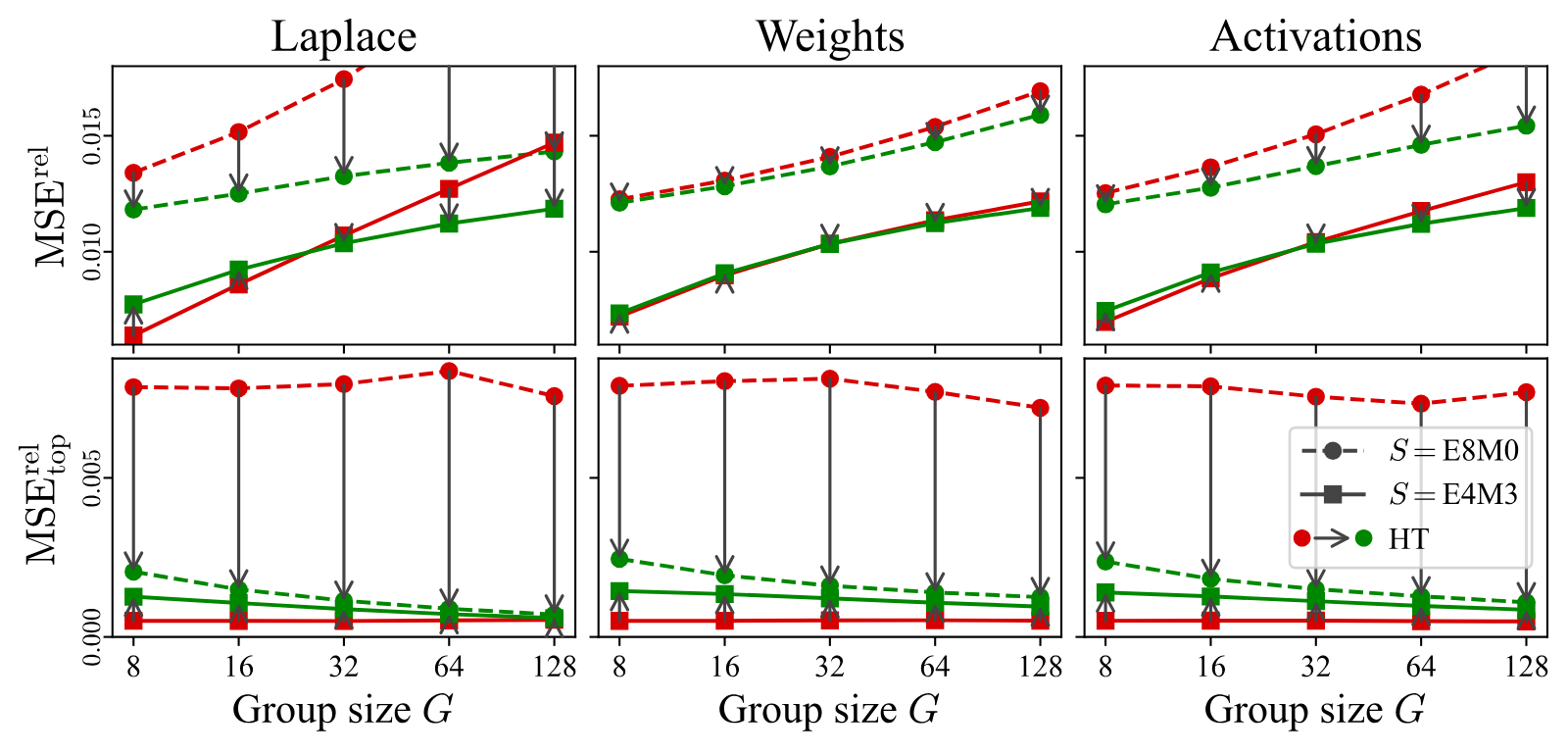
I am also not convinced the rotation would help if a loader did invert it. The MR-GPTQ paper's own measurements for the E4M3-scaled format, the solid lines in its Figure 3, show the Hadamard barely moving the error on real Llama weights at group size 16, and raising it on Laplace samples at small group sizes:
What "ComfyUI ready" means, and where it isn't
ComfyUI's quantized checkpoints are ordinary safetensors with a convention on top. For each quantized
layer there is the weight, its scale tensors, and a small uint8 tensor named <layer>.comfy_quant
holding a JSON object. When ComfyUI sees any .comfy_quant key it switches to its mixed-precision ops
(comfy/utils.py:1434-1439), and each layer's loader reads the JSON and looks its format up in a
table:
# comfy/ops.py:1202, 1211 (ComfyUI master, 0b5b009)
module.quant_format = layer_conf.get("format", None)
...
qconfig = QUANT_ALGOS[module.quant_format]
QUANT_ALGOS (comfy/quant_ops.py:211-264) registers float8_e4m3fn, float8_e5m2, nvfp4,
mxfp8 (only when comfy-kitchen reports MXFP8 support), int8_tensorwise, convrot_w4a4,
asym_w4a8_int8 and w6a8_int8. Nothing else, and the lookup has no fallback.
Now the default. quantui-rs quantize model.safetensors, with no flags, means INT8 with block scaling
at block size 128 (commands/quantize.rs:43-44), and the encoder writes this blob for every
quantized layer (stream.rs:1188-1194):
{"format": "int8_blockwise", "orig_dtype": "torch.bfloat16", "group_size": 128}int8_blockwise is not in the table, so the loader raises KeyError on the first quantized layer.
FP8 defaults to block scaling too, and writes float8_e4m3fn_blockwise; its row mode writes
float8_e4m3fn_rowwise. Neither is registered. The repository knows this. Its contract test for the
ComfyUI loader builds an int8_blockwise file, asserts it is fatal, and says in its doc comment:
"This is a real, currently-unflagged incompatibility" (tests/comfy_loader_contract.rs:167-171). The
README still lists "ComfyUI INT8 / FP8" as the first line of output formats without saying which
scaling modes stock ComfyUI can read.
The format strings come from ctq, whose README thanks a contributor "For ComfyUI int8_blockwise
support", so some loader somewhere reads them. I could not find it in ComfyUI master. If you rely on a
custom node, check that it is installed wherever the file is going. The validate --comfy command in
QuantUI-rs does flag these files as fatal; plain validate passes them, because it checks the
encoder's contract rather than the consumer's.
The widget walks the combinations and shows the blob each writes, what the loader does with it, and what the bytes are pinned to.
$ quantui-rs quantize model.safetensors
- .comfy_quant blob written per layer
- {"format": "int8_blockwise", "orig_dtype": "torch.bfloat16", "group_size": 128}
- ComfyUI loader
- stock ComfyUI raises KeyError at load (int8_blockwise is not a key of QUANT_ALGOS, and ops.py:1211 indexes it with no .get())
- bytes are pinned to
- convert_to_quant --simple, through the reference streaming quantizer (whole-file bytes)
This is what quantui-rs writes when you pass no flags at all. Its own test file calls it a real, currently-unflagged incompatibility.
For stock ComfyUI the formats that load are --format int8 -m row or -m tensor,
--format int8_convrot, --format fp8_e4m3 -m tensor, --format mxfp8 and --format nvfp4
(the last two need comfy-kitchen in the ComfyUI environment).
NVFP4 here is not ModelOpt's NVFP4 file
NVIDIA's Model Optimizer is the other NVFP4 implementation people
will compare this with, so I put the two side by side. The arithmetic agrees. ModelOpt computes the
tensor scale as reduce_amax(input).float() / (E2M1_MAX * E4M3_MAX) (nvfp4_tensor.py:208) and the
block scale as per_block_amax / (E2M1_MAX * weights_scaling_factor_2) (:195), then casts to E4M3
with round to nearest. comfy-kitchen, and QuantUI-rs after it, divide in a different order,
(block_max / 6) / s_T, which could in principle round differently. I implemented both in numpy and
ran them over a 4096×4096 Gaussian matrix and a Laplace one, 1,048,576 blocks each: every scale byte
and every E2M1 code came out identical.
The file layout does not agree:
# ModelOpt, modelopt/torch/quantization/qtensor/nvfp4_tensor.py:338
packed_weight = (q_weight[..., 1::2] << 4) | q_weight[..., 0::2]
// quantui-rs, crates/quant-core/src/quant_nvfp4.rs:237-240
// pack_uint4(hi_first=True): even index → high nibble.
let hi = encode_element(pair[0], total_scale);
let lo = encode_element(pair[1], total_scale);
row_q.push(hi << 4 | lo);ModelOpt puts the even-indexed weight in the low nibble; comfy-kitchen puts it in the high nibble.
QuantUI-rs also stores the block scales already swizzled into cuBLAS's 128×4 tiled layout, padded
to a multiple of 128 rows, where a ModelOpt export stores them as a plain [rows, cols/16] grid. And
ModelOpt clamps every block scale to at least 2^-9 before the cast (nvfp4_tensor.py:46), so a
nearly-empty block keeps a nonzero scale, where the comfy-kitchen path clamps only the top and lets
such a block round to a zero scale. None of this is wrong for ComfyUI, which reads comfy-kitchen's
layout. It does mean an NVFP4 file from this tool is not a drop-in for vLLM or TensorRT-LLM, even
though the numbers inside are the same. If you want the background on why NVFP4 has two scales at
all, the Nemotron NVFP4 and NVFP4 KV cache
pieces cover the format from the training and serving sides.
The GGUF half: a faithful port behind a flag
The gguf command is a different program wearing the same binary. It reads config.json for the
architecture, renames Hugging Face tensors to llama.cpp's (model.layers.0.self_attn.q_proj.weight
becomes blk.0.attn_q.weight), picks a type per tensor and writes the GGUF. The per-tensor policy is
a port of llama.cpp's llama_tensor_get_type, including the heuristic that decides which layers get
more bits:
// llama.cpp src/llama-quant.cpp:452-454 (master, abeada3)
auto use_more_bits = [](int i_layer, int n_layers) -> bool {
    return i_layer < n_layers/8 || i_layer >= 7*n_layers/8 || (i_layer - n_layers/8)%3 == 2;
};
For Q4_K_M that sends attn_v and ffn_down to Q6_K on the first eighth of layers, the last eighth,
and every third layer in between, and leaves the rest at Q4_K (llama-quant.cpp:590-591, 651).
llama_policy.rs reproduces that tree, with the per-category counters it depends on.
The encoders are where it gets interesting. A Q4_K block is 256 weights in eight sub-blocks of 32. Each sub-block gets a 6-bit scale and a 6-bit minimum, the block gets two fp16 multipliers (one for the scales, one for the minimums), and each weight is a 4-bit code: 144 bytes for 256 weights, 4.5 bits each. The quality lives in how you choose each sub-block's scale and minimum, and llama.cpp has two versions of that choice:
// ggml/src/ggml-quants.c:1476-1477, quantize_row_q4_K_ref (no importance matrix)
for (int l = 0; l < 32; ++l) weights[l] = av_x + fabsf(x[32*j + l]);
scales[j] = make_qkx2_quants(32, 15, x + 32*j, weights, L + 32*j, &mins[j], Laux, -1.f, 0.1f, 20, false);

// ggml/src/ggml-quants.c:1577, 1584, quantize_row_q4_K_impl (with one)
for (int l = 0; l < 32; ++l) weights[l] = qw[l] * sqrtf(sigma2 + x[32*j + l]*x[32*j + l]);
scales[j] = make_qkx3_quants(32, 15, x + 32*j, weights, L + 32*j, &mins[j], Laux, -0.9f, 0.05f, 36, false);
Both run an iterative search over candidate scales, 20 steps without an importance matrix, 36 with.
QuantUI-rs ports the second one, line for line (gguf_quants.rs:375-488), and the IQ4_XS engine,
quantize_row_iq4_nl_impl, the same way, down to the order of the floating-point multiplications. It
does not port the first one. Without an --imatrix, every K-quant goes through the rlx-gguf crate
(gguf_convert.rs:1292), whose K-quant encoders describe themselves, in the words QuantUI-rs quotes, as
a "Simplified per-sub-block quantizer; valid output but lower quality than upstream's iterative
search."
So the default gguf run, -m q4_k_m with no importance matrix, is not byte-exact with
llama-quantize. The repo says so plainly in a test header, tests/gguf_unweighted_parity.rs: "It
is NOT a byte-parity test against llama-quantize. That oracle does not exist for this path." The
CLI prints a warning with the cost measured on 20 tensors of YuE2-3B at Q2_K, relative L2 error
against the bf16 source: 0.32985 for the simplified path, 0.26936 for the weighted port, and 0.29840
for a published GGUF of the same model. The README's capability table still files q2_k through
q6_k under "usable, no imatrix" with the parity column "byte-exact vs llama-quantize", and the
contract line still says every default path is exact. Those two lines are wrong for the most common GGUF invocation the tool has.
The suggested fix is to pass an all-ones importance matrix, which routes everything through the
weighted port. That works, with two catches. An all-ones imatrix in llama.cpp is not the same as no
imatrix (the weight becomes sqrt(sigma2 + x²) instead of av_x + |x|, and the search runs 36 steps
instead of 20), so the result matches llama-quantize handed the same all-ones file, not plain llama-quantize. And
the all-ones file comes from tools/make_uniform_imatrix.py, a Python script that reads tensor names
out of a GGUF you have already produced, so the no-Python story ends at the second step.
Two smaller things. QuantUI-rs refuses iq4_xs, iq4_nl and iq3_s without an importance matrix,
citing llama-quantize "refuses the same conversion". llama.cpp's tensor_requires_imatrix
(llama-quant.cpp:856-875) only requires one for IQ3_XXS, IQ2_XXS, IQ2_XS, IQ2_S, IQ1_M, IQ1_S and
Q2_K inside a Q2_K_S file; IQ4_XS without one falls back to weights. The stricter gate matches
Unsloth's list rather than llama.cpp's. And the llama-quantize used as the oracle was built with
MSVC and -DGGML_NATIVE=OFF -DGGML_FMA=OFF (tools/build_llamacpp.sh:54). A default Linux build
compiles ggml as GNU C with -march=native, and GCC's default for GNU C lets it fuse sumqx += w*q*x into a
fused multiply-add, which rounds once instead of twice. I did not run both builds, but I would not
assume a natively built llama-quantize lands on the same bytes at every rounding tie.
A bias correction that corrects nothing
Every quantize run that meets a layer with a bias adjusts that bias, and this is where the most
elaborate porting in the repository goes: the MT19937 generator seeded with 233983427, the
Box-Muller sampler, oneDNN's GEMM accumulation order. The algorithm, from ctq's
fp8_conversion.py:325 and :751-753, is:
Bias correction is a real technique: if a layer's inputs have a nonzero mean , quantization shifts the output mean by , and folding that into the bias removes it. But the inputs here are standard normal, with mean zero. The expected correction is exactly zero, and what is left is sampling noise with a standard deviation of for output .
I checked the size in numpy on a 1024×1024 matrix with standard deviation 0.02, quantized to INT8 with 128×128 blocks. The RMS of the correction was 1.70% of the RMS per-output error that a single unit-Gaussian input sees; predicts 1.8%. Harmless, then. But it is a random perturbation of the bias, with no information about the model's real activations in it, and the torch RNG port exists so that the perturbation is the same random one ctq would have added.
What I would use it for
The cast command is the cleanest thing here, and the one I would recommend without conditions.
Merging a sharded Hugging Face model into one bf16 file is a common chore, and it does it the careful
way: same-dtype tensors are copied byte for byte, never round-tripped through f32 (which can quiet a
NaN payload); an f16 cast that would overflow past 65504 is an error naming the tensor, not a silent
infinity; f64 input is refused rather than double-rounded; the output is written to a temporary file
and renamed only at the end.
For ComfyUI, use it with flags. The formats that load in stock ComfyUI are listed above; int8 -m row
and int8_convrot are the INT8 options, nvfp4 is the 4-bit one, and nvfp4_l2 is worth trying when
4-bit quality is the constraint, with the caveat that its gain is measured in weight space. Leave
nvfp4_rot16 alone until a loader advertises support.
quantui-rs quantize model.safetensors model-int8-row.safetensors --format int8 -m row
quantui-rs quantize model.safetensors model-nvfp4.safetensors --format nvfp4
quantui-rs validate model-int8-row.safetensors --comfy
For GGUF, the weighted K-quant and i-quant ports look faithful, and if you already have an importance
matrix from llama-imatrix, passing it gets you llama.cpp's encoders without a C++ toolchain. Without
one, q8_0 and the other legacy types are exact, and the K-quants are a simpler encoder that the CLI
honestly warns about. Then check what you got. The writer sets the architecture, the
hyperparameters it can read from config.json, general.name and general.quantized_by
(gguf_convert.rs:284-296), and no tokenizer.ggml.* keys at all; the README lists this among its
boundaries. llama.cpp reads tokenizer.ggml.model as a required key (src/llama-vocab.cpp:2057), so
a text model converted here will not open in llama-cli until something adds a vocabulary. The
README's own worked examples compare tensors against Unsloth's GGUFs; they never load one.
Speed is not the reason to switch. The README's own benchmark, a 1 GiB fixture on a 24-core machine, puts end-to-end INT8 streaming at 4.10 s against 4.80 s for the Python reference, 1.17x, with the kernel alone at 1.86x. Everything runs on the CPU, and the one open issue on the repository is a request for GPU support. The win is installation: a static binary of about 2.6 MB (1.5 MB as a release archive) instead of a torch environment.
What I keep coming back to is how much honesty is already in the repo, in the wrong places. The test
that says int8_blockwise won't load, the test that says the default K-quant path has no oracle,
the DEVELOPMENT notes that record three rejected ideas with their measured failures: a reader of the
source learns all of it. A reader of the README, which is where the "byte-exact on every default path"
line and the format list live, learns none of it. The stable-diffusion.cpp
quantizer had the same kind of gap between its flag and what it did to convolutions. If you are
building a pipeline on either, read the code path for the flags you actually pass.
How I checked
I shallow-cloned wildminder/quantui-rs at d2cced6 and read the library (crates/quant-core/src),
the CLI and the test headers that state what each path is compared against; line counts and test
counts are from wc and grep over that tree. I did not build or run the binary. ComfyUI's loader is
read from master at 0b5b009 (comfy/ops.py, comfy/quant_ops.py, comfy/utils.py), comfy-kitchen
from be003b7 (backends/eager/quantization.py), ModelOpt from 33e3117
(modelopt/torch/quantization/qtensor/nvfp4_tensor.py), llama.cpp from abeada3
(ggml/src/ggml-quants.c, src/llama-quant.cpp), convert_to_quant from 5d2f539, and PyTorch's
Float8_e4m3fn.h from main, which saturates overflow to 448 as QuantUI-rs does. The seven arXiv ids
cited in the README and DEVELOPMENT notes all resolve to papers with the titles and topics the notes
describe; I read the relevant sections of the two whose figures appear here.
The measured numbers are from my own numpy re-implementations of the arithmetic I read, not from
running anyone's code: the NVFP4 comparison with ModelOpt and the clipping rate (4096×4096 Gaussian
and Laplace matrices, standard deviation 0.02), the per-block search gain on the same matrices, the
MXFP8 ceil-versus-floor count (1024×1024 Gaussian), and the bias-correction noise (1024×1024, 3072
samples). The YuE2-3B relative errors, the 1 GiB timings and the 17.7% are the repository's own measurements; I could
not reproduce them without the models and the reference outputs. Whether a custom ComfyUI node
somewhere loads int8_blockwise files I could not establish.