2026-09-22 · 19 min · edge-inference · tool-calling · quantization · fine-tuning · calibration · explainer
Cactus has published the fine-tuning guide for Needle 3, and it does the thing a guide should: it tells you what the free path does not do. Two sentences, in a section called "What a fine-tune does not change":
The confidence head. Local fine-tuning does not train it, so
needle buildleaves it out of the archive andNeedle(weights=...)reportsconfidenceasNone, with one warning.
That is the whole article, in a sense, and it is stated plainly by the vendor rather than dug out. What is not stated is how much is being handed over in that sentence, why it cannot be otherwise, and what the local path costs in bytes on top of it. So I went and read the weights.
| Local | needle finetune · LoRA r=16 on five attention projections, base frozen · 4-bit export · no confidence head |
| Platform | needle platform finetune · full model, every depth from 2 layers up · your data mixed with Cactus's own · 2-bit · head retrained on your tools |
| Checked here | Cactus-Compute/needle3 safetensors header and .cact tensor directory, cactus-needle 3.0.4 source |
| Not checked | anything requiring the engine to run, or a platform key |
What the confidence head actually is
Needle's confidence guide describes the score, not the head:
confidenceis the minimum of two signals. A calibrated post-hoc head scores the full prompt together with the call the model just produced; that is a judgement on the finished call, not a guess made before decoding. The second signal is the decoding probability of the call tokens themselves.
The head itself is six tensors in the published checkpoint, and reading them takes two range requests — eight bytes for the safetensors header length, then the header:
confidence_head/probes       F16  [21, 4, 768]
confidence_head/gain         F16  [21, 4]
confidence_head/query        F16  [4, 768]
confidence_head/row_bias     F16  [4, 21, 4]
confidence_head/proj/kernel  F16  [3072, 1]
confidence_head/proj/bias    F16  [1]
Every dimension there is legible. 21 is the embedding output plus each of
the twenty blocks — the head reads the residual stream at every depth. 4 is
mhc_lanes, and config.json carries confidence_probes: 4 and
confidence_queries: 4 to confirm it. 768 is the model width. 3072 is
4 × 768, and it projects to 1.
One output. out_dim is literally 1 in the source — class ConfidenceHead(ProbeHead): key, code, out_dim = "confidence_head", 2, 1.
Whatever is happening in between, the entire forward pass over the prompt and
the finished call collapses to a single scalar.
The head reads the residual stream at every depth — the embedding plus each of the 20 blocks — and jax.lax.stop_gradient sits between it and the backbone. Training the head cannot move a single weight of the model it is judging.
Each (depth, lane) pair scores every non-padding position, softmaxes over the sequence, and pools it into one 768-vector. The prompt and the finished call are both in that sequence, so this is a judgement about a call that already exists.
A second softmax, this time across depth and lane rather than across time. A sliced subnetwork masks the rows for blocks it does not run to −∞, so the same head renormalises over whatever depths are present.
out_dim is 1. The whole forward pass collapses to a single scalar, and the score you read is the minimum of its sigmoid and the decode probability of the call's own tokens.
The middle of it is probe_pool in needle/model/architecture.py, and it is
two attention passes stacked. First, each of the 84 (depth, lane) probe vectors
scores every non-padding position, softmaxes over the sequence, and pools it
into one 768-vector — 84 summaries of the whole trace, one per place in the
network you could look. Then four query vectors attend over those 84 summaries,
softmaxing across depth and lane this time, and the four pooled results
concatenate into 3072 and project to the logit.
Two details in that code matter more than the shapes.
The head reads the backbone under stop_gradient.
# needle/model/architecture.py
def _head_cells(self, tokens, quant=False, window=0, sink=None, exit_depth=None):
    cells = jax.lax.stop_gradient(
        self.hidden_cells(tokens, quant=quant, window=window, sink=sink,
                          exit_depth=exit_depth))
    keep = (tokens != self.config.pad_token_id).astype(jnp.float32)
    return cells, keep, ladder_row_keep(self.config, exit_depth)
Training the confidence head cannot move a single weight of the model it is judging. It is a detached read-out, in the literal sense.
And the row mask is how one head serves nineteen models. ladder_row_keep
returns a 21-vector that is 1 for the embedding and for every block whose ladder
rank is below the exit depth, and probe_pool sets the masked rows to
-inf before the second softmax. Slice the network to eight layers and the head
renormalises over the nine rows that still exist. It is a small, neat piece of
engineering, and it is the reason needle build --layers 8 can keep a
confidence head at all: ladder_slice gathers the right rows out of probes,
gain and row_bias, and the head comes along.
The whole thing is 71,077 parameters — 0.059% of the model's 121,021,910 — and 37,276 bytes in the shipped archive, 0.105% of the file. The entire calibrated half of the refusal contract weighs less than the tokenizer.
What it optimises
One logit, sigmoid, and a score you are told to threshold. The objective is a binary one and the target is not hard to name: was this finished call correct? The head is a learned verifier over the trace that produced a call — not a confidence estimate read off the decoder, which is the other term of the minimum, and which the engine takes separately.
That split is the design, and the guide is clear about the failure mode it buys:
A call is accepted only when both agree, so the failure mode is escalation rather than wrong execution: a fluent call the head doubts scores low, and a call the head likes but the decoder stumbled through scores low too.
"Calibrated," then, is a claim about that one logit: that when its sigmoid reads 0.8, roughly 80% of the calls scoring 0.8 are right. Not ordered — calibrated. Needle 3 already established that no reliability diagram, ECE, Brier figure or false-positive rate is published anywhere to check it against, and the one illustration that gestures at it labels itself "illustrative calls." Nothing in the fine-tuning guide changes that. What it adds is a second, sharper question: a head calibrated on which model?
Why a local fine-tune cannot keep it
The checkpoint answers this itself. Its safetensors __metadata__ carries the
run that produced it, and one field is the whole story:
"merged_heads": [["confidence_head", 10000, "checkpoints/needle3d_qapt_ch.pkl"]]The head was trained in a separate run, from a separate checkpoint file,
and merged into the published weights at step 10,000. Combined with the
stop_gradient, that makes it a post-hoc artefact in the strictest sense: it was
never in the main training graph, so there is no gradient path by which your
LoRA could update it.
And what the package does is exactly what that implies. From
build_main in needle/model/finetune.py:
if ConfidenceHead.key in params:
    params = {k: v for k, v in params.items() if k != ConfidenceHead.key}
    print(f"  {'dropped':<9} the confidence head; it is not trained locally, "
          f"so confidence reports None")
The tensors are deleted from the parameter dict before export. The .cact
format spec is explicit about what that produces: "extra == 0 means no
heads" — the archive carries no head manifest at all, not an untrained one. The
Python wrapper then detects the absence by walking the tensor directory, warns
once at construction, and overwrites response["confidence"] = None on every
reply.
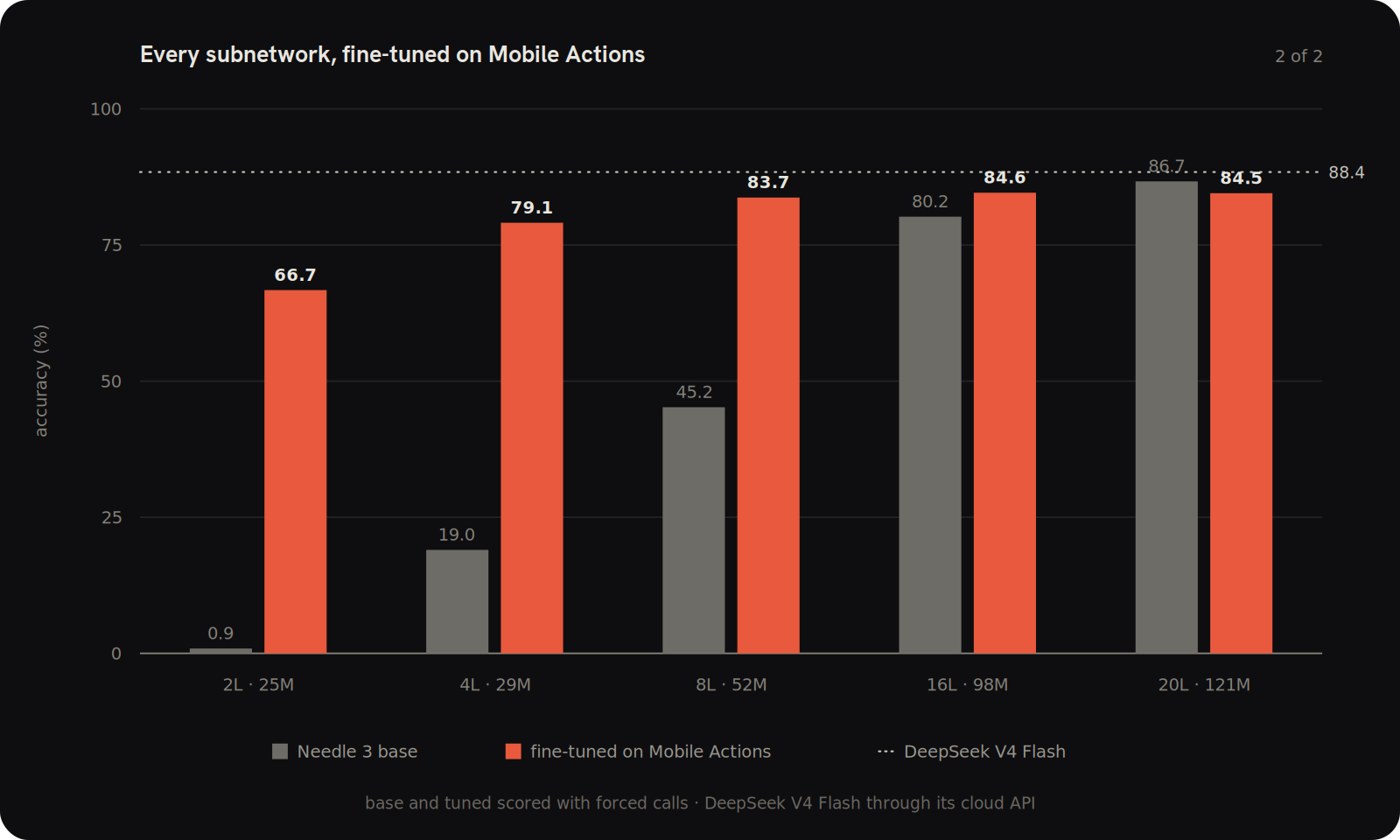
Notice that deleting is the honest option. A head fitted to the base model's error distribution, applied to a model whose accuracy just moved 18 to 36 points on DroidCall, is not a calibrated head — it is a head predicting failures that no longer happen, at a threshold you are being told to route on. Shipping it would be worse than shipping nothing. The platform's answer is the only other correct one: retrain the head with the model, on your tools.
How far the ground moves is Cactus's own chart. Needle 3 carried its DroidCall panel; this is the other one.
What is left of "empty list, not a guess"
Needle 3's refusal contract is three mechanisms, and the earlier piece took them apart. A local fine-tune removes exactly one, and it is the only one that produces a number.
`needle build --lora` deletes confidence_head from the parameter dict, so the archive carries no head manifest at all. The Python wrapper reports confidence as None and warns once. What the engine's 0.1 floor now compares against — the decode probability alone, or nothing — is not documented anywhere I could find.
Two of the three are code and survive. The third is the only one that produces a number, and it is the one the free path removes — not by accident, but because the head was never in the training graph to begin with. Cactus’s own advice for the gap is to run two models: “keep the base model for the decision and the tuned one for the call.” That is a reasonable workaround and it is also the shape a 121M-parameter model was supposed to replace.
The grammar's empty call and the rule-based grounding gates both live outside
the weights, so both survive. The confidence floor does not, and here I have to
stop short of a claim I would like to make. The engine applies a hard floor of
0.1 inside needle_complete, redirecting anything below it into
suppressed_calls, before the Python layer ever sees the response. With the
head gone, min(head, decode probability) has one argument left. Whether the
engine then floors on the decode probability alone — which for a
grammar-constrained call is nearly always high, so the floor would effectively
stop firing — or does something else, is not documented in the guide, the format
spec or the package, and I did not run the engine to find out. It is marked
unknown above rather than guessed.
I flag it because there is a reported failure with exactly this shape.
GitHub issue #117 against
Needle 2 described a LoRA-tuned .cact where JAX greedy decoding on the exported
weights reproduced the trained refusal on eight held-out rows, while the native
engine, on bit-identical weights, emitted a real tool call on six of them —
"what's the capital of France?" producing a search_site call in the engine
and a correct refusal in JAX. Different generation, different engine version, and
the issue is closed with no visible comment thread. But it is the same workflow
(fine-tune locally, export, run), the same symptom (a call where a refusal was
trained), and the mechanism above is a plausible explanation that nobody has
ruled out in public. One printed suppressed_calls from a tuned archive would
settle it in a minute.
The bits, which nobody has counted
The guide says the local path exports at 4 bits and the platform at 2. The
package says something stronger. WEIGHT_BITS = 4 in
needle/model/quantize.py, and the packer refuses anything else outright:
def _cq_pack(w, bits, group):
    if bits != WEIGHT_BITS:
        raise ValueError(f"CQ packing supports bits={WEIGHT_BITS}; got bits={bits}")
There is no 2-bit packer in the installable package. Not disabled — absent. The
shipped needle3.cact was written by tooling you do not have, which is also why
its mixed embedding=4, mhc=4, default=2 scheme cannot be reproduced by
_tensors, whose signature takes a single bits.
So what does a locally tuned archive weigh? The shipped file answers it. One range request for the first 128 KiB reads the 196-byte header, the 28-float codebook and all 581 tensor records — dtype, shape, offset, byte length, group size and bit width for each. Seven are CQ4 (the embedding, the three lane-mixing maps, and the head's three matrices), 115 are CQ2, 456 are FP16, two FP32, one the raw tokenizer. Recompute every blob from Cactus's own documented CQ layout, align to 64 bytes, sum, and you get 35,335,380 bytes — the shipped file, to the byte, zero error. That reconstruction is what licenses the rest of the arithmetic.
The shipped 20-layer file is 35,335,380 bytes and this arithmetic reproduces it exactly. Rebuild the same weights through the local path and you get 63.44 MB, because every CQ tensor moves from 2 bits to 4.
The ladder is sold as a way to pick a size. The free fine-tuning path changes the size of every rung by a factor that grows with depth, from 1.54x at two layers to 1.80x at twenty — because the embedding table and the multi-lane gates are already at 4 bits in the shipped file, so the rungs carrying the most 2-bit tensors lose the most when everything moves to 4. The comparison that stings: a tuned 8-layer archive is 27.39 MB, within a couple of megabytes of what the platform charges for sixteen layers. Fine-tuning locally does not just cost you the confidence head. It costs you about half the ladder.
The shipped needle3.cact stores 115 tensors at CQ2 and 7 at CQ4, and its tensor directory reconciles to 35,335,380 bytes exactly. The locally installed cactus-needle package cannot write CQ2 at all — export.py raises on any bits other than WEIGHT_BITS, which is 4 — so a 20-layer archive built by `needle build --lora` is 63,437,076 bytes: 1.80x the shipped file, and with the confidence head deleted. Every row is arithmetic over the archive's own published directory records, cross-checked by reconstructing the shipped total to the byte.
| build | layers | weight bits | confidence head | bytes | MB (10^6) |
|---|---|---|---|---|---|
| shipped needle3.cact (reconstructed, 0 byte error) | 20 | embedding=4, mhc=4, head=4, default=2 | present, 37,276 B | 35,335,380 | 35.34 |
| needle build --lora (local) | 20 | 4 everywhere | deleted | 63,437,076 | 63.44 |
| needle build --lora --layers 16 | 16 | 4 everywhere | deleted | 51,422,676 | 51.42 |
| needle build --lora --layers 8 | 8 | 4 everywhere | deleted | 27,393,876 | 27.39 |
| needle build --lora --layers 4 | 4 | 4 everywhere | deleted | 15,379,476 | 15.38 |
| needle build --lora --layers 2 | 2 | 4 everywhere | deleted | 13,329,108 | 13.33 |
| platform scheme at 16 layers (computed) | 16 | embedding=4, mhc=4, head=4, default=2 | retrained | 28,948,884 | 28.95 |
| platform scheme at 8 layers (computed) | 8 | embedding=4, mhc=4, head=4, default=2 | retrained | 16,175,892 | 16.18 |
| platform scheme at 2 layers (computed) | 2 | embedding=4, mhc=4, head=4, default=2 | retrained | 8,636,052 | 8.64 |
Depth rows assume the documented ladder order (0, 19, 9, 14, 4, 6, 11, 16, ...) and drop engram sites whose host layer is not kept. The 20-layer platform row is measured; the smaller platform rows are computed, because Cactus publishes no pre-sliced archives.
A locally fine-tuned 20-layer Needle 3 is 63,437,076 bytes: 63.44 MB, 1.80x the shipped file and 2.19x the 29 MB ceiling the product page advertises. The multiplier is not a flat 2x because the embedding table and the mHC gates were already at 4 bits; it grows with depth, from 1.54x at two layers to 1.80x at twenty, because the deeper rungs are the ones carrying the most 2-bit tensors to lose.
For a model whose entire pitch is microcontrollers and $200 phones, that is not a footnote. The free path's deliverable is the thing you flash onto the device, and it is nearly twice the size of the artefact the size claims were made about.
About "lossless"
The 2-bit algorithm is the platform's other exclusive, and the word attached to it in Cactus's own material is lossless — the phrasing being circulated is that the quantisation needs your original dataset to be lossless.
Take the ordinary meaning first and it cannot be right. CQ2 maps 128 rotated weights onto 2-bit codebook indices plus one shared 16-bit norm. That is a many-to-one function. You cannot reconstruct the float from the index, and no amount of training data changes the arithmetic. If "lossless" meant reconstruction, it would be false by inspection of the format spec.
The reading that is defensible is the one the checkpoint supports, and
Needle 3 already traced it: the anneal in the
__metadata__ runs bits_start: 4.0 to bits_end: 2.0 over the first half of a
10,000-step run, with a final phase pinning the embedding and mHC tensors at 4
bits. The 2-bit model is the model that was trained. There is no
higher-precision original to have lost anything relative to. Under that reading
"lossless" is a statement about the pipeline, not about a compression ratio, and
it is honest — but it is also a statement about a training run, which is exactly
why it needs your data.
That is the tell, and it is worth saying out loud because it explains the business model better than the pricing page does. The platform does not need your dataset in order to compress well. It needs your dataset because the compression is a training stage — quantisation-aware post-training over your distribution — and a training stage cannot run on data it does not have. The same is true of the confidence head: it is not calibrated on your tools because Cactus is withholding a knob, it is calibrated on your tools because calibration is a fit, and a fit needs samples.
What would make "lossless" checkable is one table: your tuned model's accuracy at 4 bits and at 2 bits, on the same held-out set, per depth. The platform prints validation and test accuracy for every depth already. Printing the 4-bit column beside the 2-bit one would turn the word into a number, and it is the number I would want before paying for it.
What the platform is actually selling
Strip the feature list to what the free path cannot do and three things are left, in descending order of how much I would pay for them.
Calibration. A confidence head refitted on your tool distribution is the only one of these you cannot build yourself, because the head is a post-hoc probe over a residual stream you would have to instrument, trained against a correctness label you would have to produce at scale. It is also the thing that turns a 121M-parameter model running a lock or a payment from a gamble into a routed decision. Everything the confidence guide tells you to do — "act above your threshold, show the call and its reasoning below it" — is unavailable on the free path by construction.
Bits. Half the file, at the size class where half the file is the difference between an ESP32-P4 and no deployment.
Not unlearning. Mixing Cactus's original dataset back in during full-depth training, so the tuned model keeps what the base knew. Real, and also the one an honest LoRA at rank 16 on five attention projections partly buys you already — freezing the base is a blunt version of the same protection.
The guide's recommended workaround for the missing head is the sentence I keep coming back to: "keep the base model for the decision and the tuned one for the call." Two archives, two forward passes, on a device chosen because it has 28 MB of RAM. It is a sound suggestion and it is also the second time in a week this site has watched a decision layer need a second model beside it — the WindTunnel board needs Mercury 2.5 to write the arguments Jev picks the tool for. A small model that returns a calibrated decision is a genuinely useful primitive. It keeps turning out to be a primitive you deploy in pairs.
The ledger
Real and checked. The confidence head's architecture, read out of the
published safetensors: six tensors, 71,077 parameters, a two-stage attention
probe over 21 depths and 4 lanes collapsing to one logit, read under
stop_gradient, merged from a separate checkpoint at step 10,000. The deletion
on --lora, quoted from the shipped package. WEIGHT_BITS = 4 and a packer that
raises on anything else. The archive arithmetic, validated by reproducing the
shipped 35,335,380 bytes exactly.
Real and disclosed by Cactus. That local tuning leaves the head untrained;
that confidence reports None; that the 2-bit path is platform-only; that
non-English text fragments to roughly 1.7x the tokens. All of it is in the
guide, in a section headed with what a fine-tune does not change. That is a
better disclosure posture than most of what this site reviews.
Unresolved. What the engine's 0.1 floor does with one of its two inputs missing. Whether issue #117's symptom has this cause. Whether "lossless" survives a 4-bit-versus-2-bit accuracy column. And the calibration question the earlier piece left open, which the platform now answers with a fit rather than a figure: calibrated on your tools is a process claim, and it will stay one until a reliability diagram ships beside it.
What would change my mind
5 claims above, and what would falsify each
`needle build --lora` deletes the confidence head, and a locally tuned archive carries no head at all.
Quoted from
cactus-needle3.0.4's ownbuild_main, and cross-checked against the.cactformat spec'sextra == 0case and the wrapper's_confidence_head_presentwalk. It falls if a later release keeps an untrained head in the archive, or if--loracombined with some flag I did not find preserves it. I read the package, I did not run it.With the head deleted, the engine's 0.1 confidence floor stops doing its job.
This is the one thing in the piece I did not verify and would most like to be wrong about. Build a LoRA archive, run a request no declared tool can serve, and print
suppressed_callsand the raw engine envelope before the wrapper nullsconfidence. If suppression still fires at the documented rate on out-of-scope requests, the floor has a fallback the docs do not mention and the refusal contract survives a local fine-tune intact.A locally tuned 20-layer archive is 63.44 MB, 1.80x the shipped file.
Computed, not downloaded — I do not have a tuned archive. The method reproduces the shipped 35,335,380 bytes to the byte from the same records, which is strong evidence the layout model is right, but one real
needle build --lora --out x.cactand onels -lsettles it. If it comes back near 35 MB, the local path has a 2-bit route I did not find in the package.The confidence head optimises a binary correctness judgement on the finished call.
Inferred from
out_dim = 1, from the head reading prompt and call, and from Cactus's own description of it as "a judgement on the finished call." It would fall if the head were trained against something else entirely — a regression on argument-level F1, say, or a ranking objective — which a published training recipe would show. No loss function for the head is published anywhere I looked.Slicing the ladder preserves the head's rows but not necessarily its calibration.
ladder_slicegathersprobes,gainandrow_biasby row, so an 8-layer build keeps a working head — that much is in the source. What I am claiming beyond it is that a head fitted while twenty blocks ran is not guaranteed to be calibrated over the nine rows an 8-layer stack produces. A per-depth reliability diagram from the base model would settle it, and the platform's per-depth validation table is one column away from being that.
Sources: Fine-tuning Needle
and Leveraging Needle's Confidence
for the quoted product behaviour; cactus-needle 3.0.4 from PyPI for every
source excerpt; Cactus-Compute/needle3 on Hugging Face for the safetensors
header, config.json and the .cact tensor directory, read on 2026-09-22 by
HTTP range request. On figures: neither Cactus post publishes a raster one.
Their charts are inline SVG rendered live in the page — the subnetwork bars on
the fine-tuning post arrive as an empty <svg> filled by script, and the three
that do come down server-side are dark-theme diagrams that do not survive
extraction — so there is nothing to mirror from either post. The product page's
three figures are already mirrored in Needle 3. What was
left is the model card's own assets/finetune.svg, whose second panel, Mobile
Actions, had not appeared here before and is the figure above; its rendering is
described in NOTICE.txt. There is no
video to take either: neither post, the product page nor the model card carries
one. Every other diagram here is mine, drawn from the tensor shapes and the
probe_pool source.
The
archive sizes are arithmetic over the shipped file's own records, validated by
reconstructing its total exactly; only the 20-layer platform row is a measured
file.