2026-10-30 · 14 min · diffusion-lm · mixture-of-experts · speculative-decoding · gated-deltanet · inference · qwen
Why read this
Notabletop 60%Reads the shapes, config, sampler and serving PR: 92.9% routed experts, 5.89 GB a token, the accept rule. Our toys, not Clover; no speed measured.
- Original analysis
- Widely used
- A new technique
Inference & servingNeeds datacenter GPUsApache-2.0Practitioner model
How this was scored
- Is it new?
- 2 of 3: A real new idea, method or capability
- Can I trust it?
- 2 of 3: Measures key facts from files, code or configs
- Can I run it?
- 2 of 3: Open code or weights with real limits
- Will I understand it?
- 2 of 3: Mechanism from first principles with figures
- Can I act on it?
- 2 of 3: A concrete recipe, numbers or comparison
- Will it last?
- 1 of 3: Relevant for months
- Does it affect many?
- 2 of 3: A widely used model, tool or lab release
- Only here?
- 2 of 3: A teardown or measurement few others did
Score 66 of 100, ranked 229 of 666 rated articles. Each question is answered 0–3 by hand, and a 3 is rare. How articles are scored
@DiffuSpace_Labs announced Clover-35B-A3B-Preview on 28 October as "the first open-weight production diffusion language model (dLLM) with 35B total parameters capable of 680 tps on a single card at BF16." The weights are on the Hub under Apache-2.0. The number comes from the launch blog, which says where it was measured: one NVIDIA GB300, BF16, batch size 1, on the team's "internal Agent scenario data" (the blog is in Chinese; the translations here are mine).
I did not run Clover. This box has no GPU, the weights are 69 GB, and the model's loader executes the repository's own Python. What I could do without any of that is read. I summed the 813 tensor shapes in the safetensors headers by range request, read the config and the sampler, and read the SGLang pull request that carries the serving code. That is enough to say what the model is, how it writes, and what the speed claim has to be made of. Every claim below is labelled measured (from the files, or run by me), reported (someone else's number) or reasoned (my arithmetic on the first two).
- branch
- main
- tests
- none found
- commit date
- 2026-10-28
local clone, 2026-10-30 at e5a130a — branch, commit, commitDate, fileCount, hasTests, shallow
shallow clone: counts describe the pinned tree, not the history
- architecture
- CloverMoeModelLM
- task
- text-generation
- library
- transformers
- license
- apache-2.0
- safetensors
- 28 shards
- largest file
- 3.96 GB
- files
- 41
- downloads
- 1.5K
- likes
- 170
repo last modified 2026-10-28
What Clover is
The model card says Clover is "derived from" Qwen3.6-35B-A3B, and the
config agrees (measured): 40 layers, of which 30 are Gated DeltaNet layers and 10 are full attention, in the repeating
pattern of three recurrent layers and then one attention layer. Every layer has 256 routed experts, routes each token to 8
of them, and adds one shared expert that is always on. The hidden size is 2,048, the vocabulary is 248,320, and the context
limit is 131,072 tokens. What is new is in four config keys: block_size is 32, mask_token_id is 151669, the
denoising_config is low_confidence with a threshold of 0.95, and moe_block_coreset_enabled is true with a top_p of
0.9.
The licence file preserves the upstream Apache-2.0 text with Alibaba Cloud's 2026 copyright, and the card's header says
apache-2.0. The weights need trust_remote_code=True, because the model class, the sampler and the config class are
Python files in the repository.
Summing the shapes (measured) gives 34,661,350,848 parameters, which is exactly the Hub's own count. Routed experts are 32,212,254,720 of them, 92.93%. One expert is three matrices, gate and up at 2,048 by 512 and down at 512 by 2,048, which is 3,145,728 parameters or 6.29 MB in BF16. A token uses the 8 experts its router picks in each of 40 layers, plus everything that is not a routed expert: that is 1,006,632,960 expert parameters plus 1,940,536,768 others, 2,947,169,728 in all. That is the "3B active" in the name, and in BF16 it is 5.89 GB that a plain decode step must read for every token it produces. Keep that figure, because the speed claim is a claim about beating it.
Two details are worth the space. The output head (508,559,360 parameters) is untied from the embedding and is read in full
at every step, so it is 1.47% of the weights but 17% of the 3B a token touches. And the parts DiffuSpace says it added for
diffusion are tiny: the bd_ softmax controls and the right-hand convolution weights total 740,160 parameters, 0.002%. The
card says Clover adds "bidirectional attention within each block" through "additional learned GDN parameters"; the
checkpoint shows how little of the file that is. It does not show what else was trained, and there is no paper or training
code yet: the repository's sft/ folder says "Coming soon".
How it writes
An autoregressive model writes one token per forward pass. Clover writes a block of 32. The loop is in
modeling_clover_moe.py, and it is short (measured, by reading):
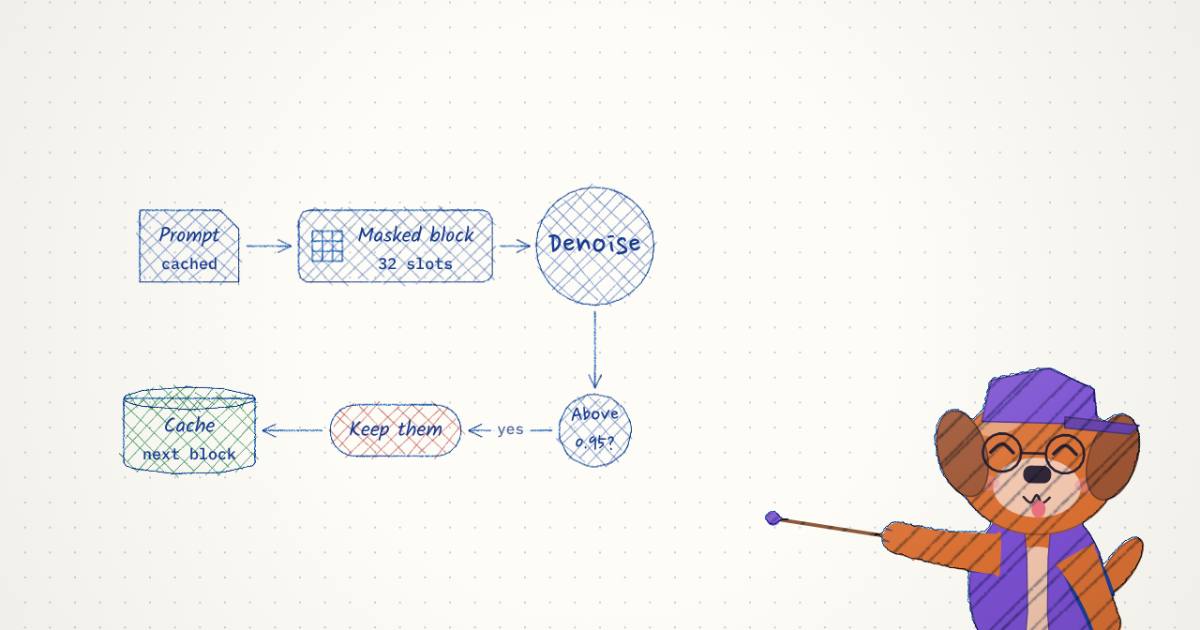
- Fill a block of 32 slots with the mask token and run the model over it, with the prompt and everything already written in the cache.
- For every slot, take the most likely token and its probability. The mask token's logit is set to minus infinity first, so a slot can never "predict" a mask.
- Commit every still-masked slot whose probability is above 0.95. If none clears it, commit the single most confident one, so every step makes progress.
- Repeat from step 1 until no slot is masked. That takes at most 32 steps and, if the model is sure of everything, one.
- Run the finished block through the model again as ordinary causal text to update the cache, and start the next block.
There is nothing mysterious in it. The two numbers that matter are how many slots clear 0.95 on a typical step, and what a step costs. The first is a property of the trained model and the text. I cannot measure it without the weights, so the widget below shows the rule on a model that is not Clover.
I ran the same rule on distilroberta-base, a masked language model with 82 million parameters, on CPU: 48 tokens of
prefix taken from paragraphs of this site, then a block of 16 masked slots with nothing to their right. The model was not
trained to fill a block this way, and the point of the toy is the rule, not the quality (measured, but it is my toy,
not Clover).
At the 0.95 threshold the model commits 1.16 slots per step on average and needs 13.8 of the 16 possible steps; with a block of 32 it commits 1.41 per step and needs 22.7 of 32. Lowering the bar to 0.4 gets it to 2.09 per step in 7.7 steps, and the cost shows in the table: the share of neighbouring tokens that are the same token goes from 19% to 43%. The first step commits exactly one slot at every threshold, including 0.4: before a neighbour is filled in, at most one slot clears the bar. What gets written is mostly page furniture, "ARTICLE CONTINUES BELOW" and runs of equals signs or hash marks, and in 10 of the 24 blocks at 0.95 a single token fills at least half the slots (a separate pass over the same paragraphs). The blocks match the original continuation in under 1% of slots, a weak test since many continuations would be fine, so the repeats are the better signal. None of this is a result about Clover. It is the reason Clover is trained for the job: a model that was never taught to be sure about slots it cannot yet see commits one slot at a time and fills the rest with noise, and the number the blog's speed rests on is how much better the trained model does.
The expert selection
The fourth config key is the one that makes a block step affordable. In an ordinary MoE forward pass each token picks its own 8 experts, and a block of 32 tokens would read the union of 32 such sets. If routing were independent that union would be about 163 of the 256 experts in every layer (the closed form is , and a simulation agrees with it at 163.4), which is 41 GB of expert weights read for one step, nearly two thirds of the 64 GB of experts in the model.
Clover's coreset_torch limits that. For a block, it adds up each token's top-8 routing probabilities per expert, sorts
the experts by that total, keeps the smallest set whose share of the total reaches top_p (0.9, and always at least the
top expert), and forbids every token in the block from routing outside it. The selector runs only in the denoising
("preview") passes, never in the causal replay that commits a block.
I ran the selector's logic on synthetic router logits, with a knob for how much the 32 tokens of a block share their preferences (measured, on invented routing; Clover's real routing is not measured). With independent routing a block touches 163.4 of the 256 experts on average, and the selector at 0.9 keeps 126.7 of them. When the block's tokens share a preference (a block-wide term added to every token's router scores, in units of the per-token noise), the union before the selector shrinks to 79.0, 40.8 and 27.5 experts at weights 1, 2 and 3, and the selector at 0.9 keeps 45.5, 16.2 and 8.6. The price is that tokens lose some of their own choices: on average 1.1, 1.2, 1.6 and 2.5 of a token's 8 slots are re-routed at weights 0, 1, 2 and 3. The real correlation is the number that decides the speed claim, and it is not in the checkpoint.
Two ways to run it
The README lists the backends: the Transformers path does block diffusion denoising only, SGLang does both denoising and "self-speculative decoding", and llama.cpp does self-speculative decoding only. The team's reply to the launch thread says the self-speculative mode is what reaches "600+ tps". The code is in two pull requests, SGLang #46927 and llama.cpp #31306; the GitHub repository itself holds a README, a benchmark image and an empty fine-tuning folder.
In self-speculative decoding (measured, by reading clover_worker.py and clover_utils.py at the PR's head commit
2243dc6e), one model plays both roles. A round previews a block of slots with the diffusion pass, then runs the same model
causally over those candidates, and keeps the longest prefix the causal pass accepts, plus one new token sampled at the
boundary. If drafts are accepted the round produces tokens. The block can be 32 or any divisor of it, and a
setting, speculative_clover_accept_rule, picks the test: exact keeps a candidate only if it is the causal pass's argmax,
and threshold keeps it if the causal pass gives it probability at least
where is the entropy of the causal distribution at that position. The function's defaults are a ratio of 0.9 and a of 0.6. With those defaults the ratio never binds, because cannot exceed 0.6: the working threshold is , which asks for probability 0.6 when the model is certain and only 0.22 when its entropy is one nat. That makes it a lossy rule: it will accept a draft token the causal model would not have picked, so the output is not the causal model's greedy output. (I recognise the form from the typical-acceptance rule of the Medusa line of work, but I did not check the source.)
To see what the rule does, I paired a 70-million-parameter drafter with a 160-million-parameter verifier (both Pythia), generated 32 tokens for each of 8 paragraphs of this site in rounds of 8 draft tokens (so at most 9 tokens a round), and counted what each rule keeps (measured, stand-in models and not Clover's own preview pass).
Exact matching keeps 3.55 tokens per round and reproduces the verifier's own greedy text in 90.6% of positions; the gap from 100% is most likely floating-point noise between a cached generate and a full forward pass, not the rule (I did not trace it). The threshold rule with Clover's default delta of 0.6 keeps 8.69 per round, almost the maximum of 9, and the text agrees with the verifier's in 12.5% of positions: nearly everything the drafter proposes passes, so the output is closer to the drafter's than to the verifier's. Raising delta to 3 gives 5.40 tokens per round and 9.8% agreement, and delta 10 gives 2.33 and 22.3%. Agreement is a harsh measure, because one early difference changes everything after it, so read it as "did the text diverge from the verifier alone", not as a quality score. The stand-in drafter is a weaker model than the verifier, where Clover's drafter and verifier are the same weights, so these numbers show the shape of the trade, that a lenient rule turns verification into a rubber stamp, and not Clover's own acceptance rate.
What 680 tokens a second has to be
The blog gives three speed claims (reported): 680 tokens a second on one GB300 at BF16 and batch size 1, on internal agent-scenario data; 515 on one H200 on agent tasks, against 365 for Qwen with a speculative-decoding method it calls DFlash2; and 101.8 on a 16 GB RTX 5070 Ti at INT4 on MATH-500, against 48.5 for comparable models. It also says Clover has the highest score among the models it lists on six agent benchmarks, including 73.6 on SWE-bench Verified, 51.7 on Terminal-Bench 2.1 and 65.3 on Overall, ahead of LLaDA2.2 flash, Mercury 2.5 and the two Qwen 35B-A3B models, and gives 83.8 on GPQA Diamond, 95.8 on ZebraLogic and 72.0 on AA-LCR. I did not re-run any benchmark.
The weights give a floor to reason from. At batch size 1 a pass is limited by the bytes it must read. One token at a time the same weights cost 5.89 GB a token, so even a perfectly efficient decode of this model on an H200 (4.8 TB/s, NVIDIA's published figure, not re-checked) tops out near 814 tokens a second, and on a GB300 (about 8 TB/s, same caveat) near 1,357 (reasoned). The reported 515 and 680 are 63% and 50% of those ceilings. They are not impossible for a plain model, so the claim is not that Clover beats physics. It is that a diffusion model can hold more of its ceiling: each pass reads the weights once for many tokens, so fixed costs such as 40 layers of kernel launches are shared by them.
A round, though, is two passes, and each reads more than a single token's 5.89 GB: the dense part (3.88 GB in BF16, the head included) plus every expert the block touches. This is the budget in the widget, with the unknowns left to you:
Take the H200 at 60% of its bandwidth and a block of 32. If the preview pass touches 64 experts per layer and the verify pass touches 163 (the independent-routing number), a round reads 65 GB and takes 22.5 ms, so 515 tokens a second needs 11.6 tokens kept per round. If both passes touch only 64, a round reads 40 GB and the same speed needs 7.1. At 80% of the bandwidth and 32 preview experts with 64 for verify it needs 4.3. Across the combinations I tried the H200's 515 needs between 4.3 and 13.2 tokens per round, and the GB300's 680 between 3.4 and 10.5 (reasoned). The checkpoint does not say which combination is true.
What follows is a pair of readings, not findings. Tokens kept per round is a property of the text, and agent traffic is full of stretches the model can call with near certainty, such as JSON keys, repeated tool names and boilerplate. The blog itself says the figure is an average over internal agent data, not a general rate. A free-form essay will keep fewer tokens per round than a tool call does, and the speed will move with it. And the RTX 5070 Ti line does not fit in its card: at 4 bits the 34.66 billion parameters are 17.3 GB before any overhead, more than 16 GB of video memory, so some of the weights must sit elsewhere, and the blog does not say how (reasoned).
What to take from it
Read as a systems result, the speed is a product of three terms. A round reads the dense weights twice plus whatever experts the block touches; the expert selection exists to keep that from being most of the model; and the acceptance rule decides how many tokens a round keeps. The checkpoint fixes the first term. It cannot give the other two, which are how correlated a block's routing is and how many drafts the causal pass keeps on real traffic.
If you want to check it, the facts above give you the shape of the test. You need one 80 GB card for the BF16 weights, the SGLang build from the pull request, and a trace of your own workload, because the speed will track how predictable your text is. Pin the revision, since the loader runs the repository's Python. Measure kept tokens per round and the share of the time the expert reads take, not only tokens a second.
What I did not check
- Any speed. Nothing here is a Clover timing. The 680, 515 and 101.8 are the blog's, on hardware and data I could not reproduce.
- Tokens kept per round and the expert union on real routing. Both are assumptions in the budget, and the budget leaves out attention state, activations and launch time.
- The training recipe and the benchmark settings. There is no paper, the fine-tuning code is not released, and the benchmark chart is an image on the blog.
- Whether SGLang's verify pass uses the coreset. I read the draft pass's use of it in the Transformers code; I did not trace the serving path far enough to say.
- The community GGUF files the team's account mentions, and the 100 tokens a second someone reported on a 3090.
Sources
- Launch post, blog (Chinese), model card and files at the Hub revision of 28 October 2026, repository.
- SGLang pull request 46927 (head commit 2243dc6e) and llama.cpp pull request 31306.
- Qwen3.6-35B-A3B, the base model.
- The toys, on CPU:
distilroberta-base,pythia-70mandpythia-160mfrom the Hub, and paragraphs from this site.