2026-09-18 · 21 min · programming-languages · formal-methods · gpu · systems · explainer
Victor Taelin's launch post for Bend 2 packs three claims into two sentences: it's
"a new programming language that blocks AI mistakes via proof checking — the same technique big AI labs
used to solve open math problems, like Navier-Stokes," and it's "also very fast, and runs on GPUs." Each
half of that is a different claim about a different system, and they deserve to be checked separately
rather than accepted or dismissed as a bundle. So I cloned bendlang/bend
— the project moved out of the Higher Order Company org it shares with
HVM — read the checker, read the 20,000-line Lean mechanization of
its core theory, read HVM2's own paper, and ran the numbers in bench/. The proof-checking claim holds up
better than skeptics of "AI plus formal methods" hype might expect. The Navier-Stokes name-drop is honest
about the mechanism and rhetorical about the connection. And the performance story turned out to have a
twist nobody announced: the runtime that ships with Bend 2 is not the one that made HVM famous.
A hundred words of syntax, so the rest of this makes sense
Bend's syntax is Python-shaped; its semantics are closer to Haskell or Lean. It's a pure language —
effects go through an IO monad — with dependent types, and it's affine by default: a bound name is used
at most once, unless its type is marked reusable (Data) and the binder carries a +:
import Base

type Shape is Data:
  Circle{r: U32}
  Square{s: U32}

def area(x: Shape) -> U32:
  match x:
    case Circle{+r}:
      (3 * r * r : U32)
    case Square{+s}:
      (s * s : U32)
is Data is what lets r be read twice in 3 * r * r; without it, and without the +, that would be a
type error. That single mechanism — a value has exactly one owner unless its type says otherwise — is doing
three jobs at once in Bend 2: it's why the type theory is consistent, it's why the compiler needs no garbage
collector, and, as it turns out, it's why the runtime no longer looks anything like HVM. All three show up
below.
Claim one: the checker is real, and it is small on purpose
"Proof checking" is not a metaphor here. Bend has law (a proposition) and def (a proof of it, an
ordinary function — there is no separate proof language, no tactics, and the pattern match is the
eliminator). A law you don't fill is an unfinished axiom; bend PROOF.bend either produces a checked term
or it doesn't compile, and there is no third option. The interesting engineering question is what, exactly,
is doing the checking, and how much of it you have to trust.
The type theory is genuinely unusual. BendTT — the theory Bend's checker implements, described in
Taelin's companion paper — has one universe,
Type : Type, no hierarchy above it, and datatypes with no positivity restriction. On its own that's the
setup for Girard's paradox: a inconsistency that has sunk every naive Type : Type theory since Martin-Löf's
original 1971 system. BendTT's move is to make paradox-building illegal for a different reason: every
known encoding of Girard's or Curry's paradox needs to apply some value to a copy of itself, and Bend's
affine discipline won't let you copy a function. A + binder — the only kind that can be used twice — is
only legal over a type of kind Data, and no function type is ever Data. Try it directly and the checker
just says so:
law dupf:
  for +f: Nat -> Nat
  Nat
- expected : Data
- observed : Type
Consistency-via-affinity instead of consistency-via-a-universe-hierarchy is a real, citable idea — the
paper's own related-work section states plainly that, among the linear/graded dependent type theories it
knows of, "none uses the absence of contraction for consistency." It buys back some of what a universe
hierarchy usually forbids: Type : Type gives you impredicative, self-referential type-level code that
predicative theories reject outright.
The kernel is one file, and it says so. bend2/bend.ts — parser, elaborator and checker together — is
3,734 lines. Its own first comment is unambiguous about the trust boundary:
// NOTE: this file was 99% human-designed and audited.
// It includes Bend's trusted kernel, including interpreter and checker.
// It has a bit of AI slop, but it is the most robust file in the repo.
Every rule in the paper is also a comment beside its case in that file. Here's check-lam, verbatim:
// T == @q x:A -> B
// Γ , x : qA ⊢ f(x) : B(x) ~ u
// where u[x] <= q
//       lhs steps by x while a parameter remains
// ---------------------------------------------- check-lam
// Γ ⊢ x => f : T ~ u - x
case "Lam": {
  const t_wnf = term_wnf(book, ty);
  if (t_wnf.$ !== "All") {
    throw Err(book, ctx, ty, typeless_show(book, ctx, tm), tm.s, lhs.def);
  }
  // ...
}
3,734 lines for a checker that also parses is a real number to compare against something. Lean 4's own kernel — the analogous "the one thing you have to trust" boundary in a very different architecture — is about 6,000 lines of C++ for its base layer, plus a few hundred more for inductive families. The comparison isn't quite apples to apples: Lean cleanly separates a small re-checking kernel from a large, untrusted elaborator, while Bend's file elaborates and checks in one bidirectional pass, so it's carrying work Lean puts on the untrusted side of its own line. Even so, the whole trusted surface of Bend 2 — parsing included — is smaller than just Lean's checking core. That's a legitimate data point in favor of "small, auditable kernel," which is the entire premise of proof checking as a trust mechanism.
The metatheory is mechanized, not just asserted. bend2/bend.lean is a de Bruijn model of the core
calculus, about 21,000 lines, and — I grepped it myself — zero uses of sorry. It proves confluence,
subject reduction, progress, weak normalization and consistency, the last by a Dershowitz–Manna measure over
pending recursive calls:
theorem consistency_holds : consistency := by
  intro β a r ps t π u hok hemp h
  obtain ⟨_, _, _, _, h', hd⟩ := norm_all hok h
  exact Check.deep_empty hok h' hd (Le.refl _) hemp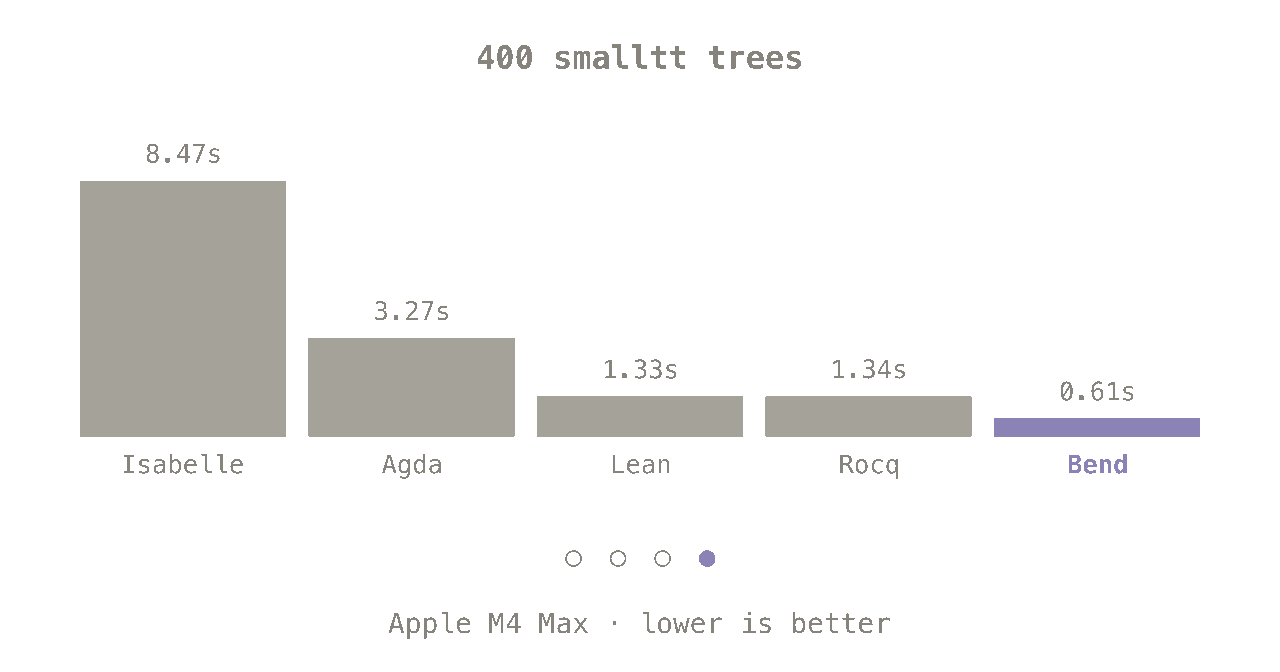
That speed gap is the payoff of doing less: no unification, no metavariables, no tactic engine, one bidirectional pass with a usage counter per binder. The head-to-head numbers on the largest checker benchmark in the repo are stark:
Isabelle and Agda are drawn at the 40s cap because both actually timed out past 300 seconds on this file —
the chart understates the gap, not overstates it. All five numbers come from the same machine, the same file
translated by hand into each system, in bench/checker/.
Now the caveats, because a checker is exactly the kind of thing you don't want to take on faith. First: the
Lean mechanization "does not yet fully match the shipped checker," in the paper's own words — bend.lean
models the core with +, kinds, Data and the meet, bend.ts has grown past it, and the file itself lists
where the two differ. The repo's limitations list is blunter: "The Lean formalization and bend.ts mismatch.
Early consistency bugs may occur." The 21,000 lines of zero-sorry Lean proof are real, but they're a proof
about a model of the calculus, not a certified compilation of the actual 3,734-line file that ships. Second:
the checker is not the whole toolchain. bend2/comp.ts, the compiler that turns a checked program into C,
Metal, CUDA or JavaScript, is 6,251 lines, and the README says outright: "the compiler (not kernel) is 99%
AI-written and has not been fully audited yet." A law that machine-checks tells you the source term
satisfies it. Whether the binary the compiler emits still does is a second question, answered so far by a
checksum-matching test suite, not a proof.
Claim two: "blocks AI mistakes" is exactly as strong as the law you wrote
The workflow is LAWS.bend (a human, or an AI under a human's review, states the rules) and PROOF.bend (an
AI fills them in; bend PROOF.bend either accepts the whole file or it doesn't). The README's demo is a
tiny game with one rule — winning is impossible — stated as a law over every possible sequence of moves:
# LAW: for any sequence of moves, replaying them
# from the start can never lead to victory.
law you_cant_win:
  for moves: List<Game.Move>
  board = Game.replay(Game.start(), moves)
  {Game.is_won(board) == False{} : Bool}
Ask an AI to "make the board wrap around" without the law in place, and — in Taelin's demo — the fix that
ships lets the player wrap into the flag's room and win. With the law in place, the same request can't land
until the AI also proves you_cant_win still holds for whatever it changed; if it can't, the change doesn't
merge. That's a real difference from code review: a reviewer can miss a wraparound edge case, a checker
cannot look the other way. The actual demo proof, for a 12×8 grid, runs to roughly 300 lines of hand-written
induction — Bend has no tactics or proof search, so every case split, every use of an induction hypothesis,
is written out by hand:
def go_ok(+a: Game.Move, +x: Nat, +y: Nat, +hp: T(okpos(x, y)),
  ca: T(chk_all(a, 11n)), e: {False{} == Game.wall(tx(a, x, y), ty(a, x, y)) : Bool})
  -> T(okpos(tx(a, x, y), ty(a, x, y))):
  and_split(Game.nat_le(x, 11n) && Game.nat_le(y, 7n),
    Bool.not(room(x, y)) && Bool.not(Game.wall(x, y)), hp,
    T(okpos(tx(a, x, y), ty(a, x, y))),
    wb => wnr => /* ... */)
That verbosity is the actual cost of "no tactics": it's a deliberate tradeoff for a checker fast enough to outrun Lean by two orders of magnitude, and it means writing (or generating) a nontrivial proof is real work, not a one-line annotation.
Here's the distinction the brief for this piece asked me to hold onto, and it matters more than the marketing copy suggests: a law that machine-checks tells you the implementation matches the law. It says nothing about whether the law matches what you actually wanted. "Winning is impossible" is easy to state and hard to get subtly wrong. "The sum of all balances must be zero" (the README's other example law) is easy to state and easy to get subtly wrong — a law that's too weak (doesn't rule out the bug you care about) or too strong (rules out legitimate behavior, so the AI "fixes" it by weakening the law instead of the code) both machine-check just fine. "Merging a bug is mathematically impossible: it is a theorem" is a true sentence about bugs that violate a stated law, and a non-sequitur about bugs that don't — a spec gap, a missing law, or a law that's vacuously true (checks a property that was never at risk) all produce the exact same green checkmark as a correct one. To be fair to Taelin's own phrasing: the README never actually claims the laws themselves are correct, only that the implementation matches them — "anything you can spell can become a law" puts the burden of spelling it right squarely back on the human. The risk is less in what's claimed than in how it reads at a skim: "make no mistakes becomes enforceable" is true of the mistakes you formalized, and silent about every other kind.
Claim three: "the same technique big AI labs used… like Navier-Stokes"
This one is worth being precise about, because it's doing real rhetorical work and it's easy to wave away too fast. Roughly two weeks before Bend 2 shipped, OpenAI announced that an unreleased model, run as roughly 10,000 autonomous agents over about 88 hours (several million dollars of compute, per researcher Sébastien Bubeck), found a finite-time singularity in the 3D Navier-Stokes equations — one of the six unsolved Millennium Prize Problems — and produced both an analytic writeup and a Lean formalization of it. About twelve hours earlier, NYU's Tristan Buckmaster and Anthropic's Levent Alpöge had independently reached a related result for the Euler equations, also Lean-checked; both efforts built on analytic groundwork from Diego Córdoba and Luis Martínez-Zoroa, who get first credit for the mathematics either way. Quanta's writeup is careful to note what "Lean-checked" buys here: mathematicians still have to verify that the Lean statement says what they think it says, but once it does, the proof itself is settled by a machine, not by trusting either the AI or the 10,000-way distributed process that produced it.
That's the actual technique, and it is the one Bend's pitch is invoking: don't read the proof and decide
whether to trust it, run it through a small kernel that either accepts or rejects it, no matter who or what
wrote it — a lone AI, a swarm of 10,000, or a human. That idea transfers cleanly, and it's the same idea
behind LAWS.bend/PROOF.bend.
Claim four: fast, and on GPUs — but not the way its own history says
The genuinely clever part
Bend's speed claims have a real lineage: HVM, Taelin's earlier runtime, evaluates interaction combinators — a graph-rewriting model from Lafont (1997) with a property that's rare enough to be worth explaining properly, because most engineers have never had a reason to meet it: reduction order never changes the result, and never changes what's safe to run in parallel.
An interaction net is agents (drawn as triangles) connected by wires. Each agent has one principal port (the tip) and, here, two auxiliary ports (the base). Two agents whose principal ports point at each other form a redex — literally, two things ready to interact — and exactly one of two rules fires, decided purely by whether the two agents are the same kind:
Two matching agents facing each other collapse in place: their leaves rewire directly, nothing elsewhere in the net is touched. This is beta-reduction and pattern-matching.
Annihilate (same agent meets same agent) is how beta-reduction and pattern matching happen: the two agents vanish and their four leaves rewire directly to each other, in place, touching nothing else in the net. Commute (a constructor meets a duplicator) is how a shared value gets copied without walking the whole structure up front: each agent clones the other, one node at a time, and the copies keep propagating outward on their own. The property that makes this parallel-safe for free is called strong confluence: firing any one redex can never disable or change the outcome of any other redex elsewhere in the net, because firing one only ever touches the two nodes at its own principal ports. A redex is a purely local fact — "these two ports point at each other" — so a scheduler doesn't have to decide anything: any number of workers can each grab a different ready pair from a shared bag, with nothing to lock and nothing to coordinate, and the net converges to the identical normal form regardless of who ran what when. That's "automatic parallelism" with the scare quotes earned rather than assumed — it's a real theorem about the rewrite system, not a benchmark trick.
The part nobody put in the launch thread
Here is the finding this piece turned up that the brief for it didn't anticipate: Bend 2's shipped runtime does not use interaction nets. BendRT — the paper describing the actual runtime, one directory over from BendTT — says so in its own words, in a sentence clearly aimed at exactly the audience who'd assume otherwise:
"Readers of the author's earlier runtimes may expect interaction nets here; there are none."
And, in its related-work section, spelled out as a deliberate trade rather than a quiet regression:
"BendRT keeps the goals and drops the mechanism: affinity gives unique ownership directly, so the graph and its duplication machinery become unnecessary. Lost is optimal reduction of shared redexes; gained are native-speed sequential code, flat memory and a cost model a programmer can read."
What replaced it: the checker already knows, statically, that every value has exactly one owner (that's what
affine typing is), so BendRT doesn't need a graph of duplicator nodes to work sharing out at runtime — a
whole-program analysis marks only the types that are actually shared as "hot" and reference-counts those
alone; everything else compiles to plain stores, loads and frees, freed the instant a match consumes it.
There's no garbage collector, because there's nothing to collect that ownership didn't already account for.
Parallelism is explicit, not automatic — a let of the shape a b = f(x) g(y) tells the compiler these two
calls may run concurrently, and a ! suffix marks a call for the GPU:
# Computes 2^d in parallel: a tree of d levels, one leaf per unit.
def pow2(+d: Nat) -> U32:
  match d:
    case 0n:
      1
    case 1n+p:
      a b = pow2(p) pow2(p)
      (a + b : U32)

def main() -> IO(Unit):
  result = pow2!(20n)  # runs on the GPU
  IO.print(U32.show(result))
Those forked tasks land on a fixed 128×128 grid of rings — no work-stealing, no shared queue, no lock — that
forks along rows and drains along columns. The price, stated as plainly as the gain: "the runtime trusts the
equal-parts promise absolutely." A let fork that splits its work unevenly doesn't error; it just silently
gives up the parallelism it was supposed to buy, and BendRT's own limitations section calls this out as
unverified. So the honest one-line summary of claim four's first half is: Bend 2 traded HVM's "no annotation
needed, ever" story for "two extra characters, and a contract the runtime doesn't check" — a real downgrade
in the magic, and, on the evidence below, a real upgrade in speed and predictability.
Why the old numbers deserved the skepticism, and what changed
HVM2's own paper is unusually candid about where this leaves single-core performance: "In single-thread CPU evaluation, HVM2 is, baseline, still about 5x slower than GHC, and this number can grow to 100x on programs that involve loops and mutable arrays." Outside reviewers were harsher. On the original Bend 1 / HVM2 launch thread, one Hacker News commenter (anon291) put the scaling-vs-absolute problem in one line: "Going from 1 core to 16k cores increases performance by 50x. That's not actually very good" — because the thing being scaled from was already slow. Another (Twirrim) reported the single-threaded build of a recursive-sum benchmark running 42 minutes and 6GB of memory on their laptop without finishing, against a few seconds for PyPy. That's the exact failure mode this piece was asked to check for: a relative-speedup chart that can't show what it's scaling from.
BendRT's own results table is the direct answer to that complaint — a hand-written C twin of every benchmark, run on the same machine, next to Bend at 1 thread, 16 threads and on the GPU:
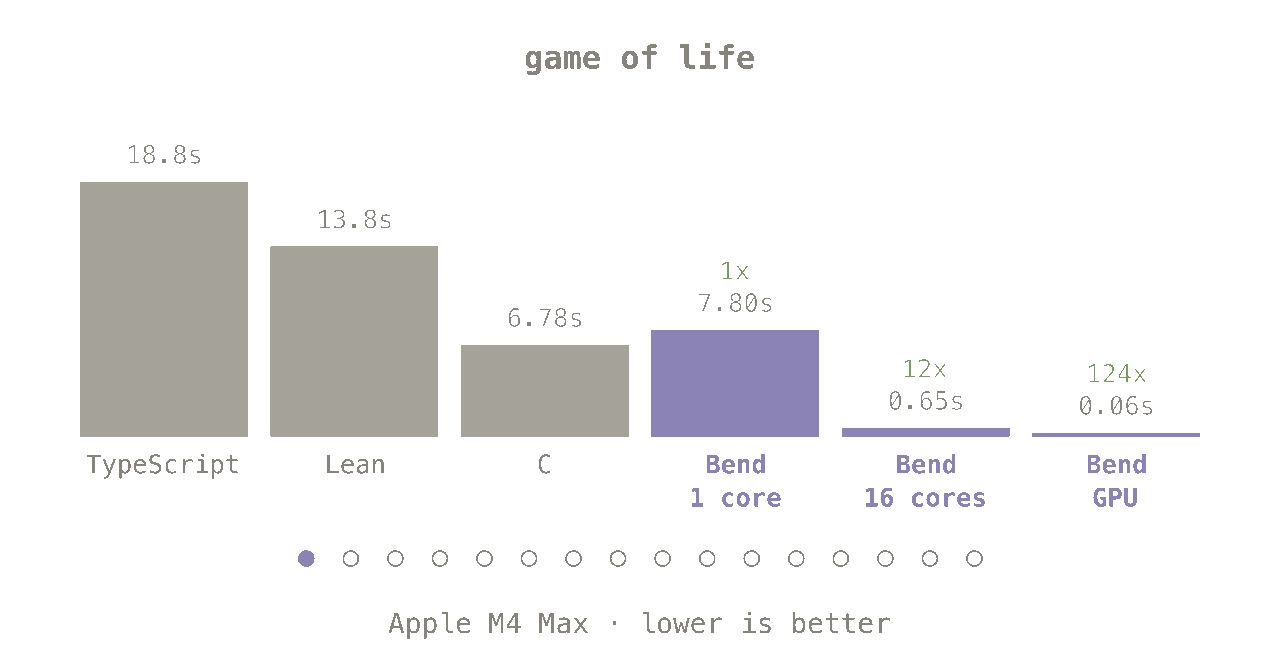
The paper's headline claim from this table: single-thread Bend lands within 0.8–1.5x of hand-written C across its twelve benchmarks, sixteen threads give 8.8–12.1x over one, and uniform workloads (game of life, n-body, mandelbrot, merkle) hit 52–67x on the integrated GPU — while it says plainly that divergent workloads (n-queens, symbolic regression) lose to sixteen CPU threads, and that "the design stance is to report the loss rather than tune the scheduler toward it." That line — publishing the case where your own hardware target loses — is exactly the kind of receipt the "meaningless baseline" critics were asking for, and it wasn't in the earlier material.
I pulled the fuller, more current pin — sixteen benchmarks as of this writing, four more than the paper's table, against C, TypeScript and Lean twins — and built both charts side by side, because the gap between them is the whole point:
This is the chart HVM1 and Bend 1 shipped: a curve against itself. It looks the same shape for every bench, because it can't show what it's scaling from.
The extra four benchmarks are where it gets interesting. Three sit inside the paper's claimed 0.8–1.5x band
(bfs 1.09x, edit-distance 1.28x, lexer sits a bit over at roughly 2x). The fourth, hashmap, doesn't: Bend's
single core runs 4.4x slower than its C twin there — the one case in the newer data that breaks the
paper's own headline number, plausibly because a hash map is exactly the kind of pointer-chasing, heavily-shared
structure that has to pay Bend's reference-counting cost on every access, where the tree-recursive numeric
kernels in the paper's original twelve mostly don't.
None of this reverses the finding. Bend 2 ships absolute numbers against three independent, competently optimized baselines, on real (if small) programs, on hardware anyone can rent, and most of them hold up the claim. It also has at least one benchmark, in its own public data, that doesn't — and the honest thing to do with a chart like the one above is use it to find that benchmark, not to stop looking once the first four look good.
- We don't have as many benchmarks as we'd like yet, especially for the checker.
- The compiler (not kernel) is 99% AI-written and has not been fully audited yet.
- The Lean formalization and bend.ts mismatch. Early consistency bugs may occur.
- Parallelism requires balanced calls. Flexible parallelism will be added later.
— bendlang/bend's own README, "Limitations"
The take
Unbundle the three claims and they land at three different heights. The proof checker is the real thing: a
genuinely novel consistency argument (affinity instead of a universe hierarchy), a 3,734-line human-audited
kernel that's smaller than the trusted core of the systems it's benchmarked against, and a Lean mechanization
with no sorry in it — undercut, honestly, by that mechanization not yet matching the shipped checker, and by
an AI-written, unaudited compiler sitting between a checked proof and the binary that runs. "Blocks AI
mistakes" is true of exactly the mistakes you wrote a law against, which the project's own words don't quite
overclaim but its tagline invites you to over-read. "The same technique big AI labs used… like Navier-Stokes"
is an honest analogy about machine-checked trust wearing a technical-sounding hat it hasn't earned — Bend and
Lean share an idea, not a lineage. And the performance story is the one that actually surprised me: the
runtime that shipped is not the one the marketing's own history would lead you to expect, it's a real
architectural bet against Taelin's earlier work, and — mostly, not universally — it backs that bet with
exactly the kind of baseline the old benchmarks were missing.
Taelin has been unusually direct that none of this is finished — Bend 2's own limitations file runs to thirty-some bullet points, ending with "and more that escape me," and the README says, in caps, "BEND IS YOUNG. EXPECT BUGS." Coming from someone shipping a launch video, that's a reasonable place to leave it too: a small trusted kernel behind a genuinely new consistency argument, a runtime that changed its mind and mostly has the numbers to justify it, and a marketing page one rhetorical flourish ahead of what's actually been shown.
Built from bendlang/bend and HigherOrderCO/HVM2
at the commits current as of 2026-09-18, the BendTT and BendRT papers in paper/, bend2/bend.lean, and
bench/checker/ and bench/runtime/ (pin of 2026-09-17, commit d0db7b3e, one Apple M4 Max). Navier-Stokes
details from OpenAI and
Quanta Magazine.
Historical criticism from Hacker News
discussion #40390287 and HVM2's own paper. Figures are
reproduced from bend-lang.com's own benchmark charts.