2026-08-03 · 16 min · llm · mixture-of-experts · attention · sparse-attention · quantization · fp8 · long-context
SK Telecom's A.X-K2 is a 688B-parameter, 33B-active Mixture-of-Experts model, trained from scratch as part of Korea's Sovereign AI foundation-model project and shipped under Apache 2.0. It is the successor to A.X-K1, and the tech report (SKT, 2026) is unusually specific about what changed: a full architecture table, a full FP8 training recipe, full RL hyperparameters, and — the detail worth building an article around — an ablation that reports the quality cost of its own efficiency trick, and the cost is close to zero.
Two things carry this piece. First, Sparse Gated Attention (SGA): a lightweight top-k indexer bolted onto gated Multi-head Latent Attention, where SKT states the LongBench score before and after adding sparsity — 62.80 to 62.99 — rather than only the speedup. Second, A.X-K2 is trained natively in FP8, forward and backward, from the first optimizer step. Not quantized after the fact. Those two facts turn out to be connected: the same architectural choices that make SGA cheap (GatedNorm suppressing outlier activations) are the choices that make FP8 training survivable at this scale.
What the weights say
Total tokens: about 8.5T (8.2T pre-training, the remainder post-training) — fewer than A.X-K1's roughly
10T, and SKT is direct about why that's the headline, not the parameter count: "despite training on
fewer tokens than A.X K1 (∼10T), A.X K2 shows substantial improvements across the board — over 30
percentage points on some benchmarks — reflecting substantial gains in token efficiency." The
architecture, read straight off config.json and Table 1 of the report:
| Total / active parameters | 688B / 33B |
| Layers | 61 (1 dense, 60 MoE) |
| Hidden size | 7,168 · 64 attention heads (Q = KV) |
| Routed / shared experts | 256 / 1, 8 active + 1 shared per token |
| Expert routing | sigmoid score, noaux_tc, 8 groups, group top-k 4, routing scale 2.5 |
| Attention | MLA + head-specific output gate + QK-norm, plus a top-k sparse indexer (k = 2,048) |
| KV-lora / Q-lora rank | 512 / 1,536 |
| Context | 128K native (ABF), 256K via YaRN (factor 2.0), zero-shot to 512K (factor 4.0) |
| Vocabulary | 163,840 (unchanged from A.X-K1), 5 languages |
| Training precision | native FP8 (MXFP8, E4M3, block 32) forward + backward |
| Checkpoint | block-scaled FP8 (E4M3, 128×128), ~646 GB on disk |
Relative to A.X-K1 (519B-A33B), the entire parameter growth is in expert count: 192 to 256, chosen because it's a power of two and a multiple of 128 for sharding, targeting a compute-derived total-parameter budget under a fixed 70-day, 512-GPU schedule. Active parameters didn't move. That's a scale-up in capacity, not in per-token compute — worth holding onto before the next section.
Sparse Gated Attention
Start from what A.X-K1 already had: Multi-head Latent Attention (MLA) with a head-specific output
gate — a learned, input-dependent gate applied to the attention output before the Wo projection,
present in every layer throughout pretraining, not something bolted on for long context. The report's
framing for why the gate matters: it "introduces non-linearity into the attention output, mitigates
attention sinks, and improves loss convergence." Attention sinks are the few uninformative token positions
(often the first token) that vanilla softmax attention dumps disproportionate probability mass onto — a
gate that suppresses that mass gives every downstream consumer of the attention output a cleaner signal.
SGA is the second half of the name: a lightweight indexer, adopted from DeepSeek-AI's sparse-attention
design, that scores every cached key and keeps only the top 2,048 tokens per query — selected at
individual-token granularity, not in fixed blocks. (That's a genuine design fork from
MiniMax Sparse Attention, which scores and selects in 128-token
blocks specifically so memory access stays contiguous. A.X-K2 trades that contiguity for finer-grained
selection.) MLA then runs exactly over the selected set, KV[I_topk], instead of the full cache. Here is
the paper's own architecture figure for the resulting block:
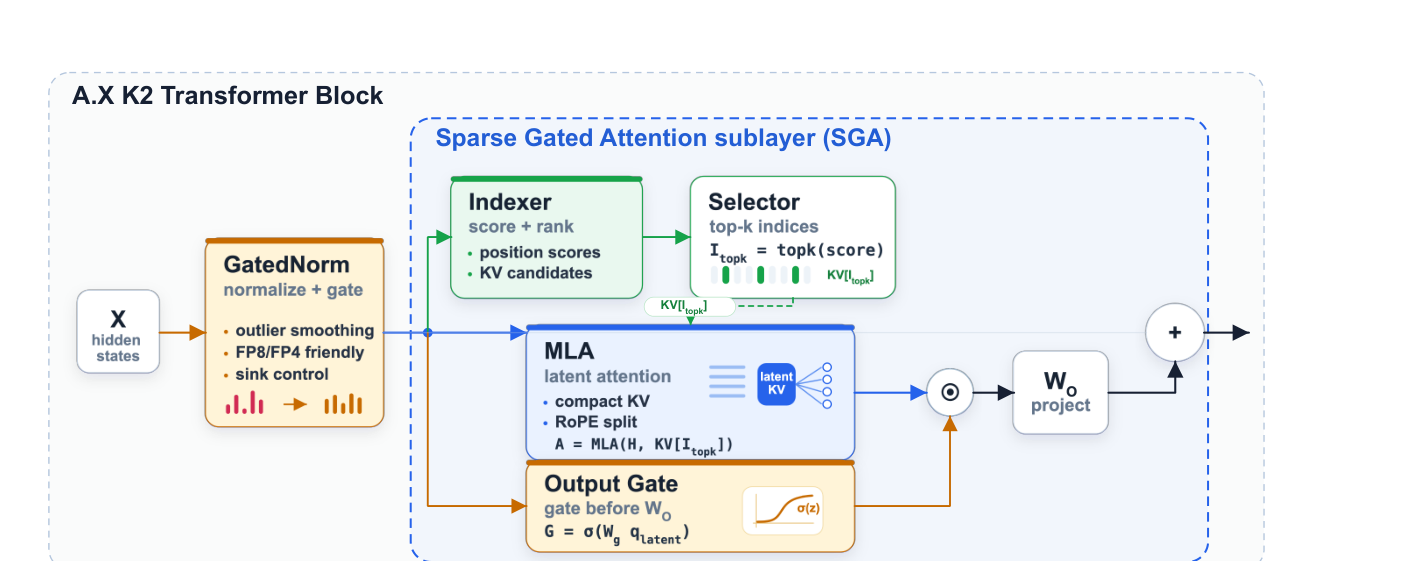
Read it as a data path: GatedNorm output splits into the Indexer→Selector pair (which decides what MLA gets to read) and the Output Gate (which decides how much of what MLA computes gets through). The mechanism I built to walk through the dynamics — how the fixed 2,048-token budget shrinks as a fraction of a growing context, and what changes when the Selector is switched off entirely:
Dense mode is A.X K2 before the sparse-warmup stage: the Indexer and Selector are bypassed, MLA reads the full cache, and the Output Gate — present throughout pretraining, not added for long context — is the only stabilizer. Switch to sparse and the Indexer scores every cached block, the Selector keeps a fixed budget of 2,048 tokens, and MLA attends only those — a shrinking slice as the slider moves from 4K to 256K. The gate does not change between modes; only the Indexer/Selector path and what MLA reads do. The report’s own ablation is the honest part: swapping in sparsity moves LongBench from 62.80 to 62.99 — an improvement, not a cost, for cutting attention compute at long context.
The report calls the gate and the indexer mutually reinforcing, and the causal story runs one direction: because the output gate already suppresses attention-sink mass throughout pretraining, the attention distribution the indexer is trained to imitate is better-calibrated before the indexer ever sees it — so its top-k budget goes to genuinely relevant positions instead of partly being spent re-discovering which tokens are sinks. The indexer itself is trained with a KL-divergence loss against the (already gated) attention distribution, introduced in a dedicated Stage 3C after the model is natively trained to 128K context.
The number that makes this worth an article: on LongBench, A.X-K2 scores 62.80 before the sparse adaptation and 62.99 after — sparsity made it very slightly better, not worse. A lab publishing the comparison that shows its own efficiency trick is nearly free — rather than only the speedup — is worth crediting on its own. And the adaptation recipe has a second, smaller honest claim attached: unlike DeepSeek-V3.2 and GLM-5, which warm the indexer up against the dense (full) attention distribution before switching on sparse selection, SKT trains the indexer against the sparse top-k selection from the outset — a "sparse warmup" — because it's cheaper (sparse attention is less compute per step than dense) and, in their experiments, cost no measurable downstream quality relative to the dense-warmup alternative used elsewhere.
The efficiency payoff shows up exactly where you'd expect — long-context serving. Reading the report's own inference sweep at 120K input tokens (concurrency 32, dp8/ep8): total-token throughput goes from roughly 9,100 tok/s for A.X-K1 to roughly 12,200 for A.X-K2 with a bf16 KV cache, and roughly 14,600 with an FP8 KV cache — with per-token latency and time-to-first-token moving the same direction, each a few tens of percent lower for K2 than K1 at that length. (Approximate, read off the report's chart, not a published table — but the direction and rough magnitude are unambiguous.)
One more piece worth naming here because it recurs in the next section: GatedNorm replaces A.X-K1's dual-normalization scheme entirely — a single input-dependent gate applied right after RMSNorm, instead of stacking normalization layers around attention and the MLP the way A.X-K1 (and Gemma-style designs) did. SKT ran the ablation at 20B-A3B scale and found GatedNorm alone matches the loss curve of the full dual-norm design; stacking a second post-MLP norm on top added nothing. The reason GatedNorm matters beyond training stability: it suppresses massive activations — the small number of hidden units that run orders of magnitude larger than the rest and persist across layers — which is exactly the failure mode that wrecks narrow low-precision formats. Which is where the second half of this piece starts.
The scale, next to what else is disclosed
Total parameters range 7× across this set (397B to 2.78T), but the sparsity ratio — total divided by active — clusters much tighter: 15.7× (A.X K1) to 31.9× (Kimi K2), with A.X K2 at 20.9× and Kimi K3 at 26.7×. K2 grew total capacity 519B → 688B by adding routed experts (192 → 256) while holding active compute flat at 33B — a pure capacity bet, not a bigger per-token forward pass. K3 spends its extra headroom differently, tripling active parameters (32.6B → 104.2B) alongside the total. This table is shorter than A.X K2’s own benchmark comparison: DeepSeek-V4 Flash, GLM-5.1, Kimi-K2.6 and MiniMax M2.7 all appear in that table but none publish a total/active breakdown as precise as the four models here — which is itself part of the disclosure gap this piece keeps pointing at.
A.X-K2 sits in the middle of this range by total parameters and at the small end by active parameters. Kimi K3 — 2.8T total, 104B active — took the opposite bet on the same axis: where A.X-K2 grew total capacity 519B → 688B while holding active compute flat at 33B (a pure expert-count expansion, 192 → 256), K3 tripled its active parameters alongside its total, spending its extra headroom on a bigger per-token forward pass rather than more parked capacity. Both are legitimate ways to spend a training budget; they're just different bets about where the marginal FLOP is worth spending.
Trained natively in FP8
Everything above assumes a working low-precision model. A.X-K2 gets there by training natively in FP8 from the start rather than quantizing a full-precision model afterward — MXFP8, E4M3, block size 32, forward and backward pass, with FP32 master weights and BF16 optimizer state as the only higher-precision parts of the recipe. I made the same argument at a different precision two weeks ago in Neutrino-1: quantization is a decision you make before training starts, not a knob you turn on a finished checkpoint. Neutrino-1 showed the cliff that decision avoids — ternary weights rounded post-hoc land at 24.2–24.7 on 5-shot MMLU, against a 25.0 chance line, while the same ternary format trained in from scratch reaches 72.1. A.X-K2 is the same principle, replayed at FP8 instead of ternary, at 688B instead of 8B.
The practical consequence: A.X-K2 has no BF16 form to compare itself against, because none was ever trained. Its FP8 checkpoint is the master weights, not a rounded-down copy of something else. Serving it in NVFP4 — a further post-hoc step, applied only to expert weights (W4A4) — is a much smaller step down than Neutrino-1's ternary rounding, because the base it's stepping down from was already trained natively in a narrow format:
A.X K1’s 1038 GB is a different model, shown only as scale context — A.X K2 has no BF16 form to compare against, because it was never trained in BF16. Its FP8 checkpoint at 646 GB is the master weights. NVFP4 at 370 GB is one further post-hoc step, applied to experts only (W4A4), on top of that already-quantized base.
The report's own robustness table backs this up on eleven benchmarks: NVFP4 tracks FP8 within about a point on most of them — CLIcK 84.21 → 84.06, MMLU 82.27 → 82.00, KoBEST-BoolQ 96.72 → 96.01 — with GSM8K (−2.50) and MATH (−2.42) as the honest outliers, and HumanEval and KoBEST-COPA actually improving slightly. Compare that spread to Neutrino-1's cliff and the shape of the difference is the whole argument: rounding into a format a model never trained in collapses to chance; stepping further down from a format it was already native in costs a couple of points at most.
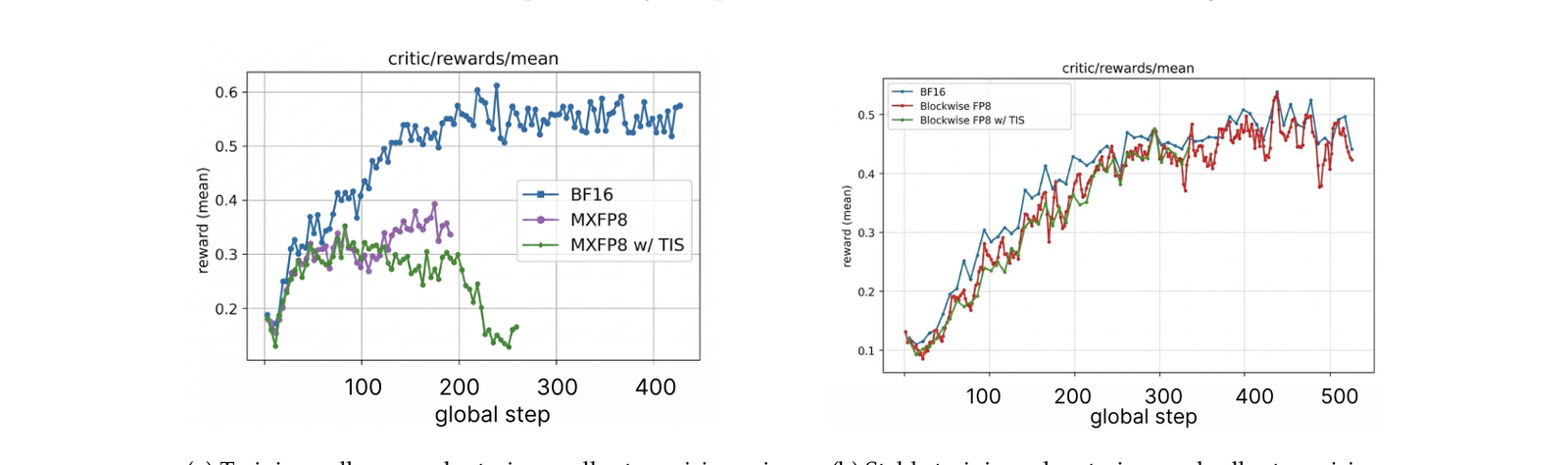
This same commitment shows up again, more sharply, inside RL post-training — and it's the cleanest evidence in the whole report that "native FP8" is an infrastructure discipline, not just a training-time flag. RL needs the trainer (Transformer Engine, on Blackwell) and the rollout engine (vLLM) to agree numerically. But Blackwell defaults to MXFP8 while vLLM's mature MoE FP8 path targets the older blockwise FP8 recipe built for Hopper — so if you leave each side on its native default, they diverge. Figure 7 above shows what that divergence does: a trainer running MXFP8 against a blockwise-FP8 rollout looks fine early, then the reward curve stalls and drifts down. SKT's own diagnosis is the sentence worth keeping: "Applying TIS does not prevent this collapse, indicating that token-level intervention alone cannot remove the underlying trainer–rollout precision mismatch." Truncated Importance Sampling is a standard token-level correction for exactly this kind of train/inference distribution drift, and it doesn't work here — the fix has to be architectural (a patched Transformer Engine branch that forces blockwise FP8 on Blackwell, matching vLLM's format end to end), not a loss-side patch. That's a small, honest, specific admission: a common trick from the RL toolbox failed, and they said so instead of quietly switching methods without comment.
One more low-precision data point, smaller but concrete: on Rebellions' ATOM-Max NPU, A.X-K2 reports 107% performance-per-watt relative to a comparable NVIDIA L40S GPU — a real deployment-hardware number, not a simulation.
The benchmarks
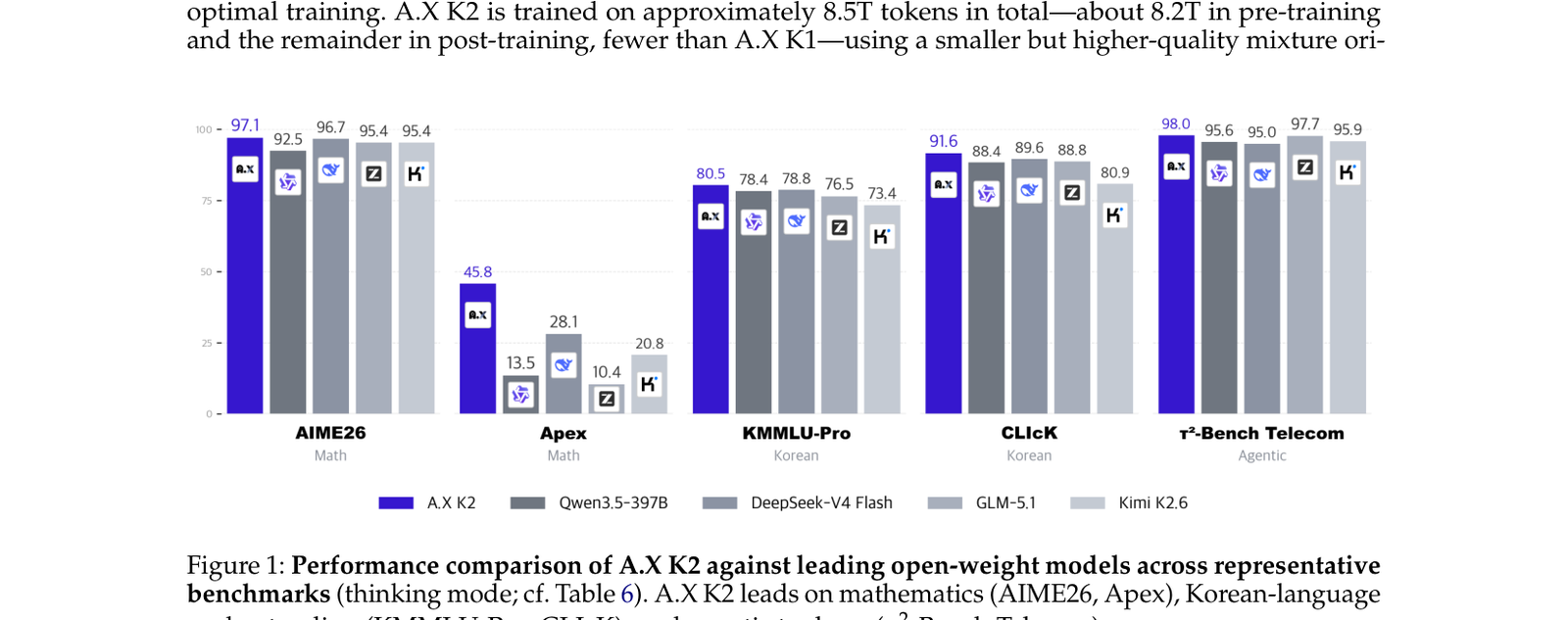
A.X-K2 leads this five-model, five-benchmark slice outright, and the gap on Apex is the most striking: 45.8 against a next-best of 28.1 (DeepSeek-V4 Flash) — more than double the third-place score. Beyond what's in that chart, SKT reports two non-benchmark math results worth noting because they aren't self-scored evals: 35/42 on IMO 2025 (the gold-medal threshold is 35, with a perfect 7/7 on each of the first five problems), and correct proofs for all eight KMO26 second-round problems, using an iterative proof-refinement method borrowed from DeepSeekMath-V2's approach.
Long-context quality holds up on RULER, staying above 92 out to 128K and only easing to 86.6 at the full 256K:
| Context | 4K | 8K | 16K | 32K | 64K | 128K | 256K | Overall |
|---|---|---|---|---|---|---|---|---|
| RULER | 97.5 | 97.2 | 97.5 | 96.5 | 94.3 | 92.7 | 86.6 | 94.6 |
Needle-in-a-haystack retrieval is a clean 100 at every position tested at both 256K (YaRN factor 2) and a zero-shot 512K (YaRN factor 4) — including after NVFP4 quantization, which is the same "the base format survives further compression" story as the precision ladder above, applied to retrieval instead of MMLU.
Where it's honest about losing
Every number above is self-reported by SK Telecom, on their own harness, with no independent reproduction
I could find. The eval protocol is disciplined — all baseline open-weight models run through OpenRouter
fixed to the model's own publisher, xhigh reasoning effort, pass@1 averaged over multiple generations
(8 for math) rather than single-shot — but it's still one lab grading a comparison it designed. The clearest
weak spot, and SKT names the reason itself:
9.3 is worst of all seven models with a reported score — GLM-5.1 leads at 29.1, and even the next-worst (Nemotron 3 Ultra at 13.4) beats A.X-K2 by 44%. The model card's own explanation: "Agentic performance is moderate — A.X K2 trails the strongest compared models on BrowseComp — reflecting limited agentic RL during post-training." That's the right way to publish a weak number — attribute it to a specific, checkable cause (the RL data mixture allocates only 18% of SFT tokens and a modest RL slice to agentic tool use, against much heavier agentic investment in a model like Kimi K3) rather than burying it. One methodology caveat the report itself surfaces: A.X-K2's only tool on this benchmark was Brave Search's API, capped at ≤10 searches per problem — a real constraint, not full open browsing — and the report doesn't state whether every compared model ran under the same cap. That could shift the absolute number somewhat; it's very unlikely to explain a 3× gap to the next-worst model.
BrowseComp isn't the only place A.X-K2 comes second. On GPQA Diamond it's mid-pack, and the surprise is which model beats it on a Korean-language benchmark:
DeepSeek-V4 Flash — not a Korean-focused lab — beats SK Telecom's own Korean-sovereign model on a Korean benchmark, by 2.3 points. A.X-K2 still wins the other two Korean benchmarks in the comparison (KMMLU-Pro, CLIcK), so this is one loss inside a category it otherwise leads, not a category-wide miss — but it's exactly the kind of specific, checkable number a self-reported table should surface rather than smooth over. Rounding out the mid-pack results: LiveCodeBench v6 at 84.0 (DeepSeek-V4 Flash leads at 89.4), SciCode at 41.0 (near the bottom of the field; Kimi-K2.6 leads at 53.5), and IFBench at 75.9 (DeepSeek-V4 Flash leads at 81.2). None of these are collapses — they're a model that wins decisively on math and most of Korean, and trails on strict-instruction-following, code-execution benchmarks, and — sharply — on open-web agentic search.
Two more limitations the model card states plainly, worth repeating because they're easy to omit: A.X-K2 is text-only (no native multimodality, listed as future work), and SKT explicitly did not run a dedicated quantitative bias or fairness evaluation.
The take
Two disclosures make A.X-K2 worth writing about on their own, independent of where it lands on any single leaderboard. It's one of the only sparse-attention releases I've seen that reports the ablation showing its sparsity is nearly free (62.80 → 62.99 on LongBench) instead of only the speedup — crediting the reader with the question "what did this cost?" instead of hoping nobody asks. And it's trained natively in FP8 end to end, with the RL infrastructure section going out of its way to show a standard fix (TIS) failing against a real precision mismatch rather than quietly working around it off-page. Set against Neutrino-1's ternary cliff and MiniMax Sparse Attention's block-granularity bet, A.X-K2 reads as the same 2026 pattern — quantization and sparsity are training-time commitments now, not deployment-time knobs — applied at a scale and with a level of self-disclosure that makes the whole argument checkable, including the parts (BrowseComp, KoBALT) where the honest answer is that it lost.
Sources: the A.X K2 Technical Report (SK Telecom, dated 2026-07-28 — architecture, training recipe, RL infrastructure, evaluation tables) and the model card and config. Figures 1 and 3 here are the report's Figures 2 and 7, reproduced for commentary; the benchmark comparison figure is the report's Figure 1. All benchmark numbers are SK Telecom's own, on their own harness, with no independent reproduction found. The inference-efficiency numbers in the Sparse Gated Attention section are approximate, read off the report's chart rather than a published table. Interactive diagrams are mine. Related: Neutrino-1 on training-native vs. post-hoc quantization, Kimi K3 on the other end of the MoE sparsity-ratio spectrum, and MiniMax Sparse Attention on block- vs. token-granularity top-k selection.