2026-07-04 · 6 min · inference · fine-tuning
Why read this
Nichelast 15%How PAW turns a plain-language spec into a LoRA through a mapper over learned basis matrices, with the paper's figures and its limits; results quoted.
- Runs on a laptop CPU
- A new technique
- Explained from first principles
Inference & servingCC-BY-4.0Practitioner paper
How this was scored
- Is it new?
- 2 of 3: A real new idea, method or capability
- Can I trust it?
- 0 of 3: Restates claims
- Can I run it?
- 2 of 3: Open code or weights with real limits
- Will I understand it?
- 2 of 3: Mechanism from first principles with figures
- Can I act on it?
- 1 of 3: General advice
- Will it last?
- 1 of 3: Relevant for months
- Does it affect many?
- 1 of 3: A specialist community
- Only here?
- 1 of 3: Some original analysis
Score 43 of 100, ranked 521 of 577 rated articles. Each question is answered 0–3 by hand, and a 3 is rare. How articles are scored
Some everyday programming tasks refuse to be written as rules. Alerting a human on only the log lines that matter, repairing malformed JSON, ranking snippets by intent, deciding whether a message is urgent — even a regex for "parse this messy text" shatters on edge cases. The modern move is to punt: call a large language model API and let it decide, per input. That works, but you pay for it on every call, and you give up locality, reproducibility, and price.
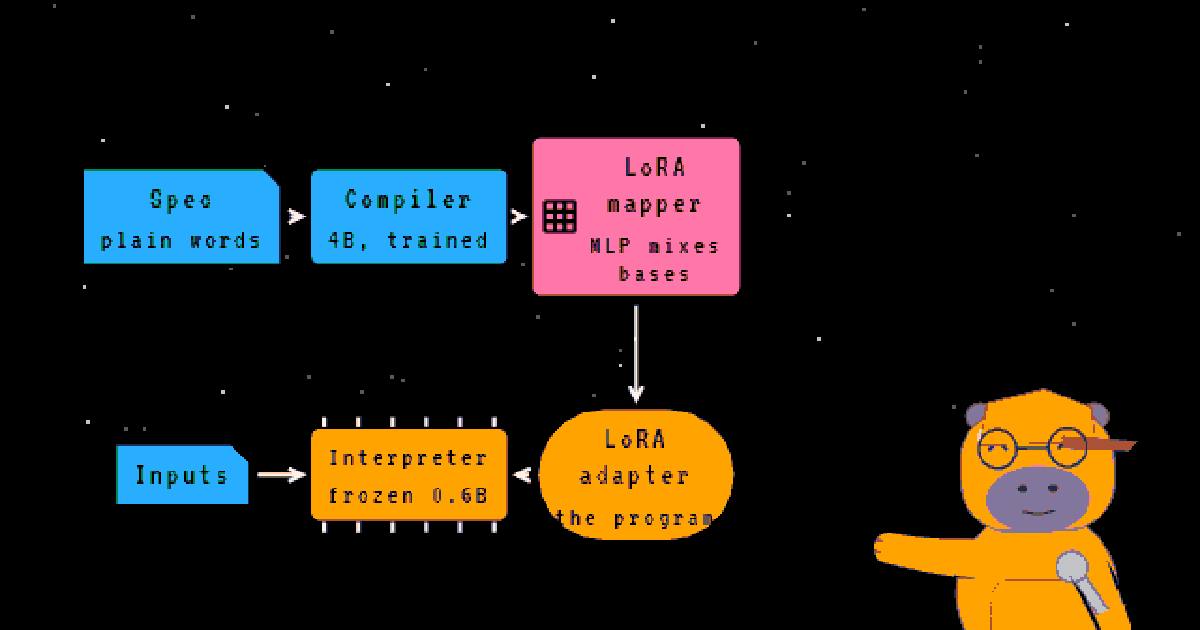
Program-as-Weights (PAW) — from Waterloo, Cornell, and Harvard — proposes a different deal. Treat that fuzzy function like source code: compile it once from a natural-language specification into a compact, locally-executable neural artifact, and then run that artifact cheaply for every subsequent input. The compiler is a 4B model; the artifact is a small LoRA adapter; the thing that executes it is a frozen 0.6B interpreter. Play with the loop first — pick a spec, compile it, then feed inputs through the interpreter:
The headline result is the payoff of that split: a 0.6B Qwen3 interpreter running PAW programs matches direct prompting of Qwen3-32B, while using roughly one-fiftieth of the inference memory and running at 30 tokens/second on a MacBook M3.
The compiler–interpreter system
PAW borrows the oldest idea in programming — separate the compiler from the runtime — and instantiates it with neural parts. The compiler reads a function specification (plus an optional pseudo-program sketch) and emits a parameter-efficient adapter. The interpreter is a small, frozen model that, loaded with that adapter, executes the function on real inputs.
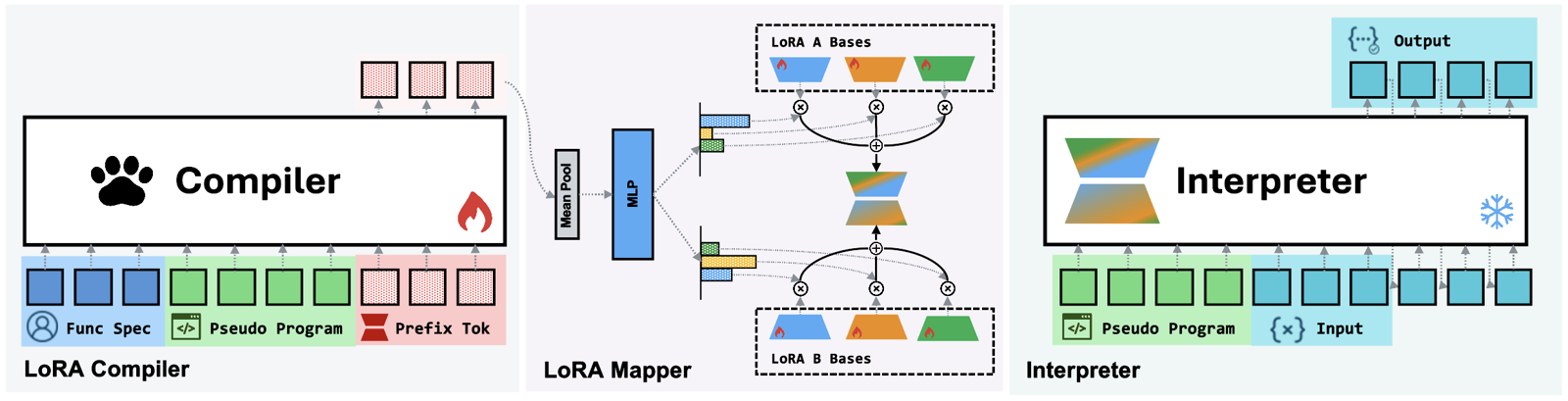
The load-bearing piece is the LoRA mapper. Rather than have the compiler regress raw adapter weights (a huge, unstructured output), it mean-pools the compiler's features and passes them through an MLP that produces mixing coefficients over a set of learned LoRA basis matrices — the emitted adapter is a combination of reusable low-rank factors. That keeps the compiler's output small and well-conditioned, and it's what makes "spec → weights" learnable at all. (An earlier prefix-tuning variant works too; Text-to-LoRA is just the current best.)
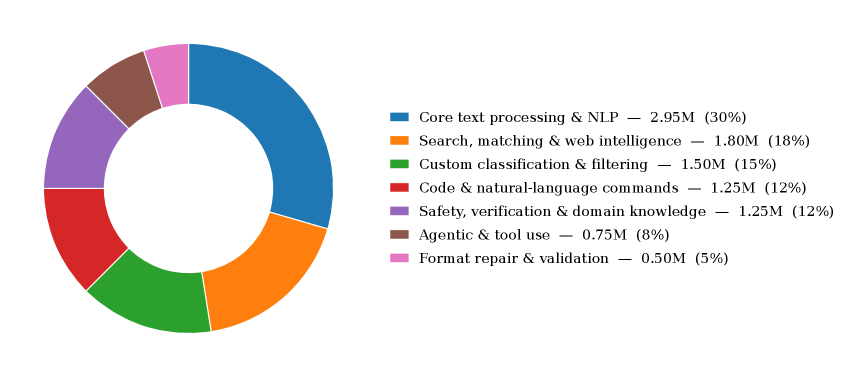
To train the compiler, the authors built FuzzyBench, a 10-million-example dataset of fuzzy functions spanning text processing, search and matching, custom classification, code and NL commands, safety and verification, agentic tool use, and format repair — with clean and noisy specification variants so the compiler learns to be robust to sloppy prompts:
Why compile at all? The economics
The reason this framing matters is cost structure. Calling a big model's API is a cost you pay on every input. PAW pays a one-time compile — a single pass of the 4B compiler — and then each application runs locally for almost nothing. So cumulative cost crosses over fast, and the gap only widens. Drag the number of calls:
That's the thesis in one picture: PAW reframes the foundation model from a per-input problem solver into a tool builder. You invoke the big model once per function definition, get back a small reusable artifact you own, and every function application after that is cheap, offline, and reproducible. Compile a library of them and each becomes a tiny local endpoint:
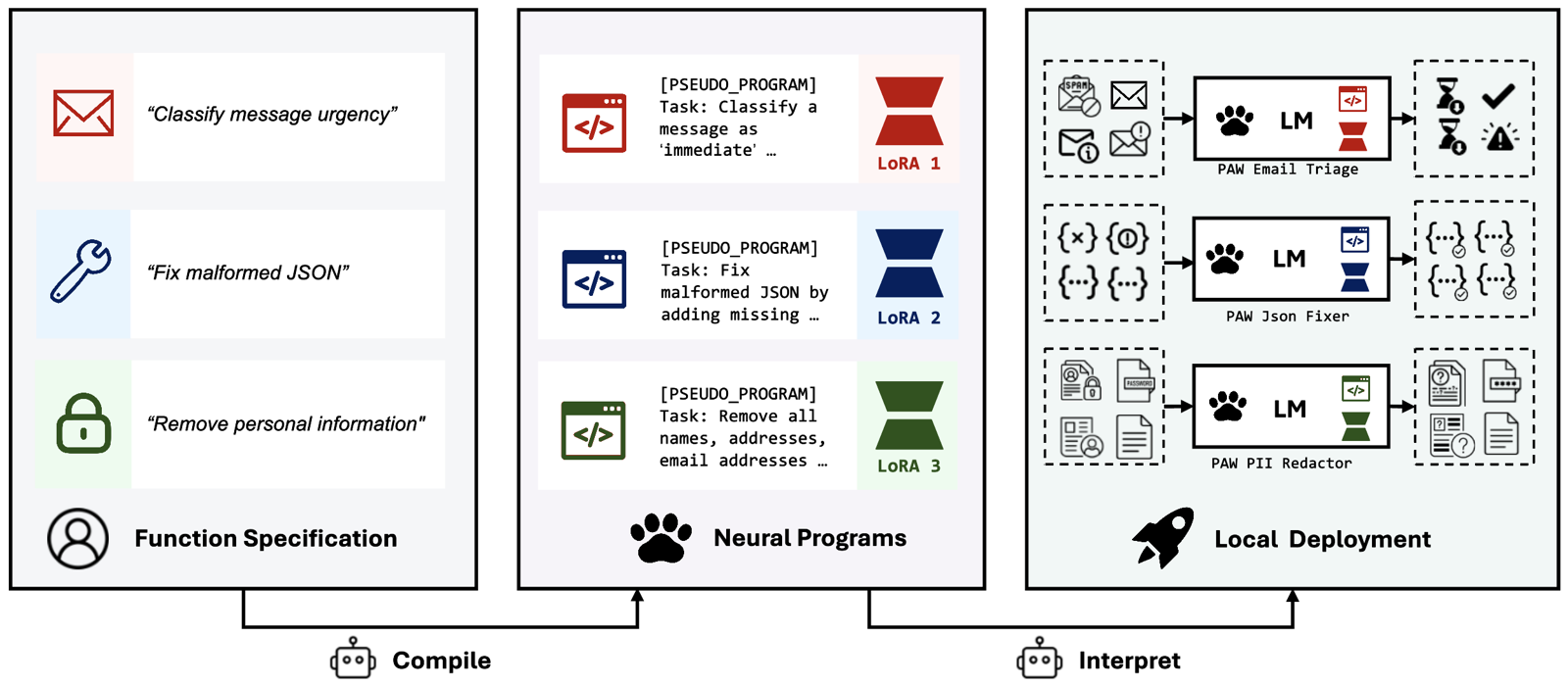
Two practical wins reinforce it: the paper reports the adapters quantize with no measurable accuracy loss, and the whole thing runs at interactive speed (30 tok/s) on a laptop — so the compiled function is genuinely local, not a cloud dependency in disguise.
The honest caveats
PAW is a genuinely new framing, but it buys its efficiency with real constraints, and the paper is candid about them:
- The compiler and interpreter are a coupled pair. An adapter compiled for one frozen interpreter isn't portable to a different one — you commit to an interpreter.
- The compiled program isn't interpretable. Unlike source code, you can't read a LoRA adapter to see what the function does; you can only run it. "Program" is an analogy for the compile-once workflow, not a claim of legibility.
- Single-step fuzzy functions. PAW targets one-shot transformations (classify, repair, rank), not long multi-step agentic control flow.
- Trained on synthetic data. FuzzyBench is model-generated; the compiler's competence is bounded by the distribution of tasks it was synthesized from, and real specs can fall outside it.
- The best adapter type is task-dependent. Text-to-LoRA wins overall, but the paper finds no single parameter-efficient method dominates every task — there's still a choice to make.
- "Matches 32B" is on FuzzyBench-style tasks. The parity is measured on the fuzzy-function distribution PAW is built for, not a claim that a 0.6B model equals a 32B model in general.
The take
What I like about PAW is that it's a systems idea wearing an ML paper's clothes. The interesting move isn't a new architecture — it's noticing that we've quietly turned every fuzzy function into a recurring API bill, and that the compile/runtime split we use for ordinary code applies here too: pay the big model once to build the tool, then run the tool locally forever. The Text-to-LoRA mapper is the clever engineering that makes "spec → weights" tractable, but the reframing is the contribution — a foundation model as a compiler for behaviors rather than an always-on oracle. Whether it generalizes past single-step functions is the open question; as a way to make a hundred small fuzzy tasks local, private, and nearly free, it's one of the freshest ideas of the season. Code, the 4B compiler, and the 10M-example FuzzyBench are released (CC BY 4.0).
Built on Program-as-Weights: A Programming Paradigm for Fuzzy Functions (Zhang, Hotsko, Kim, Nie, Shieber, Deng; University of Waterloo, Cornell, Harvard; 2026, CC BY 4.0). Figures are reproduced from the paper; benchmark and efficiency figures (0.6B ≈ 32B, ~1/50 memory, 30 tok/s on an M3) are quoted from it. The interactive playground and cost model are illustrations of the mechanism, not runs of the released model.