2026-07-16 · 9 min · attention · positional-encoding · transformers
Why read this
Nichelast 15%Walks GRAPE's group-action view in which RoPE is a rotation and ALiBi and FoX are shears, and notes the gains are about a point at 353M-770M only.
- A lasting reference
- A new technique
- Explained from first principles
LLM architectureNothing to runResearch paper
How this was scored
- Is it new?
- 2 of 3: A real new idea, method or capability
- Can I trust it?
- 1 of 3: Spot-checks a few numbers
- Can I run it?
- 0 of 3: Closed, nothing to run
- Will I understand it?
- 2 of 3: Mechanism from first principles with figures
- Can I act on it?
- 1 of 3: General advice
- Will it last?
- 2 of 3: A reference for a year or more
- Does it affect many?
- 1 of 3: A specialist community
- Only here?
- 1 of 3: Some original analysis
Score 44 of 100, ranked 509 of 577 rated articles. Each question is answered 0–3 by hand, and a 3 is rare. How articles are scored
Self-attention has no idea what order its tokens came in — permute the sequence and the raw attention scores are unchanged. So every transformer bolts on a positional encoding, and over the years these have multiplied into a small zoo of unrelated-looking tricks. Rotary embeddings (RoPE) rotate queries and keys by angle-per-position. ALiBi subtracts a linear penalty proportional to how far apart two tokens are. The Forgetting Transformer (FoX) multiplies in a per-token forget gate. Each is derived on its own terms, with its own intuition, and the folklore treats them as competing families: multiplicative phase versus additive bias.
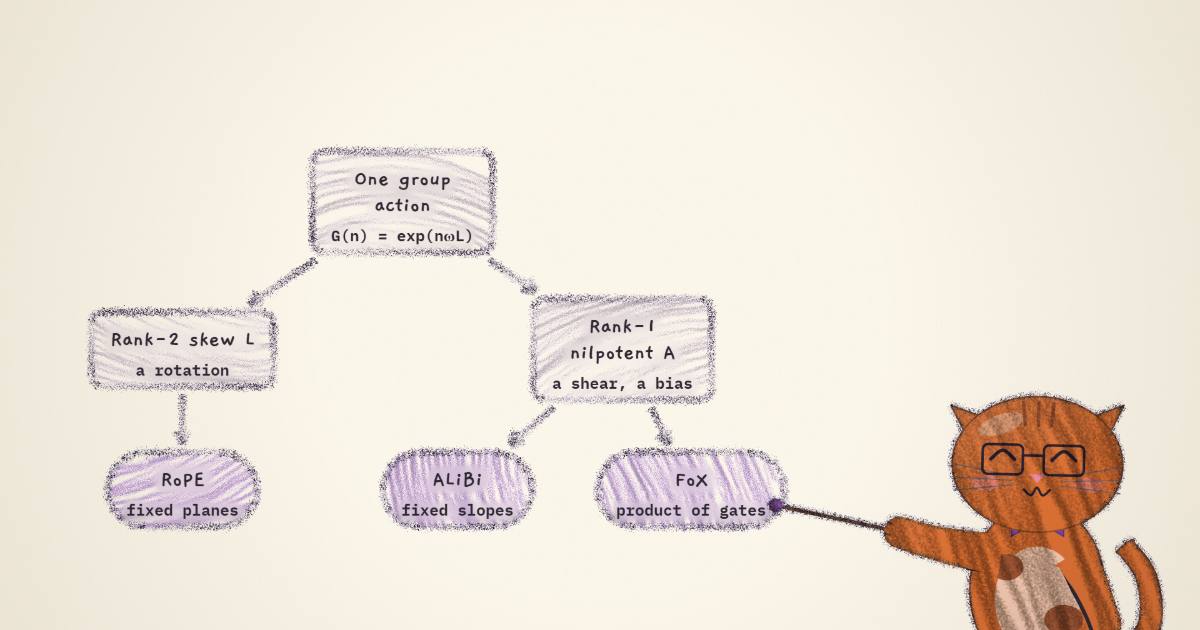
GRAPE — Group Representational Position Encoding, from Princeton, UCLA and Tsinghua's IIIS (ICLR 2026) — makes the deflationary claim that all of them are the same construction seen through different generators. A position acts on the query/key space through one group action,
and which kind of matrix you put in the generator decides the family. A rank-2 skew-symmetric gives a rotation, and RoPE falls out exactly. A rank-1 nilpotent gives a shear that injects a linear bias, and ALiBi and FoX fall out exactly. Scrub a position below and flip the generator to watch the two behaviours emerge from one law:
The payoff of the unification is not a new record — it's a design space. Once RoPE is "the rotation with the canonical basis and a log-uniform spectrum," you can ask what the learned basis does; once ALiBi is "the rank-1 unipotent action with a fixed slope," you can ask what a content-dependent slope does. GRAPE names and tries both.
One law, two generators
The organizing principle is that a positional map should respect an exact relative law:
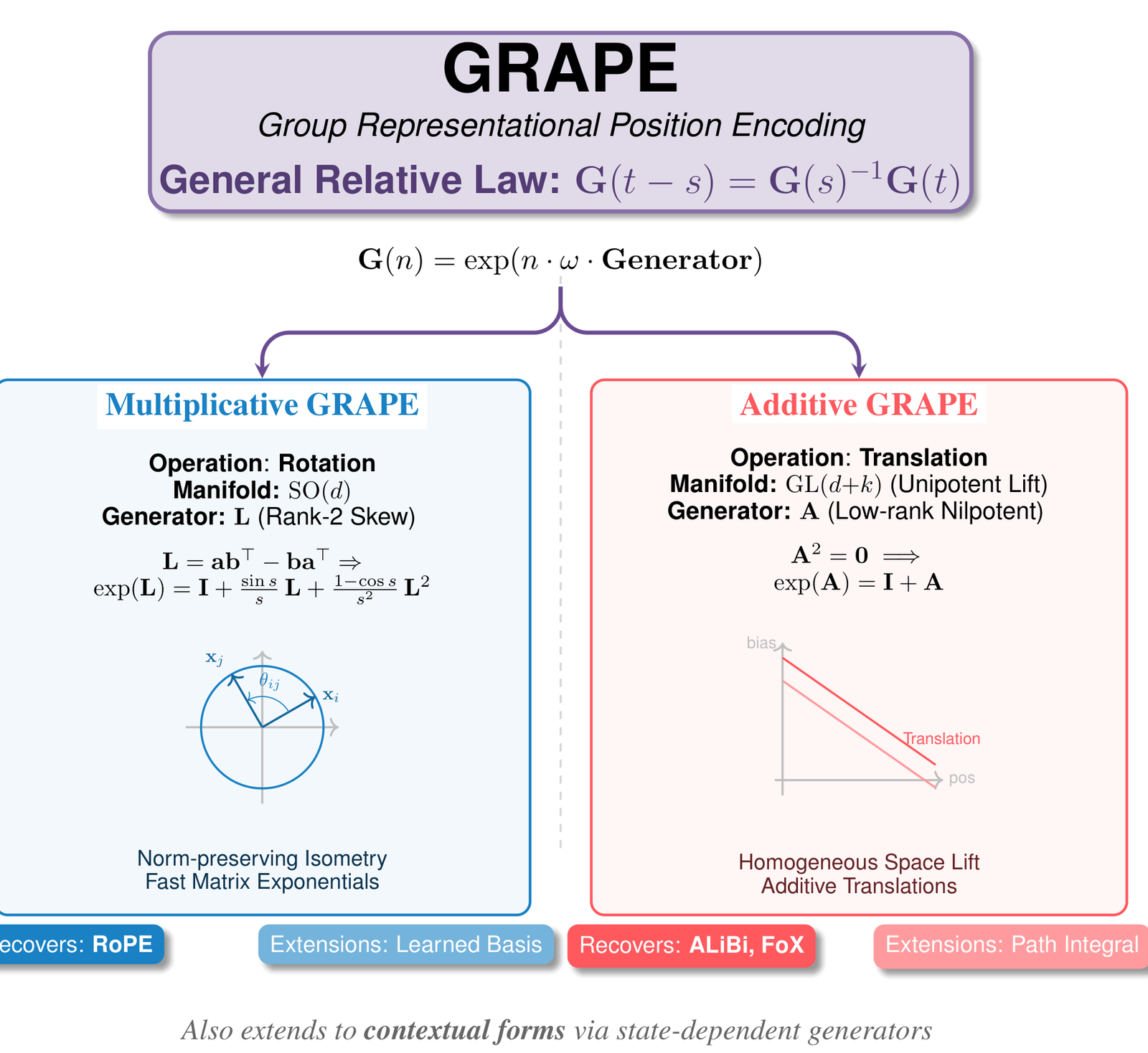
This is what makes attention translation-invariant: if you apply to query and to key , the score depends only on the offset , never on absolute position. Any one-parameter subgroup satisfies it automatically — so the whole design question collapses to which generator to exponentiate. GRAPE identifies the two generator types that keep the exponential cheap and the geometry clean:
- Rank-2 skew exponentiates to an orthogonal map — a norm-preserving rotation in . This is Multiplicative GRAPE.
- Rank-1 nilpotent with exponentiates, in one term, to a unipotent map in the general linear group — a shear that translates a feature and shows up as an additive logit bias. This is Additive GRAPE.
Multiplicative GRAPE: RoPE is a rotation with a fixed basis
Build the generator from two vectors . With , , and , the rank-2 skew squares to on the plane . That single fact collapses the matrix exponential to a Rodrigues-type closed form:
a pure rotation by angle inside the plane , computable in flops with no matrix ever materialized. Stack of these on disjoint coordinate pairs with frequencies and they commute, so
= \mathrm{blockdiag}\big(\mathbf{R}_2(n\theta_1),\dots,\mathbf{R}_2(n\theta_{d/2})\big).$$ That block-diagonal of $2\times2$ rotations *is* RoPE — the paper's Proposition 3.1 states RoPE is **exactly** commuting multi-subspace GRAPE-M with the canonical coordinate pairs and a log-uniform spectrum. What GRAPE adds is the freedom RoPE gives up: the planes and spectrum can be **learned** (commuting subspaces at $O(d)$ per head), or you can allow a compact **non-commuting** mixture (at $O(rd)$ per head) so different feature subspaces can *couple* — geometry the fixed RoPE basis cannot express. ## Additive GRAPE: ALiBi and FoX are shears in a lifted space To get an *additive* bias out of a *multiplicative* group, GRAPE uses the classic trick of a **homogeneous lift**: augment $\mathbf{x}\in\mathbb{R}^d$ to $\hat{\mathbf{x}}\in\mathbb{R}^{d+k}$ and work in $\mathrm{GL}(d+k)$ with a nilpotent generator. Because $\mathbf{A}^2 = \mathbf{0}$, the exponential is just $\mathbf{G}_{\mathrm{add}}(n) = \mathbf{I} + n\omega\mathbf{A}$. With an asymmetric lift $\hat{\mathbf{q}}_i = [\mathbf{q}_i;1;0]$, $\hat{\mathbf{k}}_j = [\mathbf{k}_j;0;1]$ and the rank-1 generator $\mathbf{A}_h = -\beta_h\,\mathbf{e}_{d+2}\mathbf{e}_{d+1}^\top$, the score becomes $$\hat{\mathbf{q}}_i^\top\,\mathbf{G}_{\mathrm{add},h}(j-i)^{-\top}\,\hat{\mathbf{k}}_j = \mathbf{q}_i^\top\mathbf{k}_j + (j-i)\,\beta_h,$$ which is **exactly ALiBi** with head slope $\beta_h$. The nilpotent structure is not decoration: it is what guarantees the exact relative law and clean streaming (cache the rotated keys once). GRAPE then generalizes the *slope*. Replace the constant $\beta_h$ with non-negative softplus gates on the query and key, and the bias becomes **content-dependent**: $$\tilde{\mathbf{q}}_i^\top\tilde{\mathbf{k}}_j = \mathbf{q}_i^\top\mathbf{k}_j + (j-i)\,\omega\big[\mathrm{softplus}(\mathbf{v}^\top\mathbf{q}_i/\sqrt{d}) + \mathrm{softplus}(\mathbf{u}^\top\mathbf{k}_j/\sqrt{d})\big].$$ This is **GRAPE-A-QK**: a learnable, content-adaptive linear bias derived from first principles rather than hand-set per head. Drag the gate below to see the fixed ALiBi head-fan give way to a content-driven slope: <AdditiveBias /> The **Forgetting Transformer** falls out of the same picture. FoX's per-token forget gates accumulate a bias $b_h(t,j) = \sum_{\ell=j+1}^{t}\log f_{\ell,h}$, which is precisely a *path product* of unipotent factors $\prod_\ell(\mathbf{I} + \log f_{\ell,h}\,\mathbf{E}) = \mathbf{I} + b_h(t,j)\,\mathbf{E}$. So FoX is an exact instance of **Path-Integral Additive GRAPE (GRAPE-AP)** — the endpoint-dependent version that keeps row-wise composition and prefix-sum streaming. ## The whole map Put the pieces together and every named scheme is a leaf on one tree. Click through them — each is either *recovered exactly* by a specific generator or sits just past a known method as a GRAPE *extension*: <FamilyMap /> ## Does the extra freedom help? Here is where the honesty starts. GRAPE is validated at **small scale**: 353M and 770M models trained on 50B tokens of FineWeb-Edu, context length 4,096, in a nanoGPT/Llama-style setup, evaluated 0-shot on a standard NLU suite (ARC, HellaSwag, OBQA, PIQA, WinoGrande, SciQ). The training curves are close, but GRAPE's additive variants hold a persistent small edge, and the authors note RoPE showed a training instability at 770M that GRAPE did not: <Figure src="/articles/grape-position-encoding/fig2.png" alt="Two line charts for the medium 353M model on FineWeb-Edu, training loss (left) and validation loss (right), versus training tokens from 0 to 50 billion. Four curves — RoPE (blue), ALiBi (green), FoX (orange), GRAPE-AP (red) — all decline from above 3.1 toward about 2.55–2.6 and stay tightly bunched, with GRAPE-AP and FoX slightly lower than RoPE late in training." caption="Training and validation loss for the 353M model across positional encodings; the curves are close, with GRAPE-AP tracking at or slightly below RoPE and ALiBi throughout (Zhang et al., 2026, Figure 2)." /> On downstream average, the ordering is consistent but the margins are small. For the 353M models, GRAPE-AP (path-integral) is the best of the eight variants, edging FoX and ALiBi, with plain RoPE last: <BenchBars title="353M models · average over 7 NLU tasks (0-shot, %)" unit="%" bars={[ { label: "RoPE", value: 51.73 }, { label: "ALiBi", value: 52.87 }, { label: "FoX", value: 52.96 }, { label: "GRAPE-AP", value: 53.25, highlight: true }, ]} /> The 770M models tell the same story — GRAPE-AP first, RoPE last — again by roughly a point: <BenchBars title="770M models · average over 7 NLU tasks (0-shot, %)" unit="%" bars={[ { label: "RoPE", value: 55.76 }, { label: "FoX", value: 56.30 }, { label: "ALiBi", value: 56.44 }, { label: "GRAPE-AP", value: 56.91, highlight: true }, ]} /> <Callout type="warn"> **Read the wins narrowly.** (1) *Small scale, standard benchmarks.* Everything is 353M/770M on 50B tokens at 4K context, on ARC/HellaSwag-style tasks — there are **no long-context or length-extrapolation experiments** (no RULER, no retrieval), which is striking given the paper motivates itself with long-context and ALiBi's extrapolation. (2) *The rotational story didn't pay off empirically.* The Multiplicative variants that generalize RoPE — GRAPE-M-ctx/nonctx — actually **underperform RoPE** on the large models (54.7–54.8 vs 55.76 avg); all the downstream gains come from the **additive** family, so the framework's practical dominance rests on the ALiBi/FoX side, not the rotation side. (3) *Margins are ~0.3–1.5 average points* over strong baselines, and the ranking flips under the KV-shift setting: with KV-shift enabled, FoX edges GRAPE-AP at 770M (57.09 vs 56.86). (4) *No efficiency measurements.* The $O(d)$/$O(rd)$-per-head costs are stated, not timed — there are no wall-clock or FLOP comparisons. (5) Baselines are the authors' own reimplementations; there is no comparison to tuned production models. The contribution is the **unifying theory and design space**, lightly validated — not a demonstrated accuracy or efficiency SOTA. </Callout> ## The take GRAPE's real product is conceptual compression. Positional encoding stops being a list of tricks and becomes a single knob — *which generator do you exponentiate?* — with RoPE, ALiBi and FoX as three specific settings and a labelled space of alternatives (learned rotation bases, non-commuting mixtures, content-gated slopes, path-integral biases) in between. That is genuinely clarifying, and the exact recoveries are proved, not hand-waved: RoPE as commuting rank-2 rotations, ALiBi as a rank-1 unipotent action, FoX as its path integral. What the paper does *not* yet show is that the new freedom the map opens up buys much at scale — the strongest empirical variant is a modest improvement on the *additive* side, the rotation-generalizing side trails plain RoPE, and the long-context claims the framing invites go untested. As a theory it's a clean unification worth knowing; as a recipe, GRAPE-AP is a small, honest win over FoX-style biases, and the rest is an invitation to experiment. --- *Built on [Group Representational Position Encoding](https://arxiv.org/abs/2512.07805) (Zhang, Chen, Liu, Qin, Yuan, Xu, Yuan, Gu, Yao; Princeton / UCLA / Tsinghua IIIS, ICLR 2026). Equations, tables and figures are quoted from the paper (353M and 770M models, FineWeb-Edu, 0-shot lm-evaluation-harness); the interactive diagrams are illustrations of the mechanism, not measured data. Related reading: [how attention works](/articles/how-transformers-attention-works), [a tour of attention mechanisms](/articles/attention-mechanisms), [MiniMax Sparse Attention](/articles/minimax-sparse-attention), and [how LLM inference works](/articles/how-llm-inference-works).*