2026-08-27 · 13 min · diffusion · reinforcement-learning · reward-design · post-training
Why read this
Notabletop 60%Reads DiffusionOPSD's own code for the exact update and its dir_mode ablation, then restricts the 19-of-20 claim to the seven evaluators anyone can rerun.
- Original analysis
- A new technique
- Concrete numbers to act on
Image & video generationNeeds datacenter GPUsApache-2.0Research paper
How this was scored
- Is it new?
- 2 of 3: A real new idea, method or capability
- Can I trust it?
- 2 of 3: Measures key facts from files, code or configs
- Can I run it?
- 2 of 3: Open code or weights with real limits
- Will I understand it?
- 2 of 3: Mechanism from first principles with figures
- Can I act on it?
- 2 of 3: A concrete recipe, numbers or comparison
- Will it last?
- 1 of 3: Relevant for months
- Does it affect many?
- 1 of 3: A specialist community
- Only here?
- 2 of 3: A teardown or measurement few others did
Score 62 of 100, ranked 279 of 577 rated articles. Each question is answered 0–3 by hand, and a 3 is rare. How articles are scored
Reward-tune a diffusion model and the only signal you get is a single number at the very end of a multi-step denoising trajectory: is the finished image good. Everything in between — the sequence of noisy, half-formed latents the model actually produced the image from — gets no direct instruction. Existing methods turn that endpoint score into a policy-gradient weight and hope the credit propagates backward through the trajectory. DiffusionOPSD instead asks a more specific question at one intermediate point: given where the policy currently is, in which direction should its clean-output prediction move, and by how much — and turns the answer into an ordinary regression target.
The paper is arXiv:2608.24646, from a ByteDance Seed–led team (Wei Zhou et al., with NUS, UC San Diego, and seven other affiliations), and the reference code lives at github.com/worldbench/DiffusionOPSD. This is a read of that source (README.md, scripts/train_opsd_ri_sd3.py, config/opsd_defaults.py) alongside the paper's own LaTeX and figures — not a paraphrase of either.
| Paper | arXiv:2608.24646 · "On-Policy Self-Distillation in Diffusion Models" |
| Code | worldbench/DiffusionOPSD · Apache 2.0 |
| Weights | WeiChow/DiffusionOPSD · 3 rank-32 LoRA checkpoints |
| Backbones | SD3.5-M (512², 10-step) and Z-Image-Turbo (1024², native 9-step) |
| Headline | best final held-out score in 19 of 20 reward-matched settings, both backbones, 10 evaluators |
| Cost | 40% fewer GPU-hours than DiffusionNFT on SD3.5-M, 63% fewer on Z-Image-Turbo |
| Evaluator mix | 7 public checkpoints + 3 internal models (not distributed, not independently reproducible) |
- task
- text-to-image
- library
- diffusers
- license
- apache-2.0
- safetensors
- 9 shards
- largest file
- 317.6 MB
- files
- 23
- downloads
- 0
- likes
- 10
repo last modified 2026-09-07
The anchor, and the two targets built around it
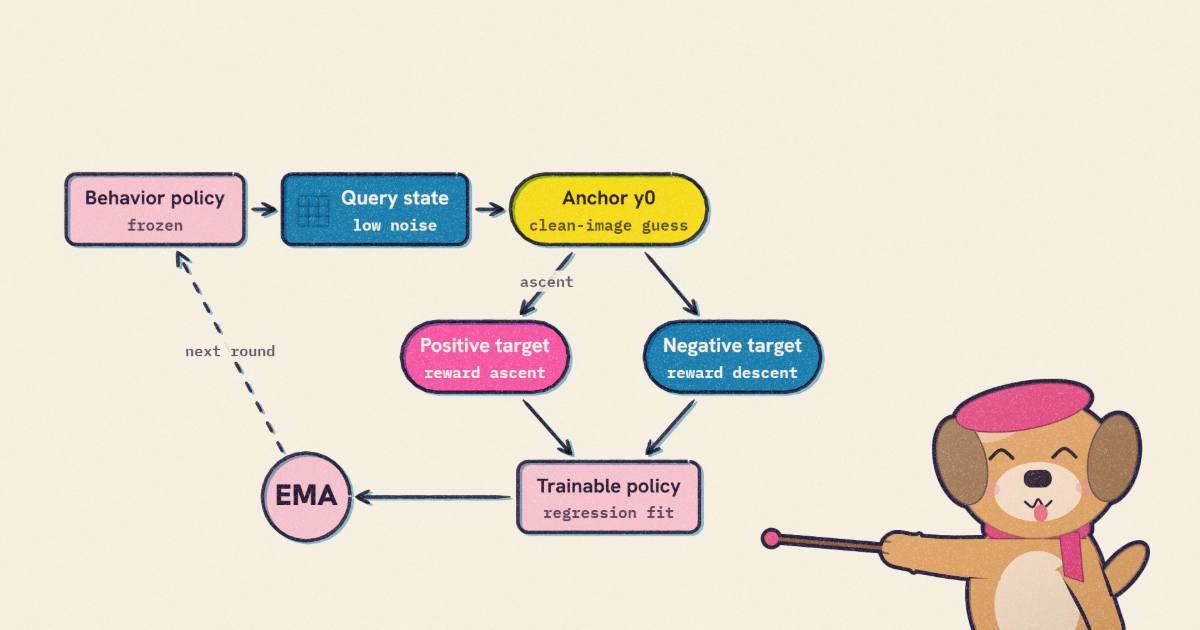
At an outer iteration, a frozen behavior policy generates a rollout and hands over one low-noise query state . Its clean-output prediction at that state is the anchor:
That single equation is the whole trick: instead of scoring the final image and backpropagating through every step, DiffusionOPSD steps directly to what the current, frozen policy already believes the clean image looks like from this one state, and treats that as a fixed point to push around.
From the anchor, a reward-gradient ascent step builds a positive target and a descent step builds a negative target, both clamped inside a trust region of radius :
Both targets are then detached — reward and decoder graphs are thrown away — and the trainable policy is fit to them with a plain weighted regression loss:
After the finite fitting budget is spent, an EMA folds the trained weights back into the behavior policy, which then produces the next round's anchors. That loop — collect on-policy, construct bounded targets, fit them as detached regression, refresh the behavior policy — is the entire method.
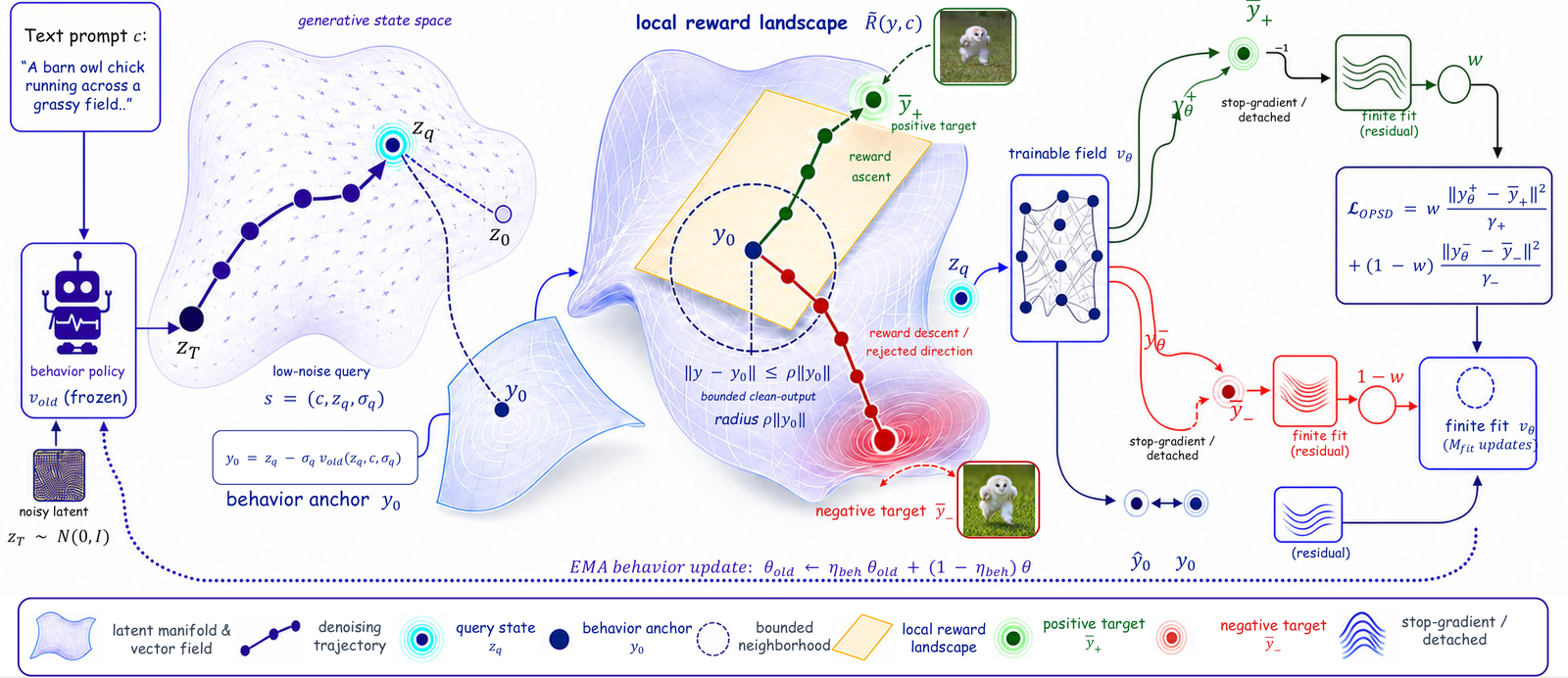
The paper is careful to name three separate things it calls "reward": the endpoint reward that scores a finished rollout and sets the fitting weight (via a group-normalized advantage), the local reward evaluated on a clean-output prediction that actually builds the targets, and a fixed-suffix reward used only to measure construction and realized gains at the same query, before and after fitting. Keeping these separate is what lets the paper ask a question most reward-tuning papers can't: did a bigger target-construction gain actually turn into a bigger realized gain after one update? Its answer, stated plainly in the abstract, is no — "larger target-construction gains do not necessarily translate into larger realized gains after a single fitting update."
Is the win the gradient, or just the perturbation?
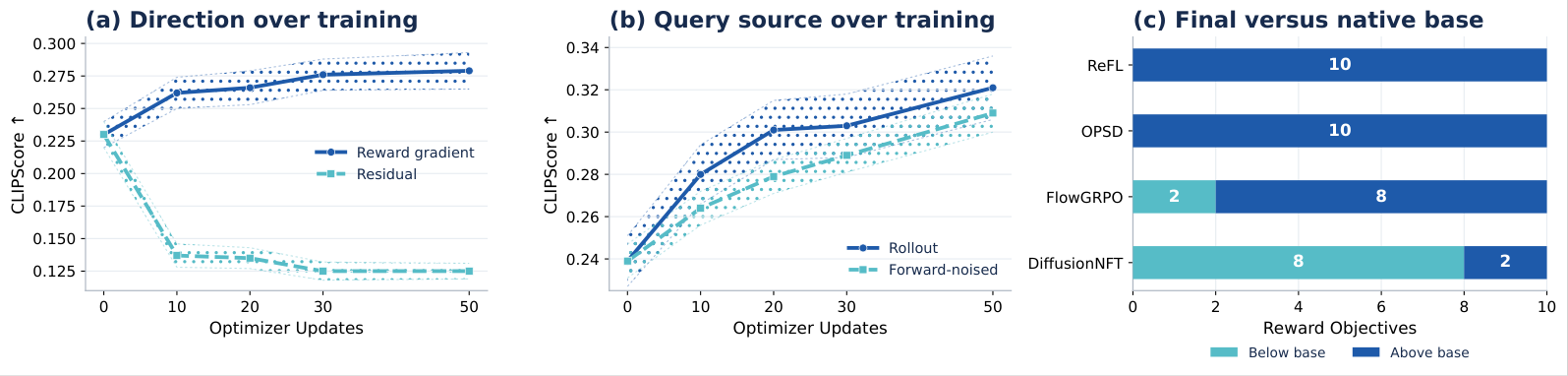
The obvious objection to any trust-region method is that displacing a prediction and fitting to the displacement might help regardless of which direction you pick — regularization by perturbation, not by reward. The repository's training script has a dir_mode ablation switch built directly into the target-construction function (_opa_tr_step, scripts/train_opsd_ri_sd3.py) that answers exactly this, with four real code paths rather than four config relabels:
# dir_mode selects the step direction (ablation knob; 'grad' IS the method):
#   'grad'     : the TRAINING reward's gradient at y0 — the method.
#   'rand'     : a fixed random unit direction, same trust region, no reward info.
#   'residual' : the denoising residual (x_end - y0) direction (ATC-style).
#   'noop'     : no displacement (y+ = y- = y0) — a no-perturbation control.
The paper ran this exact ablation for 50 real optimizer updates and reported held-out CLIPScore on 512 held-out prompts: 0.3122 for the reward gradient, against 0.2363 for no displacement at all, 0.2303 for a random direction at the same radius, and 0.1256 for the rollout-residual direction — which is worse than doing nothing. That last number is the interesting one. The residual direction is the thing closest in spirit to a plain distillation target (move toward where the rollout actually ended up), and it is the one that actively hurts. The trust-region perturbation by itself buys nothing; the reward gradient is carrying the entire result.
A second, smaller ablation checks the other half of "on-policy": does the query state need to come from an actual rollout, or would an offline forward-noised state work just as well? Swapping in a forward-noised control moved held-out CLIPScore from 0.3122 to 0.3089 — a 1.1% relative drop, against gaps above 7.5 percentage points for the direction controls above. On-policy query collection matters far less than the reward-gradient direction does, in this specific low-noise setting the paper evaluates.
The result, and what "19 of 20" is actually made of
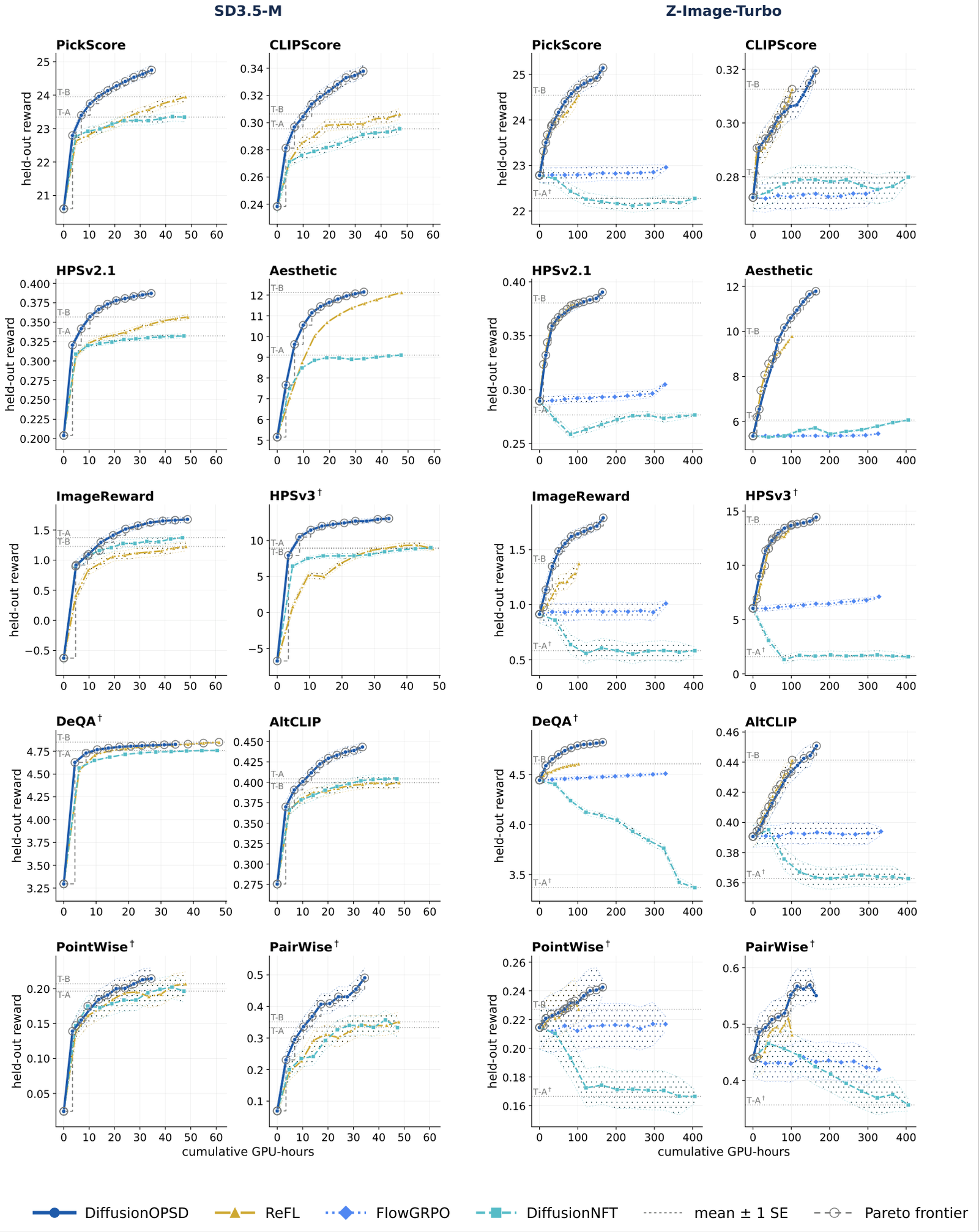
Across SD3.5-M and Z-Image-Turbo, ten evaluators score every held-out image. Seven of them are public checkpoints anyone can download and run — PickScore, CLIPScore, HPSv2.1, an Aesthetic predictor, ImageReward, HPSv3, DeQA. The other three, the paper's appendix states outright, are internal reward models: an AltCLIP-architecture model "trained on our internal data," a scalar VLM-Pointwise preference model, and a VLM-Pairwise model that scores a generated image against a fixed reference image — itself generated by a different proprietary model, Seedream 5.0 Pro. None of the three ship with the code release.
Restricting the count to only the seven public evaluators barely moves the needle — 13 of 14 against 19 of 20 — so the internal columns are not quietly propping up an otherwise unremarkable result; the public subset alone shows almost the same dominance. But the single largest percentage anywhere in the paper, the "+44.0%" figure the abstract leads with, is the SD3.5-M VLM-Pairwise gain — the one column judged by an internal model against references from a different company's proprietary generator. Both facts survive being stated in the same sentence: the aggregate claim holds up under the strictest reasonable filter, and the biggest single number is on the one axis nobody outside ByteDance can independently check.
Held out from that count, and worth reading as its own result: on 100 held-out Z-Image-Turbo prompts, human annotators with STEM degrees, blinded and randomized, preferred DiffusionOPSD's outputs over the base model, FlowGRPO, DiffusionNFT, and ReFL on 64%, 71%, 90%, and 61% of prompts respectively. That is a genuinely independent check — VLM judges did not touch it — and it still clears the majority threshold against every baseline, including the strongest one.
The cost claim, read at the same precision
The GPU-hour numbers are measured wall-clock on eight GPUs, not modelled, and they check out to the decimal: 28.2 against DiffusionNFT's 47.2 on SD3.5-M is a 40.3% cut, 149.8 against 405.8 on Z-Image-Turbo is 63.1%. The paper's own text adds a detail its headline figures don't: on Z-Image-Turbo, ReFL trains at 102.1 GPU-hours per 100 updates — a third cheaper than DiffusionOPSD's 149.8. DiffusionOPSD still wins every one of the ten Z-Image-Turbo reward-matched evaluator comparisons, ReFL included, so the result the paper is actually claiming there is quality at that cost, not lowest cost outright — and it says so explicitly. The "40% / 63%" framing is precise about its baseline being DiffusionNFT specifically; reading it as "cheapest available" would be over-reading the abstract, not a flaw in it.
One number the paper flags rather than hides: peak VRAM is not uniformly lower under DiffusionOPSD — 50.0 GB against DiffusionNFT's 47.8 GB on SD3.5-M, 61.5 GB against 49.9 GB on Z-Image-Turbo. Fewer GPU-hours, more memory per GPU; the paper states this plainly rather than only quoting the number that favours it.
The paper's own baselines are built on it
One more piece worth naming: the opd/ directory in the repository implements three second-stage distillation baselines — DanceOPD, DiffusionOPD, FlowOPD — that don't compete with DiffusionOPSD so much as consume it. All three train a single shared student by distilling from three frozen DiffusionOPSD specialists (trained separately on PickScore, CLIPScore, and HPSv2.1), using different transfer objectives: DanceOPD matches velocity at one low-noise query, DiffusionOPD matches transition means across all ten denoising steps, and FlowOPD is a full clipped-PPO transition-log-probability objective. All three land below the jointly-trained DiffusionOPSD policy on all three shared objectives in the paper's Table 1 — which is a reasonable result, since none of them ever sees a reward signal directly; they only see what the three specialists already learned.
A repository that calls itself something the paper doesn't
One detail is worth being precise about rather than papering over. The arXiv listing for 2608.24646 links to github.com/worldbench/DiffusionOPSD as its code. That repository's own README opens with a line the paper's citation doesn't carry: "Note: This is an external implementation of the algorithm in the following paper." Every hyperparameter default, every baseline configuration, and every number in the README's results tables matches the paper's Table 1 to the decimal, including the OPD family described above — so whatever the disclaimer means, it isn't describing a loose or approximate reproduction. It might be standard scope language distinguishing a released reference implementation from an internal training stack that used different infrastructure to produce the same numbers, or it might mean something narrower. The paper's own citation treats the repository as its code; the repository's own first line hedges that. Both statements are on the record, and this is worth knowing before treating the released LoRA checkpoints as a byte-for-byte replica of whatever produced Table 1.
What ships, and what one released checkpoint can't do
Three rank-32 LoRA adapters are on Hugging Face: sd35-m-hpsv3 and z-image-turbo-hpsv3, both trained against the public HPSv3 evaluator, and z-image-turbo-pointwise. That third one is trained against VLM-Pointwise — one of the three internal evaluators above — and the README says so without hedging: "The corresponding paper evaluator is not included in this repository." You can load the checkpoint and generate images with it; you cannot independently re-score what it was optimized for, because the scorer that trained it was never released.
import torch
from diffusers import DiffusionPipeline

pipe = DiffusionPipeline.from_pretrained(
    "Tongyi-MAI/Z-Image-Turbo", dtype=torch.bfloat16, device_map="cuda"
)
pipe.load_lora_weights("WeiChow/DiffusionOPSD", subfolder="z-image-turbo-hpsv3")
image = pipe("Astronaut in a jungle, cold color palette, muted colors, detailed, 8k").images[0]
The public installation path is unusually candid about its own rough edges, too — the README documents a pip check mismatch it says is intentional (ImageReward's package metadata pins an obsolete timm, while its actual inference code runs fine on the validated stack), and ships scripts/smoke_reward_gradient.py specifically to verify each of the seven public reward adapters produces a finite, nonzero image-space gradient before a multi-GPU job is launched on it.
The ledger
What is genuinely well-isolated. The dir_mode ablation is the best thing in the release: a single flag in real training code, not a paper-only appendix number, that turns off the reward-gradient direction while holding every other piece of the pipeline fixed — same trust region, same detached fit, same EMA. The result (residual worse than no-op, both far behind the gradient) is exactly the kind of controlled comparison that most reward-tuning papers assert rather than demonstrate.
What holds up under scrutiny. The 19-of-20 headline survives being restricted to the seven publicly checkable evaluators (13 of 14). The 40%/63% efficiency numbers check out to the decimal against their stated baseline. The human-preference win rates are a genuinely separate signal from the VLM judges and still clear a majority against every baseline.
What doesn't fully close. The single largest number in the abstract sits on an internal, non-reproducible evaluator scored against a different company's proprietary model's outputs. One of three released checkpoints was trained against a scorer nobody outside the lab can rerun. And the repository the paper cites as its code describes itself, in its own first line, as an external implementation — a tension the paper's citation doesn't acknowledge and the repository doesn't resolve.
What I'd want to see next. The same dir_mode-style ablation switch, but for the three internal evaluators — even a description of what VLM-Pointwise's training data looked like would let an outside reader judge how much of the win-count is generalizable preference and how much is a byproduct of that one judge's own training distribution. Until then, the honest summary is: the mechanism is real, checkable, and the ablations back it — the size of the win depends partly on evaluators only one lab can run.