2026-08-26 · 19 min · tts · audio · inference · realtime
Why read this
Hightop 30%Reads Breeze TTS 2's config and headers: unnamed Gemma, Qwen3 and Qwen codec parts, 1.18 GiB that never runs, a TTFA clock that skips the encoder, a cropped #1.
- Original, source-checked analysis
- Interactive explanations
- Concrete numbers to act on
Speech & audioRuns on a consumer GPUNon-commercial licencePractitioner model
How this was scored
- Is it new?
- 1 of 3: An incremental tweak
- Can I trust it?
- 3 of 3: Reproduces the headline result, or shows from primary files it is wrong
- Can I run it?
- 1 of 3: API-only, gated or restrictive licence
- Will I understand it?
- 3 of 3: Mechanism carried by interactives built from real code or data
- Can I act on it?
- 2 of 3: A concrete recipe, numbers or comparison
- Will it last?
- 1 of 3: Relevant for months
- Does it affect many?
- 1 of 3: A specialist community
- Only here?
- 3 of 3: The only place this analysis exists
Score 69 of 100, ranked 129 of 577 rated articles. Each question is answered 0–3 by hand, and a 3 is rare. How articles are scored
Breeze TTS 2 shipped on 25 August 2026 with weights on the Hub, a PyTorch streaming runtime, a Dockerfile pinned to four exact versions, and a README that leads with "under 40 ms time to first audio" and "#1 among open-weight models". The model card names no component of the architecture. config.json names all of them.
So this is a read of the checkpoint and the runtime rather than the marketing: what the token stream is, what it costs to emit, where the latency actually goes, and which of the headline numbers survive being checked.
| Checkpoint | BreezeBlue/Breeze-TTS-2 · 3.47 B parameters · 7.12 GiB of weights on disk |
| Text encoder | Gemma-3-1B as a bidirectional T5Gemma2TextEncoder — 26 layers, 1152 wide, ±256 sliding window, full attention every 6th layer |
| Backbone | Qwen3-1.7B's layer stack, verbatim — 28 layers, 2048 wide, GQA 16/8, text embedding replaced |
| Depth decoder | 12 layers, 1024 wide, 15 codebook heads of [1024, 2051] |
| Codec | qwen3_tts_tokenizer_12hz — Mimi-shaped encoder, custom decoder · 12.5 Hz · 16 RVQ codebooks × 2048 entries |
| Token rate | 200 codec tokens / s of audio · 2.20 kbit/s · 24 kHz mono out |
| Serial cost | 2,700 transformer-layer evaluations per second of speech |
| Streaming | chunk_frames 1 (fast) or 2 (eager) · zero lookahead · ~11.6 MiB of state per stream |
| Concurrency | the shipped API serves one request at a time — HTTP 409 otherwise |
| Licence | code Apache-2.0 · weights research / non-commercial, no hosting, no distillation |
- architecture
- BreezeForConditionalGeneration
- task
- text-to-speech
- library
- transformers
- license
- other
- safetensors
- 3 shards
- largest file
- 4.96 GB
- files
- 17
- downloads
- 12.6K
- likes
- 607
- languages
- en, zh
These add to 3.48B, not the 3.47B total — expected when a packed format stores more than one value per element.
repo last modified 2026-09-09
The stack, read off config.json
Nothing in the README or the model card says what Breeze TTS 2 is made of. The config does, in three places.
The text side is Gemma. config.json carries a text_encoder_config with model_type: "t5gemma2_text", architectures: ["T5Gemma2TextEncoder"], 26 layers, hidden_size 1152, head_dim 256, intermediate_size 6912, 4 attention heads over 1 KV head, sliding_window 512, and query_pre_attn_scalar 256 — Gemma-3-1B's shape, term for term. tokenizer_config.json removes any doubt: "tokenizer_class": "GemmaTokenizerFast", "processor_class": "Gemma3Processor", <start_of_image> at id 255999. The vocabulary is Gemma 3's 262,144 plus fourteen additions — <|AUDIO|>, <|audio_eos|>, ten speaker tags [S0]–[S9], and <ins_bos>/<ins_eos>.
The audio side is Qwen. config.json embeds a backbone_config block that is byte-for-byte Qwen3-1.7B's own config.json — same 28 layers, same 2048/6144, same head_dim 128, same rope_theta 1000000, same bos_token_id 151643, same transformers_version: "4.51.0". I summed the shipped tensors: backbone_model.* is 1,409,410,048 parameters, and Qwen3-1.7B's 28 layers plus final norm are 1,409,402,880 — the 7,168 difference is exactly 28 × 256, the per-layer q_norm and k_norm vectors that Qwen3 has and my hand count did not. It is the same stack, with BreezeBackboneFactory swapping the text embedding for one that reads codec tokens.
And the codec is Qwen's too. audio_tokenizer/config.json declares Qwen3TTSTokenizerV2Model, model_type: "qwen3_tts_tokenizer_12hz", loaded at runtime out of the pip package qwen-tts==0.1.1. Its encoder is Mimi with the decoder deleted, and the deletion is the whole class body:
class Qwen3TTSTokenizerV2Encoder(MimiModel):
    def __init__(self, config: MimiConfig):
        super().__init__(config)
        self.upsample = None
        self.decoder_transformer = None
        self.decoder = None
So the analysis side is Kyutai's Mimi — all 32 of its quantizers still on disk, truncated to the first 16 at encode time by encoder_valid_num_quantizers — and the synthesis side is a separate ConvNeXt/Snake stack with its own quantiser weights: encoder.quantizer and decoder.quantizer are different tensors in the same file. Three organisations' models in one checkpoint, redistributed under a licence more restrictive than any of theirs.
Two vestigial strings are worth noticing because they say what this was built from: "backbone_flavor": "llama-1B" and "decoder_flavor": "llama-100M", alongside the Sesame copyright header on models/breeze_base_config.py. This is a CSM descendant — Sesame's backbone-plus-depth-decoder shape — with the two Llamas replaced by a Qwen3 and a bigger depth decoder, and a Gemma encoder bolted onto the front.
The token stream: 12.5 Hz is not 12.5 tokens
The frame rate is the number everyone quotes, and on its own it tells you very little.
audio_tokenizer/config.json gives encode_downsample_rate: 1920 and input_sample_rate: 24000. That is 12.5 frames per second, and decode_upsample_rate: 1920 means each frame decodes back to 1920 samples — 80 ms of audio. Twelve and a half hertz is the same frame rate Qwen-Audio-3.0-TTS uses, and that model emits 12.5 tokens per second of speech.
Breeze emits 200, because each frame is 16 residual codebooks deep at 2048 entries each.
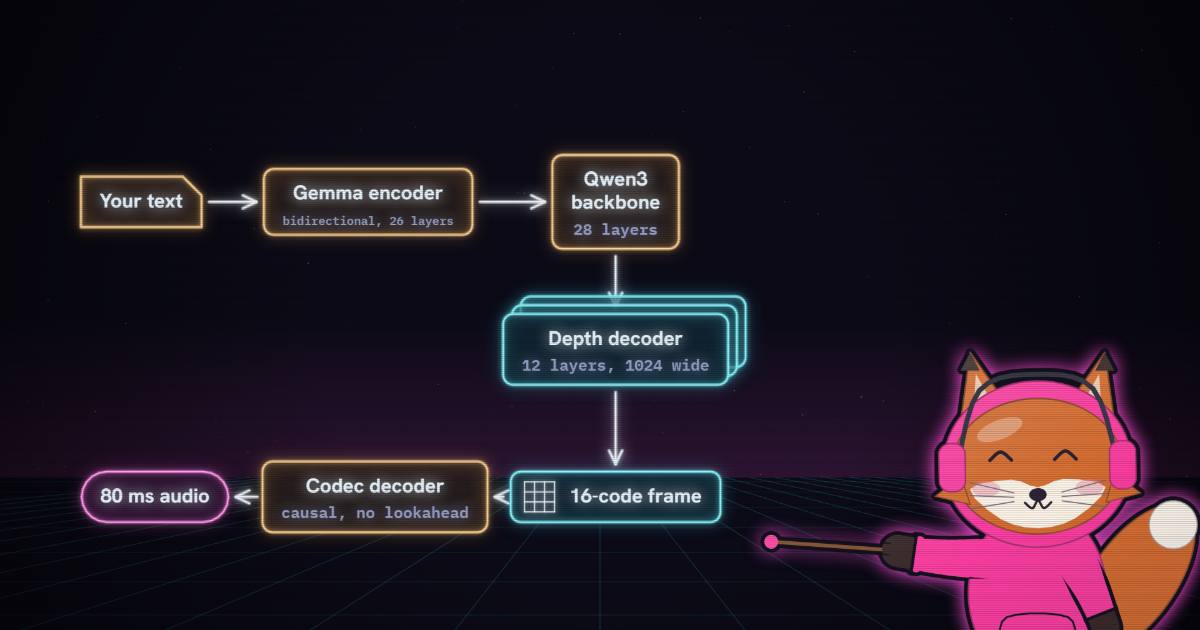
The arithmetic that saves it is the split. models/fast_streaming.py samples codebook 0 from the Qwen3 backbone, hands the backbone's hidden state to a 12-layer, 1024-wide depth decoder, and gets codebooks 1–15 back:
depth_tokens = self._depth_decoder_graph.run(depth_hidden, token_batch, ...)
frame = torch.cat([token.view(1), depth_tokens[0]], dim=0)   # 16 codes
So only 12.5 of those 200 tokens per second touch the 1.4 B-parameter model. The other 187.5 go through a model 3.2× smaller. That is the whole trick, and it is CSM's trick — Breeze's contribution is making the depth decoder three times deeper than Sesame's default (12 layers rather than 4) and then engineering around the cost.
Sixteen codebooks, and you cannot drop one
RVQ's usual selling point is that depth is a dial. Keep the first four codebooks for a cheap coarse stream, all sixteen when you want fidelity. Breeze does not offer that, and the reason is one line.
Qwen3TTSTokenizerV2Decoder.forward opens with a shape check against num_quantizers, and the streaming runtime always stacks all sixteen before calling it. Depth here is a property of the checkpoint, not a knob.
There is one loose thread in the codec config. decoder_config.semantic_codebook_size is 4096, which would give the semantic codebook twice the vocabulary of the acoustic ones — but SplitResidualVectorQuantizer is constructed with bins=config.codebook_size, so every one of the sixteen gets 2048 entries. The field is dead, and the checkpoint agrees: decoder.quantizer.rvq_first weighs 0.79 M parameters, which is 2048 × 256 plus two 512↔256 projections, not 4096 × 256.
The language model's side of the boundary is slightly wider than the codec's. lm_head is [2052, 2048] — 2051 codebook classes plus one extra EOS class at index vocab_size — and the runtime permanently suppresses ids 2048, 2049 and 2050 on every sample:
self._reserved_codec_token_ids = tuple(
    range(self._codec_codebook_size, int(self.model.config.vocab_size))
)
Three logits that can never be chosen, on every one of the 200 samples per second. Harmless, and a good tell that the vocabulary was inherited rather than designed.
Where the latency actually goes
The interesting thing about this stack is that the big model is not the long pole.
Eighty milliseconds of speech costs 28 layer evaluations on the Qwen3 backbone and 180 on the depth decoder, because the depth decoder runs fifteen times per frame. At batch one, decode steps are launch- and bandwidth-bound rather than FLOP-bound, so 180 small serial steps hurt more than 28 large ones. That is why --fast-depth-decoder gets the most aggressive treatment in the whole repo — models/cudagraph/depth_decoder_graph.py unrolls the entire fifteen-step loop and captures it as one CUDA graph, with the sampling parameters and the CFG guidance scale living in pre-allocated tensor buffers so they can change without recapture.
The other piece of latency engineering is a reordering, and the code says why:
# A complete codec frame can be decoded immediately. Emit it
# before computing the next backbone token so that one full
# backbone decode step is no longer on the TTFA critical path.
That is a real 28-layer saving on the first chunk, and it is the kind of change you only make after staring at a profile.
The codec decoder is where streaming is won or lost
A vocoder that needs future frames puts a floor under latency that no amount of graph capture can lift. Breeze's does not need them, and models/stream_runtime/stream/lane.py is 435 lines of making sure.
Every causal convolution is rebuilt as a step function with an explicit left cache — left_cache_len = conv.padding for a normal conv, (kernel - 1) // stride for a transposed one — and the pre-transformer gets a StaticShiftKVCache whose window is the config's sliding_window: 72, i.e. 5.76 seconds of history and no future at all. Persistent state per stream is 528.25 KiB of convolution caches plus 4.50 MiB of KV; the scratch workspace at chunk_frames=1 is 6.59 MiB. Call it 11.6 MiB per concurrent stream, in fp32, because every tensor in audio_tokenizer/model.safetensors is F32.
The cost of that rewrite is coupling. models/stream_runtime/core/compat.py reaches into qwen_tts.core.tokenizer_12hz.modeling_qwen3_tts_tokenizer_v2 for six internal modelling classes by name — Qwen3TTSTokenizerV2CausalConvNet, Qwen3TTSTokenizerV2DecoderDecoderResidualUnit, and friends. requirements.txt pins qwen-tts==0.1.1 and the Dockerfile's smoke check asserts that exact version at build time, which is the honest way to ship something this brittle.
Voice cloning is a prompt prefix, not a speaker embedding
There is no speaker encoder anywhere in this checkpoint. breeze_infer/templates.py builds the reference into the token sequence itself:
def _ref_edit_tata_segments(request):
    prefix = _speaker_prefix(request)          # "[S0]"
    return [
        {"type": "text", "text": f"{prefix}{request['ref_text']}"},
        _ref_audio_segment(request),           # <|AUDIO|> × T frames, then <|audio_eos|>
        {"type": "text", "text": f"{prefix}{INSTRUCTION_BOS}{request['instruction']}{INSTRUCTION_EOS}{request['text']}"},
    ]
The reference wav goes through the Mimi encoder to [T, 16] codes, one <|AUDIO|> placeholder is emitted per frame, and _merge_input_ids_with_input_values replaces each placeholder's embedding with the sum of sixteen per-codebook lookups:
self.embed_audio_tokens = nn.Embedding(config.num_codebooks * config.vocab_size, hidden_size)
...
input_embeds = self.embed_audio_tokens(input_ids + self.audio_tokens_offsets).sum(dim=2)
Text positions, meanwhile, are filled with the Gemma encoder's output projected 1152 → 2048 by a single bias-free Linear. One projected encoder state per text token, one summed codebook vector per audio frame, all in the same causal sequence. No cross-attention anywhere. The text encoder is bidirectional (self.is_causal = False in models/t5gemma2_compat.py), which means the whole utterance must be known before the first token can be sampled — this streams its output, not its input.
The genuinely elegant piece is the guidance. For voice direction, the negative branch is not an empty prompt:
def _ref_edit_tata_negative_segments(request):
    return _ref_clone_tata_segments(request)   # same reference, no instruction
Positive is reference + instruction, negative is reference alone, so uncond + scale × (cond − uncond) amplifies exactly the instruction delta and leaves the speaker identity where it was. --cfg-scale 4 is the README's recommendation, and it costs a branch_batch_size of 2 through both the backbone and the depth decoder.
There is a third CFG mode in templates.py — build_dual_branches returns separate uncond, ref and ins branches with independent scales — and it is unreachable. infer.py and breeze_infer/api.py both hard-code guidance_scale_ref=None, and the fast runtime rejects it outright:
def reject_dual_cfg(inputs):
    ...
    raise ValueError("fast streaming supports only no_cfg and single_cfg; ...")
Checking the headline numbers
Three claims are worth the arithmetic.
"Ranks #1 among open-weight models ... while outperforming frontier proprietary systems." The repo ships its own chart of the Artificial Analysis TTS arena, drawn the day of release.
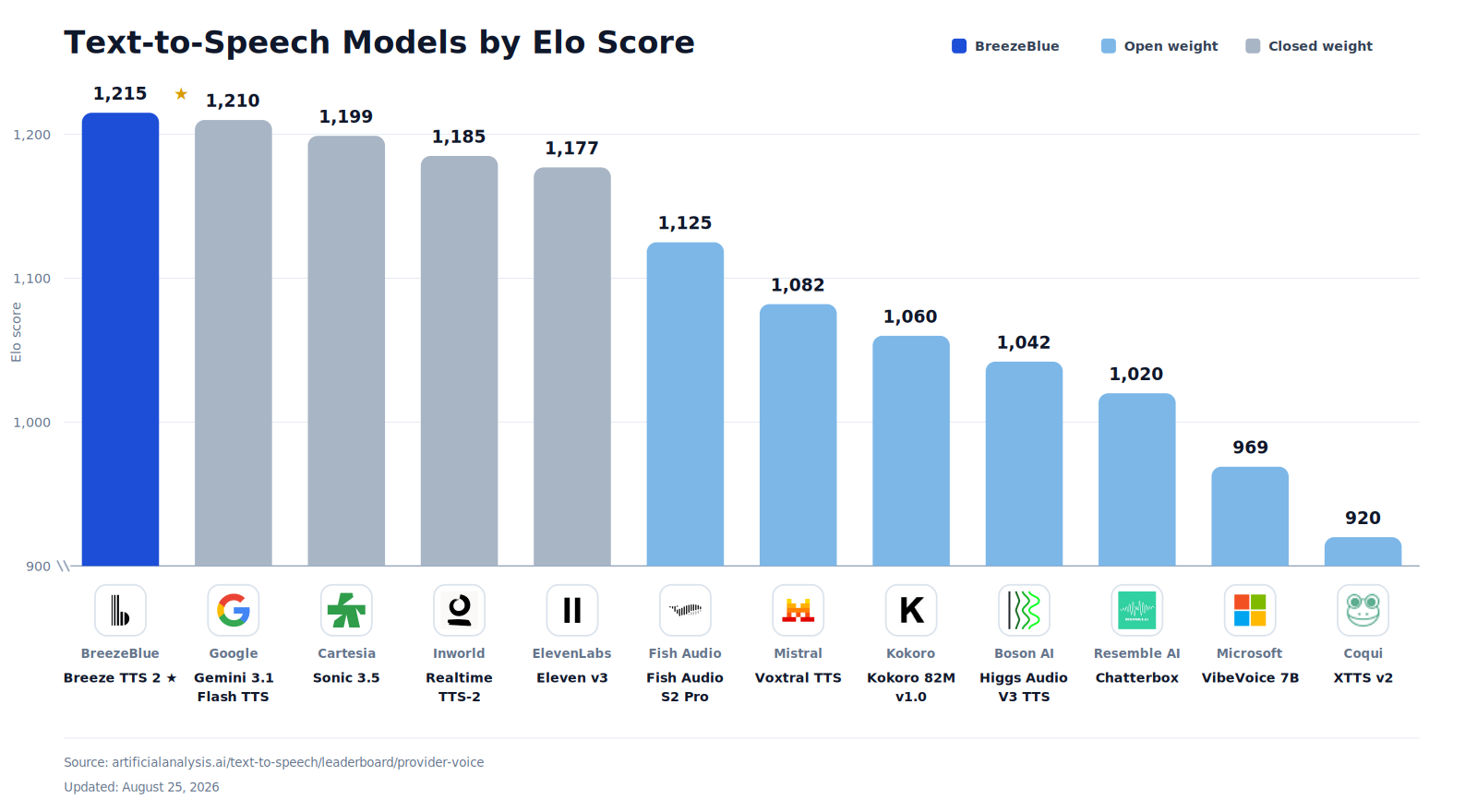
The Elo score is right — 1,215 is what the live board says. The ranking is a selection effect. On the board today Breeze TTS 2 sits sixth, behind Cartesia Sonic 3.6 (1,283), Qwen-Audio-3.0-TTS-Plus (1,238), Speechify Simba 3.2 (1,238), VUI Labs Luna TTS (1,223) and ElevenLabs v3 Conversational (1,219). Every one of those five is missing from the chart, including a newer Cartesia model when an older Cartesia model is shown. The narrower claim — first among open-weight entries — probably survives: the board does not label weight status, and I could not confirm it for every entry above. The picture does not.
The five-point margin over Google is not a margin anyway. Five Elo points is an expected win rate of 1/(1 + 10^(-5/400)) = 50.7%, and Breeze has 1,095 comparisons on the board, the smallest sample in the top fifteen. That gap is noise.
"Under 40 ms TTFA." This one is true and it does not mean what a reader will assume.
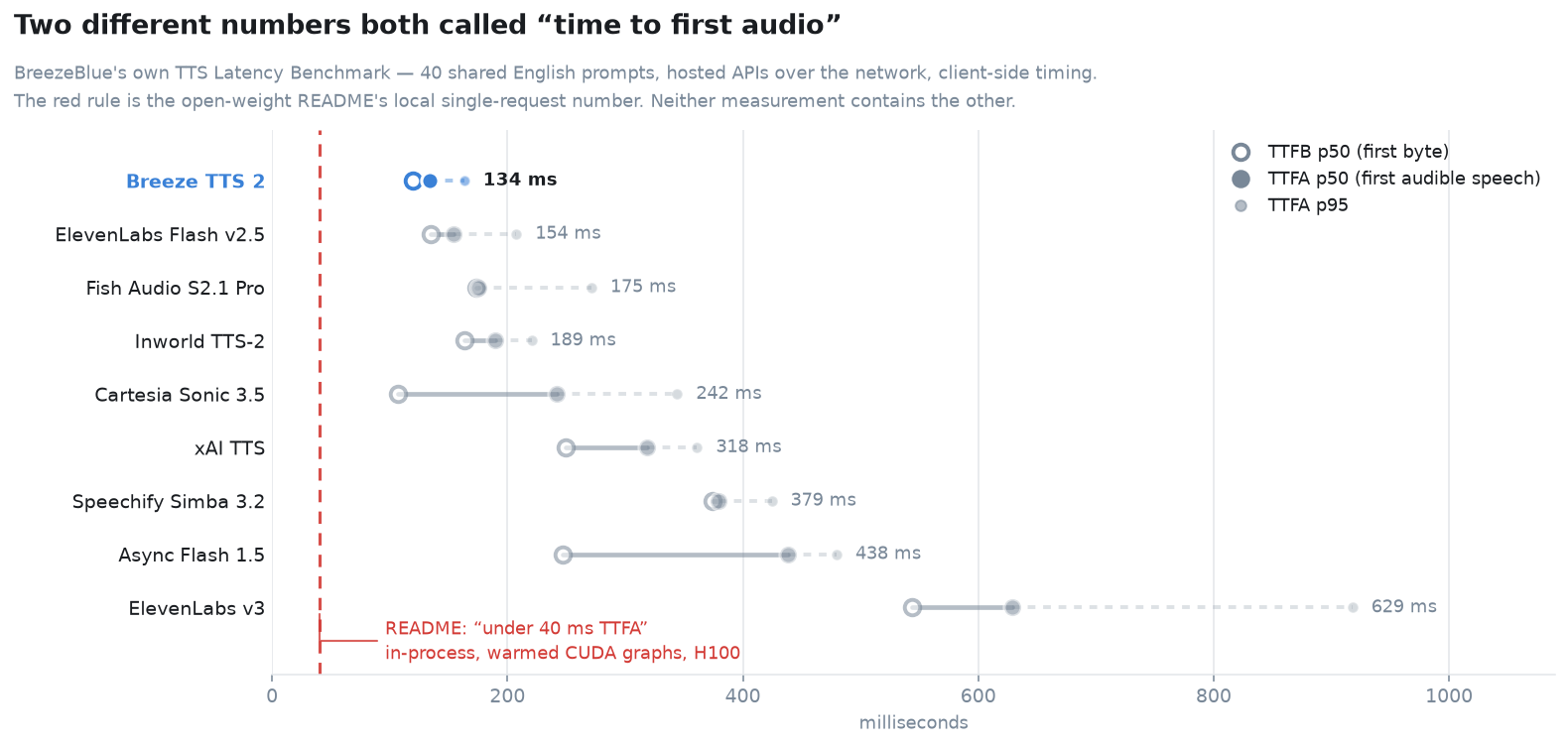
The only TTFA the repo actually computes is ttfa_internal_ms, and it is worth reading where its clock starts. In iter_audio_chunks:
branch = self._build_branch_batch(inputs)      # line 755 — runs the text encoder
...
t_start = time.perf_counter()                  # line 770
_build_branch_batch is where the 26-layer Gemma encoder runs and where the prompt embeddings are assembled. The stopwatch starts fifteen lines after it finishes. So the measured window is backbone prefill, one sample, fifteen depth steps, one codec decode and the copy back to host — not tokenization, not reference-audio encoding, and not the text encoder. On the first-chunk path in the diagram above, that is 26 of 242 layer evaluations excluded from a number reported as time to first audio.
Even taken at face value it is a compute figure for one warmed-up request on an H100 with every CUDA graph pre-captured. BreezeBlue's own latency benchmark — the same company measuring its own hosted service from a client, which is what a user experiences — reports TTFA p50 of 133.6 ms. Both numbers are theirs, both are called TTFA, and they differ by 3.3×. The 40 ms is a real engineering result about part of the model; it is not a latency anyone will observe.
The Cartesia row is the reason the benchmark is interesting rather than self-serving. Sonic 3.5 has the lowest TTFB of the nine at 106.8 ms and the fifth-worst TTFA at 241.9 ms, because the benchmark subtracts leading silence — it measures when speech starts, not when bytes start. That is the right metric and it is the one that makes Breeze look good, which is worth holding both thoughts about at once.
"Bilingual: English and Chinese." The model card and the HF metadata both say en, zh. BreezeBlue's launch post for Breeze TTS 2 — published 7 August, eighteen days before any weights existed — advertises 50 languages with accent control. Those are different products sharing a name: the post is about the hosted API, the checkpoint is bilingual. The three benchmark tables in that post — Voice Design 78.02, Voice Direction 4.25, SIM 0.67 — were measured against the hosted service on BreezeBlue's own newly-published benchmarks, not against these weights. I would not carry any of them over.
I also cannot evaluate the audio. There are no samples in the repo, no WER, no speaker-similarity number, no MOS, and no eval harness — the entire release is inference code. Whether it sounds good is not a question this checkout can answer, and I am not going to relay someone's arena score as if it were.
1.18 GiB that never runs
Summing the safetensors headers turns up something that has nothing to do with marketing.
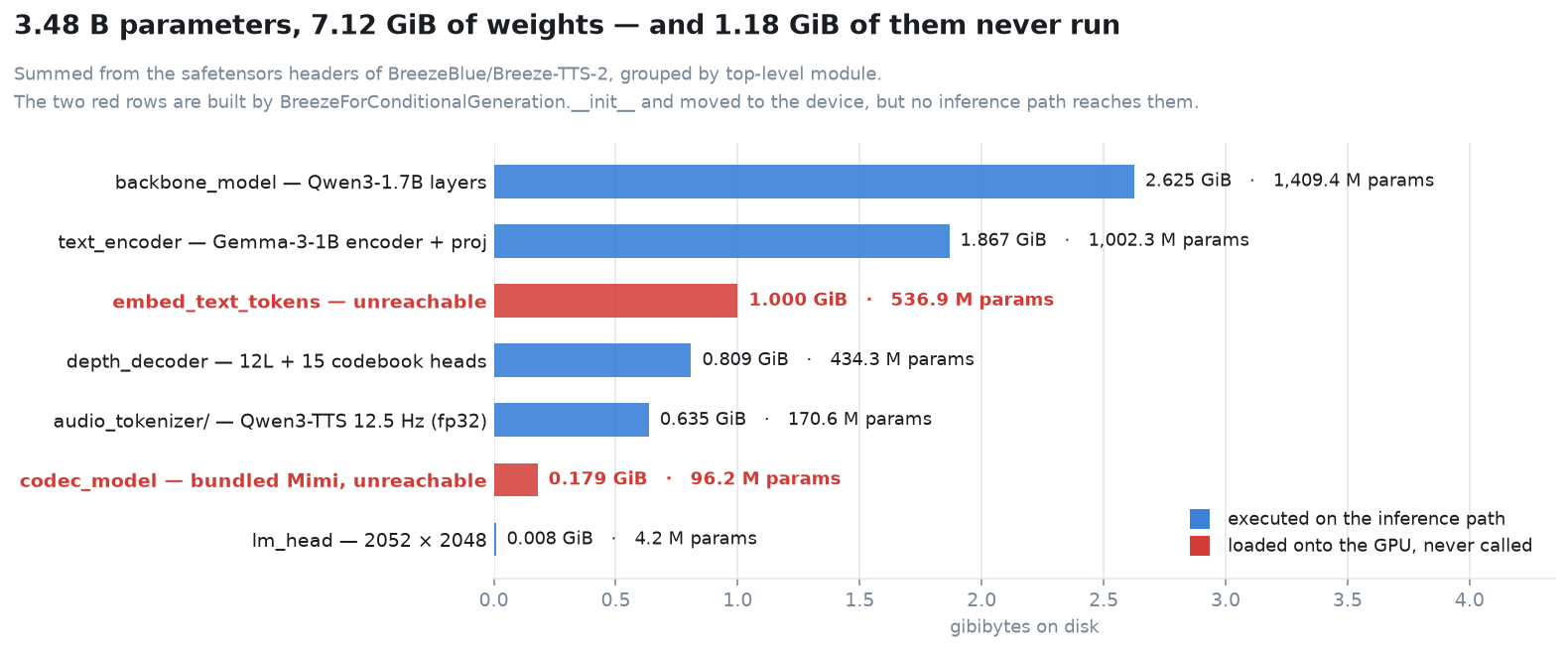
embed_text_tokens is an nn.Embedding(262158, 2048) — 536,899,584 parameters, exactly 1.000 GiB in bfloat16. It has one call site in the entire repository:
if self.text_encoder is not None:
    inputs_embeds, ... = self.convert_input_ids_to_embeds(...)
else:
    inputs_embeds = self.embed_text_tokens(input_ids)
This checkpoint ships a text_encoder_config, so self.text_encoder is never None, so the else never runs. The only other mention of the module is self.embed_text_tokens.weight.dtype in a branch that handles zero text segments. It is a fallback path for a configuration this checkpoint is not.
codec_model is the same story with a different cause. BreezeForConditionalGeneration.__init__ builds a full Mimi from config.codec_config — encoder, decoder, both transformers, 96.2 M parameters — but breeze_infer/runtime.py raises FileNotFoundError unless audio_tokenizer/ is present, and every decode path prefers the tokenizer when it exists. The bundled Mimi is reachable only in a state the loader refuses to create. Its config is still load-bearing, which is the part I enjoyed: codec_config.codebook_size is where the streaming runtime gets 2048 for its suppression mask, and codec_config.sampling_rate is where it gets 24000 for the WAV header. A dead module read for two integers.
Together: 1.18 GiB of the 7.12 GiB is allocated, initialised from disk, moved to the device by model.to(device), and never executed. The README asks for a 12 GB GPU and reports ~7.7 GiB of usage — which, given 7.12 GiB of weights, means almost the entire footprint is the weights, and 15% of it is inert. Deleting two modules would take the model comfortably under 6 GiB.
Where the fast path falls over
configs/fast.json sets "freeze_after_warmup": true and enumerates the CUDA graph shapes to pre-capture: text-encoder and backbone-prefill buckets in steps of 32 tokens, up to 256 at branch_batch_size 1 and up to 512 at branch_batch_size 2. After warmup the caches are frozen, and a shape that was not declared does not fall back to eager:
if record is None:
    if self._frozen:
        raise RuntimeError(
            f"backbone prefill CUDA graph {key} was not declared in the warmup profile"
        )
The prefill bucket covers the whole merged prompt, audio placeholders included, and a reference clip contributes 12.5 placeholder tokens per second. Without CFG that gives you roughly 17 seconds of reference audio before the request raises instead of synthesising. With --cfg-scale 4 the batch-2 buckets go to 512, so the ceiling roughly doubles — the fast path is more robust with guidance on than off, which is not an intuition anyone would arrive at from the README.
Pre-capturing those graphs is also what turns the README's ~7.7 GiB eager footprint into 14.4 GiB with --fast-all — nearly the whole weight budget again, spent on static input buffers, StaticCache tensors and graph memory pools. That is the trade the release makes and does not spell out: roughly 2× the memory and a warmup that captures fifty-odd graphs, in exchange for the latency number on the front page.
The same file says "concurrency": 1, and breeze_infer/api.py enforces it with a non-blocking lock and a 409:
if not _request_lock.acquire(blocking=False):
    raise HTTPException(status_code=409, detail="An inference request is already running.")
Every performance number in this release is a batch-1, single-stream number, and the shipped server cannot produce any other kind.
Two smaller notes from the sampling path. MAX_NEW_TOKENS = 1500 frames caps a single utterance at 120 seconds, and MAX_SEQ_LEN = 2048 matches max_position_embeddings, so prompt plus generation share a hard 2048-frame budget. And the default repetition_penalty of 1.1 is applied only to codebook-0 history — sensible, since the semantic codebook is where autoregressive TTS loops — but it is applied to token_history.unique() over the whole utterance, so its selectivity decays as the generation lengthens. Over a long take, most of the 2048-entry codebook has been visited at least once and the penalty stops discriminating.
The ledger
What is genuinely good. The streaming codec decoder. Rebuilding every convolution in a pretrained vocoder as a cached-left-context step, verifying the chunk-to-sample ratio at startup against a theoretical value, and keeping the whole thing under 12 MiB of state is real work, and it is the piece that makes the latency claim mean anything. Unrolling the fifteen-step depth loop into a single CUDA graph is the right call for the right reason. And the voice-direction CFG — negative branch = same reference, no instruction — is the cleanest formulation of "amplify only the instruction" I have seen in a TTS repo.
What is convergent. Everything else. The backbone-plus-depth-decoder shape is CSM's, down to the Sesame copyright header and the llama-1B flavour string. The 12.5 Hz RVQ codec is Mimi's frame rate with Qwen's decoder. A bidirectional text encoder projected into a decoder's embedding space is what half the field does now. Instruction tokens, speaker tags, inline (laugh) events — Qwen-Audio-3.0-TTS and Nar TTS have the same control surface. The assembly is competent; none of the pieces are new.
What I would watch. Whether the depth decoder keeps growing. Sesame shipped four layers; Breeze ships twelve, which is where 180 of the 216 serial layer evaluations per frame come from and why the repo needs a CUDA-graph strategy per stage. There is an obvious ceiling: at some depth the 12.5-tokens-per-second saving the split was supposed to buy is entirely eaten by running the small model fifteen times. Either the codebook count comes down, or something replaces the sequential depth loop with a parallel head.
What I would not carry forward. Any number from that launch post. The 40 ms, the Elo ranking, the 78.02, the 50 languages — each was measured on something that is not this checkpoint, or on a field that is not the whole field. The checkpoint is more interesting than its press release, which is a nicer problem to have than the reverse.